Thursday, August 3, 2017


BOOK COVER


Click on the image to get a close-up.

Yesterday right after the state supreme court released its decision, I emailed my editor to ask if I could still make a few small revisions to the text. I caught him just in time, as he was preparing to send it to the printer. Thankfully, I was able to revise several sentences and paragraphs to reflect the new decision and brings some closure to the story.

Here is the cover. It includes info about the book and four (very kind) endorsements. I am pleased with the illustration, but I must say I did not choose it. My first choice was the Sheldon church ruins. Then, I thought too depressing. Next, I wanted the two cathedrals in Charleston. Then, I thought too confrontational. After, I though nature scene: Angel Oak on Johns Island (my favorite tree) to symbolize age and endurance; generic cypress swamp, same; marshes, vast, eternal and serene, as the power of God. My editor chose the last without consulting me. As it turned out, I could not have chosen a better picture.

I am told the book is to be in hand by the end of the month, first as a large and thick paperback (550 pages).

I will keep readers posted on when pre-orders can be made on the Wipf and Stock website.

After I saw a lot of historical misinformation yesterday, I think we need this book now more than ever.  

For those of you who have been kind enough to ask about my health, I can tell you I am well. I finished my radiation treatments a few weeks ago; and all signs are good now. It was a bit of a struggle to finish the book while I was having treatments, but I managed well with the support and help of many good people. I thank you all for your thoughts and prayers.

Wednesday, August 2, 2017


BREAKING NEWS!!!

SC SUPREME COURT RENDERS DECISION
!


The South Carolina Supreme Court has just issued its decision on the Church case. See it at

www.sccourts.org/opinions/HTMLFiles/SC/27731.pdf

The decision is split.

I will return momentarily with my summary and analysis.


My First Response:

Upon my first scan, the decision is split and mixed. Here is the main point I see at cursory glance:

The Episcopal Church regains the 28 local churches that overtly affirmed the Dennis Canon.

The 7 other local churches that did not affirm Dennis are allowed to keep their properties. The 7 are:

Christ the King, Pawleys Island

St. Matthew's, Darlington

St. Andrew's Land Trust, Mt. Pleasant

St. Andrew's, Mt. Pleasant

St. Paul's, Conway

Prince George Winyah, Georgetown

St. John's, Florence

St. Matthias, Summerton

This means that all the great churches as St. Philip's, St. Michael's, St. Helena's, Church of the Cross, Holy Cross etc. are subject to the Dennis Canon and therefore under the authority of the Episcopal Church and the Episcopal Church diocese of South Carolina. St. Andrew's of Mt. Pleasant is now part of another diocese (ACNA Diocese of the Carolinas). This would leave 6 local churches in the breakaway diocese.

I will return soon with more thoughts on the decision.


My Second Response.


OVERALL VICTORY FOR THE EPISCOPAL CHURCH AND THE EPISCOPAL CHURCH IN SOUTH CAROLINA.

Here is my understanding of the decision now. I reserve the right to change this as I reread the document.

---The Court split 3 (Pleicones, Hearn, Beatty)-2 (Kittredge, Toal) to enforce the Dennis Canon in the 28 local parishes that had explicitly adopted the Canon. This would mean the Episcopal Church and Church diocese are indeed entitled to legal trust power over these local parishes. In other words, the quit claim deeds Lawrence issued are ineffective.

---The Court split 3 (Beatty, Kittredge, Toal)-2 (Pleicones, Hearn) to say that the 7 local parishes that had not explicitly adopted the Dennis Canon can keep full title to their local properties.

---The 3 (Beatty, Kittredge, Toal)-2 (Pleicones, Hearn) majority said that the Dennis Canon alone could not establish a trust interest for the Episcopal Church and Church diocese. In order for the Canon to have legal effectiveness, the local parish would have to give explicit recognition to the Canon.

---The majority said that the question of control of local diocesan rights such as titles must be resolved by the United States Court (Judge Duffy is now presiding over the federal case in which Bishop vonRosenberg is suing Mark Lawrence for rights of the Episcopal bishop of South Carolina).

---The 3-2 majority declared that the Church diocese is the rightful heir of the pre-schism Episcopal Diocese of South Carolina (but the U.S. Court must settle the issues there).


Two big wins for TEC and TECSC:  1-return trust control over 28 local churches that had voted to leave TEC.  2-state court (apparently unanimously) deferred to the federal court the decision of the legal status of the diocese. This gives the advantage to TEC and ECSC as federal courts typically lean to the national institution.


On the whole this is a major but not total victory for the Episcopal Church and her diocese and a major defeat for the independent diocese.

Judge Duffy's ruling, in the federal court, should end the litigation in South Carolina. (The state supreme court decision can be appealed to the U.S. Supreme Court and Duffy's decision could be appealed to the U.S. Court of Appeals in Richmond.) If Duffy rules in favor of the Church, the Episcopal Church and its diocese would resume the rights, properties and assets of the pre-schism diocese. However, the independent diocese could still continue in the 7 parishes that have been granted their local properties by the state supreme court. If Duffy rules in favor of Lawrence, presumably the breakaways would keep possession of the rights, properties and assets of the old diocese as they have now. However, they would hold just the 7 local parishes that have been allowed to keep their local properties.

There is a great irony here. In June of 2015, the Episcopal Church offered an out-of-court settlement to grant all the 35 local parishes in question full rights to their properties and independence. The diocesan office immediately and furiously announced a rejection. Thus, the 28 local parishes that have now lost control of their property could have had full control over the buildings, lands, and assets. 

I will return with more thoughts on this monumental event.


My Third Response.


What does today's decision mean for the schism?

(and what does it mean for my history of the schism that I just recently turned in to be published? Wouldn't you know the court would rule right after I turned in the manuscript? I have sent an urgent message to my editor asking if it is still possible to make at least a small addition to reflect the decision.) Update-the editor just told me I can make a small addition, just in the nick of time before printing.

---This is a major victory for the Episcopal Church. The court majority ruled that the Church is hierarchical. 

---This is the first ruling by a state supreme court in the dispute between the Episcopal Church and the five dioceses that purported to leave the Church. The essence of the decision is to recognize the sovereignty of the Church over the dioceses. This will give great weight in the law to the Church side.

---The decision did not uphold the Dennis Canon in and of itself. The majority said that the Canon was effective in the 28 local parishes only because those parishes had given explicit recognition to the Canon. In other words, in South Carolina, the Episcopal Church cannot unilaterally establish a trust without the permission and action of the local property holder. To my knowledge, no court in the U.S. has recognized the effectiveness of the Dennis Canon in and of itself.

---Today's decision does not return anything to anybody. It was a decision in principle, not in specifics. Presumably, the Church diocese may have to get court orders to enact the decision in each parish. 

---The state court deferred to the federal court to settle the question of which of the two dioceses is the legitimate one, that is, entitled to the rights, titles, symbols, and assets of the pre-schism diocese. However, the majority today made it plain they consider the TEC diocese to be the legal one. This is bad news for the breakaways.

---The state supreme court surprised me in some ways. As it turned out, Justice Pleicones took the lead for the Church side and made as powerful a case for the Church as imaginable. Justice Hearn really echoed, and not as well, Pleicones, for the Episcopal Church. On the opposite side, the strongest position was made by Justice Kittredge who was completely in favor of the breakaways. He made a stronger presentation even than Justice Toal who also favored the locals. Justice Beatty turned out to be the "swing" vote between the two resolute and opposite blocks. He is the one who moved the balance over to the Church side by deciding that the local parishes that had affirmed the Dennis Canon were subject to it while the eight that had not approved it were not subject to it. It was his vote that decided the case. 

---In my view, this is the turning point of the history of the schism. The Episcopal Church has won. The breakaways have lost. All odds are the federal court in Charleston will affirm the state supreme court position. 

I should caution all, however, that this is not a moment of rejoicing. Quite the opposite. This is an appropriate time to grieve over the destruction and loss of a once great diocese. The grand old Episcopal Diocese of South Carolina, a founding member of the Episcopal Church, lies shattered, broken by the willful acts of its own misguided leadership. The largest part, the independent diocese of Mark Lawrence, has just suffered a major defeat, and in a lawsuit that it itself had initiated. There is division, resentment, hurt, and loss all around. This is not likely to go away anytime soon, but today's decision may well be the beginning of a healing, a binding up of the wounds, that will restore at least some of the life of the old diocese. 

I believe we have reached a turning point in a long road. Let's believe that road leads home.

I will return with more reflections on this landmark day in church history.


My Fourth Response.


Having reviewed the parishes included in the lawsuit, I have found 29 that the state supreme court has determined to be subject to the Dennis Canon. That means trust interest of the Episcopal Church and the Episcopal Church in South Carolina has returned to the properties of these parishes:

All Saints,  Florence

Christ/St. Paul's,  Yonges Island

Church of the Cross,  Bluffton

Church of the Holy Comforter,  Sumter

Church of the Redeemer,  Orangeburg

Holy Trinity,  Charleston

St. Luke's,  Hilton Head

St. Matthew's,  Fort Motte

St. Bartholomew's,  Hartsville

St. David's,  Cheraw

St. James, Charleston (James Island)

St. Paul's,  Bennettsville

Cathedral of St. Luke and St. Paul, Charleston

Church of Our Saviour, Johns Island

Church of the Epiphany,  Eutawville

Church of the Good Shepherd, Charleston (West Ashley)

Church of the Holy Cross,  Sullivans Island

Church of the Resurrection,  Surfside

St. Philip's,  Charleston

St. Michael's,  Charleston

St. Jude's,  Walterboro

St. Helena's, Beaufort

St. Paul's,  Summerville

Trinity Church,  Myrtle Beach

Trinity Church, Pinopolis

Trinity Church, Edisto Island

Christ Church,  Mt. Pleasant

St. John's,  Charleston (Johns Island)

Old St. Andrew's, Charleston (West Ashley)


I will return with more reflections.


Thursday, July 27, 2017


FORTHCOMING:

A HISTORY OF THE EPISCOPAL CHURCH SCHISM IN SOUTH CAROLINA


Wipf and Stock Publishers have informed me that our work, A History of the Episcopal Church Schism in South Carolina, is to be published next month, August 2017. It should be in hand within about a month.

This book is the result of four and one half years research and writing. I examined 2,500 original and secondary sources, what I believe to be all of the publicly available evidence of the schism. I cited 900 of these items, as often as possible in the original words. There are 2,200 footnotes.

The book is 527 pages not counting the front matter, as table of contents and preface. The publisher now plans to print it as one (hefty) paperback volume. A hardback book will be issued a few weeks later. In time, it will also be released as an e-book.

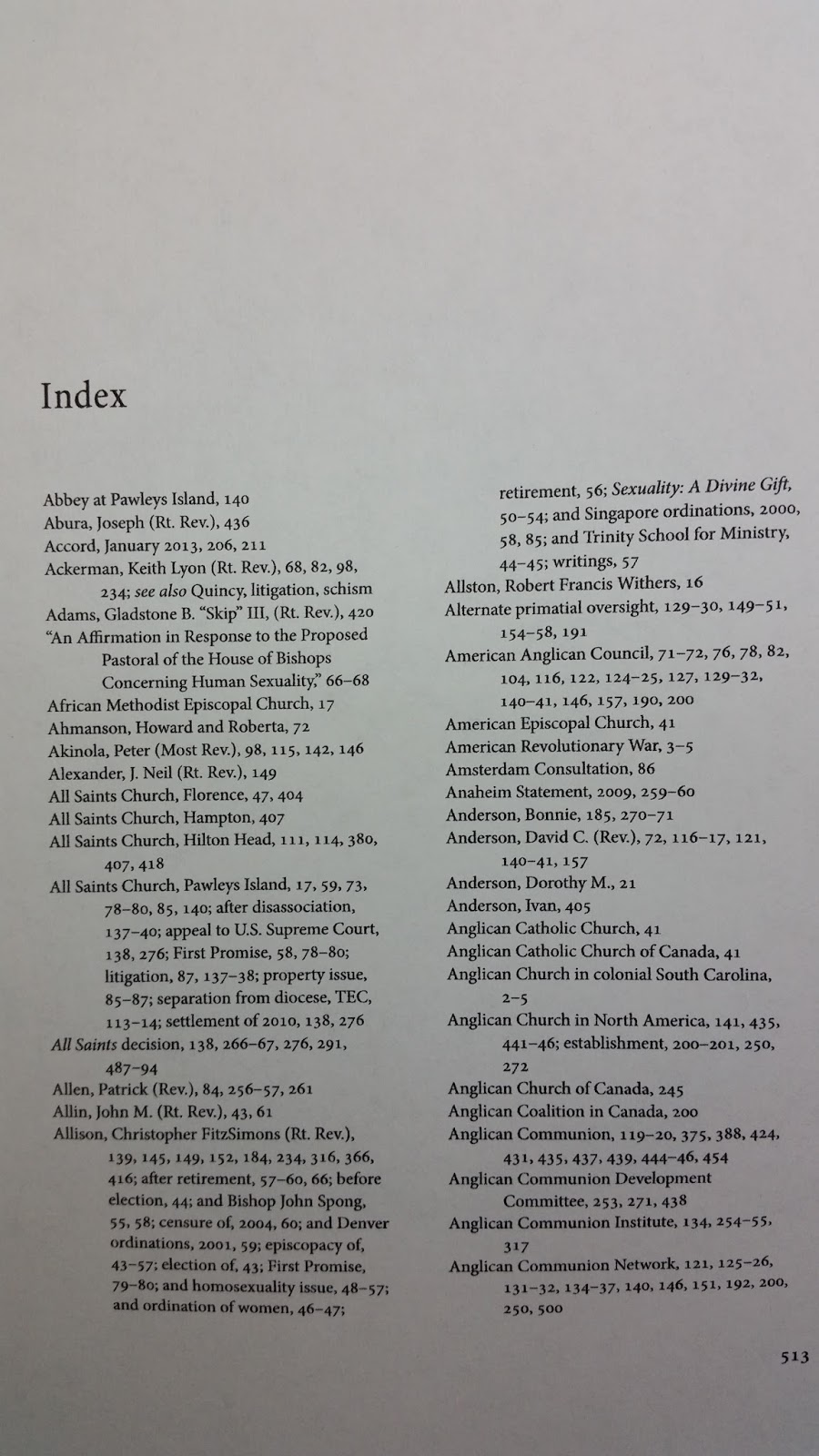
My blog entry "Notes---June 30," provides the first pages of the chapters and the index. This gives one an idea of the scope and depth of the book. 

I am posting here the first four pages of the Preface. This should give one a better idea of the purpose, aim, and method of the book. Forgive the poor quality of these images, they were made on my smart phone:


Here are two of the readers' "endorsements" that will appear on the cover of the book:

"A thorough and balanced study of the events that led not only to the schism among Episcopalians in South Carolina, but in four other dioceses as well. There is something of interest for anyone interested in the history of American religion, the Episcopal Church, or contemporary reactions to the liberalism in mainstream denominations." Joan R. Gundersen, Professor Emerita of History, California State University San Marcos and Archivist, Episcopal Diocese of Pittsburgh.

"Dr. Caldwell's narrative of this critical moment in Episcopal Church history is fast-paced and compelling, a rare achievement in such a comprehensive effort. His description of the penultimate years building to the schism itself returned me inexorably to a time freighted with the paradoxes of humanity: a potent stew of truth and deception, grace and law, faith and fear, loyalty and betrayal, persistence and impatience, and above all, hope for reconciliation met face to face with determined---and planned---separation. I couldn't help thinking of David M. Potter's classic work, The Impending Crisis: 1848-1861, on the events, politics and personalities that led our nation to war over whether we would stay together or go our separate ways." The Rt. Rev. W. Andrew Waldo, The Episcopal Diocese of Upper South Carolina.

A soon as I have the information, I will post on this blog how this book may be ordered. One may always check the Wipf and Stock website. In time, it will be available there and on other sites, as Amazon. Of course, I will announce to all the moment the book is in hand. We are almost there.

Friday, July 21, 2017


                 JUDGE HOUCK DIES


Judge Charles Weston Houck died on July 19, 2017. He was the federal judge handling the Church case in Charleston. He was 84 years old.

Judge Houck voluntarily took the case. As a semi-retired senior judge he could have passed on it. Apparently he found the whole matter far more complicated and difficult than he had imagined. He once said with sad resignation that he was having trouble making heads or tails of it.

Houck handled two different aspects of adjudication and essentially passed on each. In one instance, the Episcopal Church side moved the state court proceeding to Houck's federal court in April of 2013. In June, Houck refused and remanded the case to the state circuit court.

The second instance was the larger one. In March of 2013, Bishop Charles vonRosenberg brought suit against Bishop Mark Lawrence claiming that ML was in violation of the federal Lanham Act that protects against trademark infringement. VonR said ML was falsely claiming to be the Episcopal bishop even though he had left TEC.

There are two principles that federal judges may follow in deferring to state courts. Brillhart/Wilton allows a wider discretion. Colorado River has a much narrower window. Under it, a federal judge may defer to state court on a matter of federal law only under rare and exceptional circumstances.

In August of 2013, Judge Houck cited Brillhart/Wilton as his guide in refusing to adjudicate and deferring to the ongoing proceedings in the state court. At the same time, Houck declared that ML had renounced the ordained ministry and the Episcopal Church was hierarchical.

The Church lawyers appealed Houck's decision to defer. The U.S. Court of Appeals ruled that Houck had used the wrong standard and should have followed Colorado River. They remanded to Houck.

Houck ruled a second time as the first. He deferred to the state court. A second time the Church lawyers appealed to the federal court of appeals that, once again, directed Houck to follow the narrow Colorado River principle. This was six months ago. Houck did not respond to the second direvtive.

Presumably another judge in the U. S. District Court in Charleston has been or soon will be assigned to the case. I would imagine this will drag out matters even more.

Obviously the courts are finding the Church dispute far more difficult to resolve than they had thought. Judge Houck essentially threw up his hands in exasperation and kicked it all down to the state courts. The circuit court decision was so over-the-top in favor of the secessiomists that the state supreme court could hardly restrain their ridicule. Now apparently that court has slogged to a halt. After 21 months of waiting we have nothing at all from the five high justices of Columbia. Unfortunately for them, they cannot punt the ball as Houck did. They are obliged to give us a decision.


Monday, July 17, 2017


THE TRUTH ABOUT THE LAWSUITS


Kendall Harmon has posted on his blog a flatly untrue statement that must be set straight.

On July 17, on his blog, TitusOneNine ( kendallharmon.net) he posted a note entitled "A Look Back to the Episcopal Church in 2007..." He wrote:

"There is not one but two active lawsuits by the Episcopal Church against the Diocese of South Carolina currently ongoing at the present time." This is a very serious charge that is false.

Here is the truth:
There are indeed two lawsuits but neither was started by the Episcopal Church and neither was against the Diocese of South Carolina.
Lawsuit # 1, was entered in state court by the Diocese of South Carolina on January 4, 2013 against the Episcopal Church. A few days later, the Church diocese, called the Episcopal Church in South Carolina was added as a defendant. THE DSC SUED THE EPISCOPAL CHURCH. 
This went to trial in the circuit court of Dorchester County in July of 2014. Judge Goodstein's ruling entirely favorable to the DSC was appealed to the South Carolina Supreme Court which held a hearing on Sept. 23, 2015. We are still awaiting the written decision from that hearing.

Lawsuit # 2, was issued by Bishop Charles vonRosenberg against Bishop Mark Lawrence in March of 2013 in the United States District Court (federal court) in Charleston. Bp vonR charged that Lawrence was in violation of the federal Lanham Act, that protects against trademark infringement, because Bp Lawrence was holding himself out to be the bishop of the Episcopal diocese of SC even though he had left the Episcopal Church.
The federal judge (Houck) refused to act and deferred to the state court proceeding whereupon the Church lawyers appealed to the federal appeals court. That court remanded the case to the lower court with direction for adjudication. The local judge refused again whereupon the Church lawyers once again went to the appeals court that, a second time, remanded the case to Charleston with direction for adjudication. Six months on we are still awaiting Judge Houck's action.

Let's separate fact from fiction. Facts are the Diocese of South Carolina sued the Episcopal Church and the Episcopal Church bishop sued the former Episcopal Church bishop. These were not initiated by the Episcopal Church. These were not made against the Diocese of South Carolina.


Saturday, July 15, 2017


CHURCH OF ENGLAND
MOVES FORWARD
 WITH INDISCRIMINATE INCLUSIVITY


In case you missed it, there was big news from the Church of England recently. On July 9, the Synod of the Church overwhelmingly passed a resolution welcoming transgendered people. This is a major milestone in a Church which only recently stood up for equal rights in boldly rejecting a bishops' report critical of full inclusion of homosexuals.

The 9 July resolution recognized "the need for transgender people to be welcomed and affirmed in their parish church." The Synod also called on the House of Bishops to consider liturgies to support transgender.

The vote:
House of Bishops: 30-yes; 2-no; 2-abstain
House of Clergy: 127-yes; 28-no; 16-abstain
House of Laity: 127-yes; 48-no; 8-abstain

This indicates clearly that the Church of England is moving along the path toward full rights for homosexual and transgendered people behind the Anglican Church of Canada, the American Episcopal Church, and the Episcopal Church of Scotland. Numerous others among the 38 Anglican provinces are also moving in the direction of equality. 

Of course, the GAFCON primates of equatorial Africa expressed their displeasure. All of this should make the upcoming Anglican Communion primates' meeting in October, in Canterbury, interesting. As far as we know, the GAFCON/Global South primates will be there and ACNA's Archbishop Foley Beach will not. Apparently he has not been invited. If he had been, we would all know about it.

For years before the schism in South Carolina, Bishop Lawrence was fond of railing against what he called the false gospel of indiscriminate inclusivity. By that he meant equal rights and inclusion of homosexuals. Yet, he seemed particularly concerned about transgender. I sat in on a "bishop's forum" in October of 2012 in which he spent a good deal of time bemoaning the fact he had met two transgendered priests at the recent General Convention. Ultra conservatives assert that God created everyone male or female. For them, it was bad enough to question that but worse to try to alter "identity." In the annual diocesan convention of 2015 Lawrence put himself on the line to oppose gender reassignment. He insisted on keeping rejection of transexuality in a resolution even though it was extraneous to the point which was against homosexual rights. The convention affirmed his stand by two-thirds vote.

Meanwhile society across the western world is moving quickly to accept equality for and inclusion of homosexuals and transgendered. A recent Pew Research study showed that 60% of Americans now approve of same-sex marriage, a fifteen point jump in a decade; and the trend is rising rapidly. Among young people, the percentage is at 90. This is true for South Carolina too. In time, the socially reactionary Diocese of South Carolina will have a harder and harder time attracting young people. Just look at the photos of the DSC conventions these days, mostly old white men. The DSC churches lost 28% of their communicants in the first three years after the schism. This downward track is only bound to accelerate as demography overwhelms them. So, the leaders of DSC can continue their campaign against human rights for all people but they will be doing so to increasingly empty churches.

Indiscriminate inclusivity is not the false gospel. It IS the gospel. Our Lord turned away no one. He did not discriminate. As His followers, we are to love one another and not stand in judgment.   

For a report on the 9 July vote, see this article . See also this article


Saturday, July 1, 2017


NOTES - JUNE 30


On Wednesday, I made no report on the state of the South Carolina Supreme Court. This will be my practice from now on. Of course, I will report if and when the Court ever does issue a decision. After 21 months of waiting, I am beginning to have serious doubts that we will ever have a definitive ruling by the state high court. Obviously, something is very wrong in the process to create such a delay.

In writing my history of the schism, I had been waiting on the Court to issue a ruling in the Church case in order to have some closure to the story. I grew weary of waiting and went ahead and finished the book to submit for publication.

For readers who are curious about the status of my history of the schism:
I am happy to report that all is finished in the preparation for publication. The book is all set up for production, that is, the printing process. Unfortunately, I have no idea how long this will take. It depends on many factors such as the number of books ahead of mine with the publisher, Wipf and Stock. Perhaps the book will be in hand by the end of the year.

I am posting here some sample pages from the book. These are pictures from my cell phone, so are not very clear. But, one gets the idea of the format and appearance. I am pleased at how it turned out.

Title page. Publisher is Wipf and Stock, of Eugene, Oregon. They specialize in works of religious themes.


As evident, the publisher decided to go with a larger page and smaller print in order to conserve space. Even so, the text is 512 pages. Counting the index and front matter, the book comes to about 550 pages. I think the plan at Wipf and Stock still is to publish it in two volumes.

I believe that I have consulted all of the publicly available documents and have produced as complete a narrative history of the background, events, and aftermath of the schism of 2012 as possible given the evidence available today. The chapters are long and detailed. The 2,200 footnotes cite 900 of the 2,500 works I consulted. The book contains 300,000 words. I doubt that I have many words left to say about it. When published, this will be the first scholarly history of one of the five schisms in the Episcopal Church, 2007-12. 

Thursday, June 8, 2017


BREAKING NEWS - 
SCOTLAND ADOPTS MARRIAGE EQUALITY


The Anglican Communion News Service has just announced that the Episcopal Church of Scotland has adopted marriage for same-sex couples. These couples will be allowed to marry in Episcopal churches of Scotland. The vote in the church synod today was not close: Bishops 4-1 for, clergy 42-20 for, laity 50 to 12 for. This is another victory for human rights.

Numerous other Anglican provinces are moving along in the pioneering path made by the Anglican Church of Canada and the U.S. Episcopal Church. 

The Anglican primates meeting in October should be quite interesting.

Read the story here .


TIME OUT


These are troubling, disturbing, even dark times in which our basic institutions of church and state and being tested to their cores. It is easy to get overwhelmed by the gravity of all of this. The grand old diocese of South Carolina lies shattered in four parts and bitterly divided, hostile parties in civic courts. There is no resolution in sight. The courts appear to be unable to resolve the differences. Our federal government is now being tested to see if the old constitutional system can stand the challenge of a president who does not understand, let alone respect, the basics of the American constitutional governmental structure. The problems of both church and state here stem from the same basic issue: government by laws or by men. As for the old diocese, the majority decided that it would no longer recognize the rule of church law and turned to guidance of a leadership that declared it alone knew truth. They threw in their lot with a highly authoritarian system in defiance of the standing church law. In short, they chose rule of man over rule of law. President Trump is trying to do the same, to set up personal power in disregard of the traditional structure of the government. He is challenging the country to decide between rule of law and rule of man. I think the government is strong enough to stand up for itself although getting there will be traumatic. We have always been a country of the rule of law and I am confident this will prevail.

Yesterday, I returned to work in my garden for the first time in six months. I managed two periods of work. It was my best day in months and I slept soundly afterwards. This lifted my spirits greatly. I think we are all in need a lift now. So, let's take a break and walk around my garden as it appeared this morning. (You see from the weeds all the work I still have to do, but then a garden that will not grow good weeds is not much of a garden.)


Butterfly bush (Buddleia davidii, "Black Knight") and Sabal minor "McCurtain." In late afternoon, the bush is covered with numerous monarch butterflies.


Gardenia "August Beauty." Every southern garden should have gardenia, for the aroma is nothing else.


Dwarf peach tree (Prunus persica 'Bonanza').


Japanese Pea Shrub (Lespedeza thunbergii). Tiny purple flowers from frost to frost.


Every southern garden/yard should have a banana tree.


Balloon flower (Platycodon grandiflorus). Tough perennial.


Andorra juniper, lower; Dwarf Yaupon Holly (Ilex vomitoria 'Nana'), middle; Abelia grandiflora 'Sherwood,' with white flowers.

Beyond, or in spite of, all the disturbing events going on all around us, the beauty and wonder of God's creation is a constant. It is always there. It reminds us that in the big picture there is an order in the universe that exists independently of human behavior, good, bad or indifferent.


Tuesday, June 6, 2017


ON THE SCHISM - PART 4


This is Part 4 of my reflections on the schism of 2012 in South Carolina. This time I want to address the question:

Why did the Episcopal Church remove Mark Lawrence as a bishop in 2012?

Actually, this is not a good question, because in fact Lawrence removed himself from the Episcopal Church voluntarily on Oct. 15, 2012. The Church's official "release and removal" of Lawrence as a bishop came seven weeks later (Dec. 5). Then, the question should be:

Why did Lawrence leave the Episcopal Church? That is the issue at hand.

There is a great deal involved in this. We have already discussed the causal factors of the schism, the underlying causes, direct causes, and initiating events.

Entwined in all of the many layers of events was a crucial permeating factor, how to leave the Episcopal Church with the local property in hand. Anyone may leave the Church at any time. However, not anyone can leave with the property, not under Episcopal Church law.

That was the dilemma of the schismatics in South Carolina: how to take the diocese out of the Episcopal Church with the diocesan and parish properties in hand. The first four cases of dioceses that voted to leave the Church (2007-08) all had to go to court, and all to mixed results. Only one of the four went on to win in court (Quincy). Two went on the lose outright (San Joaquin and Pittsburgh). One is still pending (Ft. Worth). Thus, South Carolina's leaving the Episcopal Church with perhaps $500m in property was problematical at least. Schism would be a risk, but one worth taking in the view of the secessionists.

The Episcopal Church adopted the Dennis Canon in 1979, the DSC in 1987. The canon said that all local church property was held in trust for both the Episcopal Church and the diocese. What this meant in practice was that the deed holder could not dispose of any property without permission of the two trustees. This would be true even if the local parish held the legal title to the property. Under Church law, the trustees held control over the property. For the secessionists of South Carolina then, the problem was how to leave the Episcopal Church in defiance of the Church law. The diocese could surrender its own trust interest, but could it do the same for the national Church?

Here is a summary of how this problem evolved in DSC:

1. On Jan. 26, 2008, Lawrence made a sacred oath before God, dozens of bishops, hundreds of clergy, and a thousand laity: "I, Mark Joseph, (...) do solemnly engage to conform to the doctrine, discipline, and worship of the Episcopal Church." At the time, DSC explicitly recognized the Dennis Canon and held in its corporate charter that it existed "under" the authority of the Constitution and Canons of the Episcopal Church. Lawrence and DSC were under the Dennis Canon.

On October 15, 2012, Lawrence effectively rejected the discipline and, together with the Standing Committee and lawyers, unilaterally agreed on the independence of the diocese, property in hand. This was the schism of 2012.

Thus, in less than five years, DSC went from recognition to rejection of the Dennis Canon. How did that happen?

2. It began with building a platform of hostility to the Episcopal Church, something that had actually been going on in the diocese since 1982. Lawrence attended the GAFCON I meeting and welcomed the Jerusalem Statement of June 29, 2008. This statement rejected the authority of the Episcopal Church (because of its support of rights for homosexuals). Lawrence supported the statement. The DSC Standing Committee unanimously adopted the statement on Nov. 6, 2008. In effect, the diocesan leadership renounced the legitimate authority of the parent Church. This set the diocesan trajectory for all subsequent events.

3. On May 30, 2009, in a secret meeting of the Standing Committee, chaired by Jeff Miller, and attended by Lawrence, the committee approved the transfer of several million dollars worth of property held by St. Andrew's Church, of Mt. Pleasant, into a special trust of the parish beyond the control of the diocese and Church. Recall that the Dennis Canon was still diocesan law. This event remained hidden from the public until the minutes of the Standing Committee were uncovered in the circuit court trial. This transfer set the template for the diocese from then on.

4. Three months later, the SC Supreme Court issued its All Saints decision, on September 18, 2009. The court ruled that All Saints was entitled to its local property because the diocese had issued the parish a quit claim deed a century earlier. The justices said that, in SC, only the title holder could make a trust. It could not be imposed by another party. This decision greatly bolstered DSC's disregard of the Dennis Canon.

DSC refused to appeal the decision to the U.S. Supreme Court. The local Episcopal congregation at All Saints did file an appeal with SCOTUS but got no help from DSC. Shortly thereafter, they made a negotiated settlement with the breakaway parish and withdrew the appeal to SCOTUS.

Also, shortly after All Saints, Alan Runyan met with Lawrence and agreed to become the lawyer for the Standing Committee.

5. A month after All Saints, DSC held a special convention and declared virtual independence from the Episcopal Church. It resolved to withdraw from the governing bodies of TEC as well as to nullify all the acts of General Convention with which they disagreed. TEC made no response.

6. On Dec. 17, 2009, St. Andrew's of Mt. Pleasant voted to leave TEC and DSC for the Anglican Church in North America, property in hand. This was finalized in 2010. DSC did nothing to enforce the Dennis Canon to which it still officially adhered. TEC began to respond.

7. In January of 2010, Atty. Thomas Tisdale contacted Wade Logan, the chancellor of DSC, to seek agreement that the Episcopal Church could exercise its particular trust interest in the properties of the diocese, as per the Dennis Canon. Tisdale sent several letters to this effect Jan. 25-29, 2010. He asked for the minutes of the Standing Committee. 

Unknown to him, at that very moment, DSC was apparently preparing to issue the first quit claim deeds, to three parishes. On Feb. 1, 2010, DSC secretly gave the quit claims to St. John's Church of Johns Island, Church of the Holy Communion in Charleston, and Church of the Cross in Bluffton. If DSC granted Tisdale's requests, he would discover the St. Andrew's and the quit claim acts of the diocese. (Two more were issued in March of 2010: Christ/St. Paul's of Yonges Island and St. James of James Island.)

Lawrence assumed control of the Tisdale affair and declared a crisis. He moved the upcoming diocesan convention back by three weeks and loudly demanded that the Presiding Bishop remove her counsel from the diocese. He adamantly refused to surrender one item to Tisdale who wound up with nothing. DSC's rising disregard of the Dennis Canon remained hidden.

When the diocesan convention did meet, in March of 2010, it handed over to Lawrence absolute control over the interpretation of the constitution and canons of DSC.

8. On October 15, 2010, the special diocesan convention completed the virtual independence from TEC that the Oct. 2009 convention had begun. It resolved to revoke its accession to the canons of TEC (including the Dennis Canon), and to alter the corporate charter to remove all reference to TEC (this was done on Oct. 19, 2010). This ended DSC's official recognition of the Dennis Canon.

9. DSC secretly issued 15 more quit claim deeds to parishes between Oct. 19, 2010 and Nov. 16, 2011.

10. May 25, 2011, Atty. Melinda Lucka sent letter of complaint against Lawrence and supporting documents to TEC. This led to the first investigation of Lawrence by the Disciplinary Board for Bishops on abandonment of communion. Since the diocesan property actions remained secret, the investigation centered not on property but primarily on Lawrence's role in the diocesan conventions' actions withdrawing from TEC. On Nov. 29, 2011, the DBB announced decision not to charge Lawrence with abandonment.

11. On Nov. 15, 2011, two weeks before the DBB announcement, Lawrence notified the clergy he had issued quit claim deeds to all parishes. Logan mailed the deeds the next day and the stunning news became public. However, the DBB could not consider the deeds at that point since they had not been part of the original May 25 complaint.

12. DSC's open and public defiance of the Dennis Canon in Nov. of 2011 finally forced the Episcopal Church to respond since it maintained that all dioceses were required to adhere to the constitution and canons of TEC. It could not allow one diocese to defy canon law. On Mar. 23, 2012, Lucka and 23 other lay people of DSC filed a new complaint with the DBB. The first item was "Failure to Safeguard Property." The second investigation, of 2012, remained secret, but everyone knew Lawrence was likely to be charged anew following the sensational news of the quit claim deeds.

13. The DBB voted in secret on Sept. 18, 2012, that Lawrence should be charged with abandonment, primarily on the strength of his issuance of the quit claim deeds in direct violation of the Dennis Canon. This remained secret for the moment. Finally, it was the issue of property that effected the break between DSC and TEC. This was where the Episcopal Church finally lost patience with Lawrence.

14. Knowing that Lawrence could very well be charged anew following the quit claim deeds, in August of 2012, DSC leadership met secretly and apparently planned the final act of schism. They would break away from the Episcopal Church to protect their claims to the properties. On September 20, 2012, the Standing Committee requested of Lawrence his interpretation of how they could effect the schism. On Oct. 2, 2012, Lawrence told the Standing Committee they could "disassociate" the diocese from TEC; the committee resolved that DSC would separate from TEC if TEC took any action of any kind against Lawrence. This remained secret. It was a trap set for the completely unsuspecting Presiding Bishop as a justification for the schism.

15. On Oct. 10, 2012, the DBB reported its decision to the Presiding Bishop. On Oct. 15, 2012, PB called Lawrence and placed a restriction on him. Immediately after the call, Lawrence, his lawyers, and the Standing Committee agreed among themselves that DSC had disassociated from TEC. Lawrence announced this to PB on Oct. 17. DSC announced this to the world on Oct. 19.

16. Before and after the schism, DSC established several talking points to justify the schism: 

a-TEC was out to remove Lawrence in order to flip the diocese from "orthodox" to liberal. There is no evidence to support this claim.

b-TEC deliberately set up the Title IV revision to "get" Lawrence. Ditto.

c-Lawrence was trying to negotiate a peaceful settlement with TEC when he was "attacked." The evidence shows the opposite.

d-Lawrence was "mistreated" by TEC. DSC witnesses in the circuit court trial repeated this opinion.

17. In fact, after the schism, DSC immediately initiated legal actions to retain the diocesan and parish properties. The local parishes were brought in as parties to the lawsuits. All of the litigation since Jan. 2013 has basically revolved around ownership of the properties.

Back to the original question on why Lawrence left the Episcopal Church. He left when it finally became clear that the Episcopal Church would enforce the Dennis Canon. Everyone knew in 2012 it was likely he would be investigated a second time by DBB and probably charged with abandonment following the violation of the Canon in the quit claim deeds. 

So, how well did it work for DSC to leave the Episcopal Church with the property in hand? It worked very well for the majority of diocesan communicants. So far so good for DSC. Today, going on five years since the schism, DSC is completely in control of the property in question and the state supreme court seems unable to decide what, if anything, to do about it.   

Thursday, June 1, 2017


ON THE SCHISM - PART 3


"On the Schism - Part 1" (April 20) covered the use and misuse of history. "On the Schism - Part 2" (May 1) discussed the reasons why the fourth reform movement in TEC produced schism while the first three had not. In "On the Schism - Part 3," I will look at the question of whether the schism was the result of a conspiracy.

The word "conspiracy" can have different meanings. In the legal sense, it means a secret agreement among two or more people to do something illegal. Otherwise conspiracy can mean a secret deal among a group to something nefarious, not necessarily illegal. 

On the legal side, attorney Thomas Tisdale, representing the Church diocese in the circuit court, formally charged conspiracy. At first, he tried to get twenty-eight people named, but Judge Goodstein overruled it. Then, Tisdale charged that four prople were involved in a quid pro quo deal to make Mark Lawrence bishop of the diocese in return for his taking the diocese, with property in hand, out of the Episcopal Church. Goodstein overruled that too, as she did practically everything Tisdale requested. That is as far as the legal charge went.The legal issue of conspiracy was never really hashed out in court.

I am not qualified to speak to the legal issue of conspiracy, but I can speak to "conspiracy" in the historical and general sense.

Was the schism of 2012 the result of a conspiracy?

Short answer - Yes.

Long answer - requires a great deal of explanation. Space here does not allow a full discussion (my history of the schism is in press). I will summarize what I found in my research on the history of the schism.

The "smoking gun" of the conspiracy was the secret resolution of the DSC Standing Committee to "disaffiliate" DSC from the Episcopal Church "if any action of any kind" were taken by TEC against Bishop Lawrence. This was made on October 2, 2012, thirteen days before the schism happened. I counted seventeen people in on this act, the twelve members of the Standing Committee, and five others. Everyone knew that the Disciplinary Board for Bishops might be at work bringing charges against Lawrence. If the DBB did charge Lawrence with abandonment, the Presiding Bishop, Jefferts Schori would have to act. She would be required to "restrict" Lawrence formally. The October 2 resolution was a hidden trap set for the Presiding Bishop who was entirely unaware of it and would remain so until the trap had snapped closed. In short, the resolution was a set-up as an excuse for schism. It was a "conspiracy" of about seventeen people in the leadership of the DSC.

Now, the question is, how far back did the conspiracy reach in time before Oct. 2, 2012? This, unfortunately is impossible to know for sure given the documents publicly accessible now. Nevertheless, I will share with you what I found.

There are four substantial pieces of evidence that seemed to me to indicate a conspiracy before 2012. 1-Rev. Thomas Rickenbaker's testimony that he had been approached in late 2005 by two men from Bishop's Search Committee who said they were looking for a bishop to take DSC out of the Episcopal Church, property in hand. He made an affidavit and provided written testimony in the circuit court (he was not present in person). He gave a contemporary account to his bishop, Clifton Daniel. 2-Rev. Dow Sanderson's testimony in the circuit court that the Rev. Jeff Miller (member of the Bishop's Search Committee) had told him in 2009 that "we" had hired Lawrence to take DSC out of TEC. 3-By DSC's own documents, in 2010, Bishop Lawrence issued five quit claim deeds to parishes while the diocese still acceded to the Dennis Canon and to the Constitution and Canons of TEC. 4-In 2011, while Lawrence was being investigated the first time by the DBB, the DSC Standing Committee passed a resolution, similar to that of Oct. 2, 2012, to "disaffiliate" if TEC took any action against Lawrence. That one became moot when the DBB refused to charge Lawrence at that time. Whether these four items prove pre-2012 conspiracy must be left to the judgment of the reader.

Although the direct evidence of conspiracy before Oct. 2, 2012 may not be conclusive, there is a mountain of circumstantial evidence that must be considered. Space here does not permit a full accounting, thus a summary:

1. Diocesan leaders used the Robinson affair of the General Convention of 2003 to create a crisis to unite DSC in hostility against TEC. On August 18, 2003, the Standing Committee joined with the bishop, and several others to form a diocesan ruling block of two to three dozen people. All decisions from then on would be made as one and sent down to the deans, the clergy, and the laity. All pro-TEC elements in the diocese were excluded from the power block. When the Episcopal Forum arose, it was treated as the enemy. On Oct. 2, 2003, the special diocesan convention declared the right of nullification, local sovereignty, and defeated a resolution affirming loyalty to TEC. This set the template for the future.

2. In 2004, DSC was one of a dozen ultra-conservative dioceses of TEC to form the Anglican Communion Network. It demanded alternative primatial oversight, that is, authority of a foreign Anglican primate over their dioceses. This was impossible under the Constitution and Canons of TEC that forbade foreign rule in the Episcopal Church. TEC offered four plans of oversight within the structure of TEC. DSC, and the others in ACN, rejected all of TEC's offers. In 2006-07, four of the ACN dioceses declared, unilaterally, realignment to a foreign primate (Southern Cone), thus the first four schisms. DSC was to act several years later, after a new bishop was settled in place.

3. The Bishop's Search Committee of 2005-07 was a set-up to choose a new bishop overtly hostile to TEC. Although Bishop Salmon had sought to maintain the Constitution and Canons of TEC (he applied the Dennis Canon against All Saints, Pawleys Island), in the end he created a search committee guaranteed to lead to a new bishop who would not be so committed to the authority of TEC. Of the 12 members of the committee, 3 were named by Salmon, 3 by the Standing Committee, 3 by the Diocesan Council, and 3 by the diocesan convention. Thus, the ruling establishment set up the committee. Moreover, Salmon said that no nomination could come from the floor of the convention. All candidates would have to be approved by the committee. 

The Search Committee represented the ruling establishment. In time, all twelve members left the Episcopal Church. The committee conducted its business in secret. Its records, if they still exist, are hidden. It considered about 50 candidates, turned them all down, and called on Mark Lawrence to present himself. Lawrence was known to the committee as the leader of the opposition in the House of Deputies to Robinson in 2003 and as the author of an essay calling on the Episcopal Church to surrender its independence to the rule of the Anglican Communion. He was soon to write another paper advocating "dissociation" from TEC.

To summarize DSC before Lawrence became bishop (Jan. 2008), there is no hard evidence of a written, or even spoken, conspiracy. However, it was entirely possible there was an unspoken understanding, an attitude, of a trajectory of relentless hostility against TEC, the logical end of which would be schism. It did not have to be written or spoken. It could have been silently understood. 

4.  The trajectory of differentiation from TEC accelerated after Lawrence took office. In May of 2009, he gave at least tacit support to a pivotal act in disregard of the Dennis Canon. The Standing Committee, chaired by Rev. Jeff Miller, approved St. Andrew's of Mt. Pleasant's, movement of millions of dollars' worth of parish property into a irrevocable trust beyond the reach of the diocese and TEC. This was the practical end of DSC's recognition of the Dennis Canon although the state Supreme Court was yet to rule on All Saints and the diocese still overtly adhered to the Dennis Canon.

In 2010 and 2011, the DSC granted quit claim deeds to all local parishes.

5. The DSC leaders used the General Convention of 2009 to create a crisis in which DSC declared its virtual independence from TEC. This was planned in a highly secret leadership meeting of July 28, 2009. Diocesan conventions soon thereafter declared the sovereignty of the diocese, nullified resolutions of General Convention, resolved to withdraw from the governing bodies of TEC, revoked diocesan accession to the canons of TEC, and rechartered the corporation of the diocese to remove references to TEC. This was essentially the schism that formally occurred in 2012.

Lawrence was investigated by the DBB in 2011 following the virtual schism. The DBB refused to charge him choosing to give him every benefit of the doubt and forestall another diocesan schism. However, at the very moment the DBB cleared him, Lawrence announced the issuance of the quit claim deeds leaving TEC no choice but to enforce its authority over the diocese. Defiant disregard of the Dennis Canon finally forced a reluctant TEC to act. 

6. DSC leaders used the General Covnention of 2012 to set the stage for the final act of the schism that they had essentially made in 2010 (the only tie left was accession to the Constitution of TEC). They worked steadily the first six months of the year preparing the diocese for the event. The issue of homosexuality, that the leaders had used conveniently for years, now came to the front as TEC resolved to establish a liturgy for the blessing of a same-sex union. Homosexuality, long the leaders' wedge issue, now inflamed the diocese against TEC in the last push for "disassociation."  

Soon after the GC of 2012, the DSC ruling establishment met in an ultra secret session on August 18, 2012. Apparently this was the moment of decision for final schism. This gathering was so secret that no word of it has ever leaked out. A month later, the Standing Committee met in secret and discussed removing DSC from TEC. They asked of Lawrence his authoritative opinion on how the schism could be done. On October 2, he presented a 16 page explanation to the Committee approving, perhaps urging, of their right to disassociate the diocese from TEC. It was on the strength of Lawrence's letter that the Committee passed its unanimous, and top secret, resolution for schism on Oct. 2, 2012.

Looking back, the circumstantial evidence of a conspiracy seems overwhelming even if a legal case might be dubious.


A quid pro quo?

If there were a deal, as Tisdale claimed, between Lawrence and the diocesan power base, Lawrence apparently got the better part of it. This son of a postal worker, this man who spent eight years working his way through college, whose first rectorship was "under the poverty level" now has wealth he could only have dreamed as a child. His annual compensation package amounts to around a quarter of a million dollars a year. On Mar. 17, 2010, he was awarded a ten-year lease on the diocesan-owned $1-2 m bishop's residence in downtown Charleston at $1/yr. The rent on that place would be $5-10,000/mo. Even better, on Feb. 1, 2011, he got an open-ended employment contract whether he remained bishop or not. If not bishop, he would remain chief operating officer of DSC at full pay.

Lawrence has also built up his authority in the diocese. He spent the first few years bonding with the clergy and laity of the diocese until he routinely used the term "we." In March of 2010, the convention awarded him total authority over the constitution and canons of the diocese. His word was hereafter law and could not be questioned, let alone disputed (this was the basis of his letter to the Standing Committee on Oct. 2, 2012). He soon became the guiding power of the Standing Committee. By 2012, he had personal power over the Board of Trustees. He came to routinely appoint the members of the important diocesan committees. Of course, the clergy of DSC are entirely beholding to him having been released and removed from the Episcopal Church. He named the persons on the discernment committee and the Marriage Task Force. The convention has never denied Lawrence anything. Sometimes he puts his name on the line. In the convention of 2015, some delegates questioned a resolution condemning transgender. Lawrence made a personal appeal for approval. The meeting voted two-thirds to support him. This year, he made the vote on affiliation a vote on himself. Before the balloting, he made a long and personal appeal ("10 Reasons") for approval. The convention unanimously approved it, and by extension him. Under the terms of the Marriage Task Force actions, he can fire any employee of the diocese at will. It is hard to imagine a bishop with more power.

Meanwhile, the local parishes have come under complete control of the diocese. At the schism, they were presented with a "commitment" form to bond them with the diocese. In the lawsuits they were brought in as plaintiffs. No other schismatic diocese had done such a thing. In 2015, the DSC rejected, in their name, a negotiated settlement that would have given them their local properties and independence. They are being drained of money to pay for two sets of lawyers, one set for the parish and another for the diocese. Now they are trapped in a web and could not get out even if they wished.

Where does all this leave the Diocese of South Carolina having thrown in its fate to the decisions of its ruling establishment? When Lawrence became bishop in 2008, DSC had 27,003 communicants (active members). At last count, in 2015, it had 15,556 communicants. DSC is now 58% of what it was when Lawrence arrived. Its budget is a 66% of what it was then. The surviving members are facing ever rising legal costs and years more of litigation with a very uncertain future. Joining the Anglican Church in North America will not solve their problems. It is not now and almost certainly will not be a province of the Anglican Communion.

In the big picture, the schism of 2012 was part and parcel of a great cultural war in world civilization. The twentieth century saw the great democratic revolution of history. The Episcopal Church played a vital role in that fighting for rights, equality, and inclusion of all people regardless of race, gender, or sexual orientation. However, not everyone in the Church agreed with the democratic revolution. Five dioceses voted to break away from the Church in a counter-revolution. The ultra-conservatives who made these schisms believe they are warriors in a great struggle against secular humanism. They have the right to believe whatever they wish. But the reality of history is clear. The tide is against them. They have already lost the war.