Saturday, April 7, 2018


THE DIOCESE OF SOUTH CAROLINA'S
AMICI CURIAE


On March 29, 2018, two briefs were presented to the U.S. Supreme Court in support of the Diocese of South Carolina's Feb. 9, 2018, petition to the court for a writ of certiorari. DSC asked SCOTUS take take an appeal of the August 2, 2017 decision of the South Carolina Supreme Court. The two briefs of Amici Curiae (Friends of the Court) were meant to bolster DSC's petition to SCOTUS.

When DSC filed its petition on Feb. 9, the Episcopal Church side decided to waive temporarily its right to a response, apparently on the belief that the court would handily deny  DSC's petition. However, SCOTUS asked the Church lawyers for a response and gave the deadline of March 29. 

Amicus Curiae (plural, Amici Curiae) briefs are common in the Supreme Court and can increase a petitioner's chances of gaining cert considerably. About 90% of the appeals that are accepted are supported by Amici Curiae briefs. There are reports of as many as 100 Amici Curiae briefs for one case. Two groups decided to file Amici briefs in support of DSC and informed the Church lawyers of their intent to file. (For rules on Amicus Curiae procedures see this link .) Rules say the Amicus must inform their opponents of intent to file ten days before the deadline. That would have been March 19. Cleverly, a few days after having been informed, on March 23 the Church lawyers asked the Supreme Court for a thirty day extension for filing their response brief. The court granted this. Under the rules, the Amici had to file by the original deadline of March 29 and could not get an extension. Thus, the two Amici briefs were submitted on March 29. That gave the Church lawyers another month (to Apr. 30) to prepare their response to DSC's petition and the two Amici briefs. This was a clever ploy on the TEC lawyers' part.

All of the litigation between the breakaway groups and the Episcopal Church essentially revolves around one Supreme Court ruling, the Jones v. Wolf decision of 1979. Therefore, it is fitting to revisit the salient part of this landmark opinion as it applies to the working of the neutral principles guideline in the Episcopal Church cases. The Jones decision reads in part:

the constitution of the general church can be made to recite an express trust in favor of the denominational church. The burden involved in taking such steps will be minimal. And the civil courts will be bound to give effect to the result indicated by the parties, provided it is embodied in some legally cognizable form.

Thus, Jones allows courts to resolve religious property disputes between parties neutrally, that is, by the local property laws. Yet, the clause above allows the court to recognize a trust made by a general church. The catch is the last phrase, "provided it is embodied in some legally cognizable form." Exactly what "legally cognizable" means is the heart of the dispute between the two sides. There is the battle line.

In the South Carolina Supreme Court decision of Aug. 2, four (Pleicones, Hearn, Beatty, Kittredge) of the five justices regarded the Dennis Canon, and the 29 parishes' accession of it, as legally cognizable. However, the four split into three different interpretations of what legally cognizable meant. Pleicones and Hearn said the Dennis Canon was effective in an of itself. Beatty and Kittredge said the Canon was not effective automatically, but became effective only after the 29 parishes in question acceded to it. Both agreed that the 29 had in reality acceded to the Dennis Canon and therefore made TEC and TECSC the beneficiaries of the trust. Then, these two justices split. On one hand, Beatty held that the parishes could not legally revoke their accession (as one side cannot unilaterally revoke a contract). Thus he joined Pleicones and Hearn in upholding the power of the trust for TEC and TECSC. On the other hand, Kittredge held that the 29 parishes that did accede had the right to revoke their accession, and did so. Thus, he joined former Chief Justice Toal in dissenting from the majority opinion on the effectiveness of a trust for TEC and TECSC over the 29 parishes. Toal and Kittredge held that the 29 parishes were not bound by a trust for TEC and TECSC.

DSC argued in its Feb. 9, 2018, petition to SCOTUS that the SCSC did not strictly adhere to "neutral principles." They called the SCSC decision a "hybrid" approach, using some of neutral and some of hierarchy. The DSC appeal asked the high court to clarify exactly what neutral principles should mean. What DSC wants is a strict and narrow interpretation that would apparently exclude everything but the local property laws. Find DSC's petition to SCOTUS here . DSC's position is fairly clear and simple. They want SCOTUS to make the Jones decision rest entirely on local property laws. This would mean that "legally cognizable" would be strictly limited to explicit adherence to local laws, primarily on property. For instance, in SC the court could recognize only a trust made explicitly and officially by the deed holder for the beneficiary. Under this narrow definition, none of the 29 parishes would be under a trust.

The looming cloud over the idea of neutral rights is the first clause of the First Amendment to the U.S. Constitution. It forbids the civic state from interfering in a religious institution:

Congress shall make no law respecting an establishment of religion, or prohibiting the free exercise thereof...

The big problem, then, is how to define the intersection between the rights of a religious institution to govern itself and neutral rights, that is, the local property laws. The DSC position is that the solution rests entirely on local laws. The TEC position is that it rests entirely on the right of an hierarchical religious institution to govern itself. It is that simple. 

The Texas decision of Apr. 5 came down on the side of TEC as a hierarchical institution. The vast majority of court decisions in the past several years have followed this line. There were two important exceptions against the power of an hierarchical institution, the Quincy case and the circuit court of South Carolina. The state courts in Illinois took a narrow, literal, and strict approach and applied only local laws. Their decisions went consistently and entirely for the breakaway diocese as a local institution. I see this as the approach DSC now wants SCOTUS to take. In SC, Judge Goodstein (Feb. 5, 2015) went farther. She agreed on local laws but also declared TEC to be a congregational, that is, non-hierarchical, institution. In general, however, the weight of all state and federal court decisions in America is on the side of TEC as an hierarchical institution. The problem then is just how far courts can go in settling property disputes within the parameters of the rights of an hierarchical church. On the whole, courts have been reluctant to infringe on the First Amendment protection.


THE TWO AMICI CURIAE BRIEFS


1. The 18 law professors.

One of the two briefs is entitled "Brief for Professors Randy Beck, Ashutosh, samjuel Bray, Nathan Chapman, Robert Cochran, Richard Epstein, Marci Hamilton, John Inazu, Michael McConnell, John Nagle, Michael Paulsen, Lawrence Sager, Chaim Saiman, James Stern, Anna Su, Nelson Tebbe, Eugene Volokh, and Robin Fretwell Wilson as Amici Curiae in Support of Certiorari."

I have read through the brief and it sounds to me exactly like the brief DSC submitted to SCOTUS on Feb. 9. The argument is clear and simple: the SC supreme court failed to follow "neutral principles" and erred by veering into a "hybrid" approach combining neutral principles with hierarchy. The decision then was erroneous because it did not strictly adhere to local property laws. SC law required the deed holder to explicitly establish a trust for a beneficiary. The majority of the SC court had interpreted the 29 parishes' accession to the Constitution and Canons of the Episcopal Church as tantamount to establishing a trust. This was not strictly by SC law. Thus, in this brief, the amici are, in effect, asking SCOTUS to define "legally cognizable" as explicit adherence to local property, and other relevant, laws. As I see it, this is exactly the argument DSC made in its brief of Feb. 9.

Who are these 18 professors? How did they come together to agree on this? Why are they doing this? All good questions, that, unfortunately, we can only guess about now.

It seems to me, from bits and pieces I have put together, the most important figure among the 18 is Michael McConnell. Find out more at the Stanford University website here . Apparently he has closely followed the case in SC and has aided the independent diocese. On November 10, 2017, he was the lead name on the Amici Curiae brief in support of DSC's petition to the SC supreme court for a rehearing (it was denied):  "Brief for 106 Religious Leaders as Amici Curiae in Support of Respondents' Petition for Rehearing." Find it here . This was not the first time he participated in legal actions supporting secessionist parties. The website above indicates that in 2010, he wrote the brief for the Becket Fund in support of the breakaway Truro Church in its appeal to SCOTUS.

McConnell served as a judge on the 10th Circuit of the U.S. Court of Appeals from 2002 to 2009. To my knowledge, he is the only one of the 18 to have held such a position. Even before that he had established a reputation as a leading legal scholar on questions of religion and the law. In fact, the Texas decision of a few days ago quoted McConnell's writings several times as authoritative. 

He also has a history of supporting conservative social/cultural causes. In 1996, he backed the idea of a constitutional amendment to ban abortion. On Mar. 22, 2013, he published in The Wall Street Journal, "The Constitution and Same-Sex Marriage." He has published works on the late Justice Antonin Scalia, whom he apparently admires e.g., Scalia's Constitution: Essays on Law and Education. Scalia is generally regarded as the most conservative (strict construction) judge to sit on SCOTUS in recent years. McConnell has published a great deal on the relations of church and state, as in Religion and the Law, Christian Perspectives on Legal Thought.

McConnell obviously carries a great deal of weight in legal arguments involving religion, and the SCOTUS justices will certainly take note of his presence among the 18 "amici." They will also note that two of the other 17 were clerks under McConnell when he was Appeals judge: Samuel L. Bray (find info here ), a UCLA prof, and Chaim Saiman (find info here ), of Villanova.

All of the other 15 are also highly credentialed and respected legal scholars and university professors, and all seeming to come from a conservative social/cultural orientation. Two are at the University of Georgia: Randy Beck (find here ), who has written on law and abortion and on "Christian perspectives on legal thought and constitutional law," and Nathan S. Chapman (find here ) who also is an authority on Christianity and the law.

The others:

---Ashutosh Bhagwat, of University of California, Davis. Find his bio here . In 2010 he published a book entitled The Myth of Rights.

---Robert F. Cochran, Jr., of Pepperdine. Find here .

---Richard A. Epstein, of the Hoover Institution, NYU law school, and the University of Chicago. Find info here . His website lists many commentaries of conservative interest.

---Marci A. Hamilton, of the University of Pennsylvania ( find here ). She published God vs. the Gavel: The Perils of Extreme Religious Liberty.

---John D. Inazu, of the Washington University. Find bio here . He writes on religion and the First Amendment.

---JohnNagle, of Notre Dame. Find info here .

---Michael Stokes Paulsen, of St. Thomas U. Find bio here . The Federalist Society lists him as a "contributor." This society is a well-known conservative association supported by right-wing foundations as the Koch brothers.

---Lawrence Sager, of University of Texas. Find here .

---James Y. Stern, of William and Mary, a specialist in property law. Find info on him here .

---Anna Su, of University of Toronto, a specialist on religion and the First Amendment. Find info here .

---Nelson Tebbe, of Cornell (find here ). From his website: "He argues for a way forward that vigorously protects civil rights while safeguarding the ability of religious traditionalists to dissent from what they view as a new egalitarian orthodoxy."

---Eugene Volokh, of UCLA. Next to McConnell, perhaps the best-known of the 18, primarily from his popular blog:  The Volokh Conspiracy (find it here ). He is a specialist in the First Amendment. His blog calls itself libertarian and conservative.

---Robin Fretwell Wilson, of the University of Illinois (bio here ). She heads the Fairness for All Initiative which apparently advocates both for rights for gays and for protection of religious views.


Altogether, the 18 law professors form an impressive chorus for DSC. SCOTUS is certain to pay great attention to this. The question then is whether they will be more impressed by the stature of the 18 or their arguments. As far as I can tell, the 18 present nothing new in the way of arguments. It was all presented in the DSC brief of Feb. 9.


2. Falls Church and the American Anglican Council

The second brief is "Brief of the Falls Church Anglican and the American Anglican Council as Amici Curiae in Support of Petitioners." The main thrust of this seems to be the unconvincing argument that the Episcopal Church never really arrived at a definitive stance on property. I do not understand why the breakaway Falls Church would be a part of this. Their case is closed. They went through the courts of Virginia only to lose. Their appeal to SCOTUS was turned down. On the other hand, no one should be surprised that the AAC would be a party. It was formed in 1996 by a right-wing PAC to diminish the Episcopal Church and its promotion of human rights for homosexuals. Ever since then the AAC has been busy in its mission and has met a certain amount of success, i.e. five diocesan votes to leave TEC, and the creation of the anti-homosexual-rights Anglican Church in North America, set up as the replacement of TEC in the Anglican world.


So, where does all this leave us?
The lawyers and their friends will argue the law, but this fight is really much bigger than this. The five schisms in the Episcopal Church were part of a great cultural war going on in contemporary America, even in the world. TEC evolved reforms of equality for and inclusion of social elements that had been neglected, particularly blacks, women and gays. People who disagreed with this formed a backlash, and a replacement church, ACNA. The struggle in court is really part of a larger war in society, whether to continue the course of human rights or backtrack into the past.

How much the culture war will impact on SCOTUS's decision on whether to accept the case depends on how they interpret the importance of it. The best chance DSC has is for SCOTUS to want to clarify the differences between neutral rights and hierarchical rights. They will certainly see it as interpretation of the law, but they will also know the direct cause of the schisms in the Episcopal Church, rights for homosexuals. One should recall that this Supreme Court (except Scalia who has been replaced by Gorsuch) voted 5-4 in favor of marriage for homosexuals. One should also remember that it takes only 4 justices to grant cert. It is possible the 4 who voted against marriage equality would want to take up the Church case. However, if they do grant cert, one should not jump to the conclusion the court will rule in favor of DSC. If the 5-4 vote on marriage equality should hold, it stands to reason that TEC would come out on top. 

In the DSC, there are real signs that the leaders know the game is up. They have lost in the state supreme court and are now preparing their followers to leave the 29 parishes and form churches in exile. The most glaring example of this is the "course in basic theology" that Rev. Kendlal Harmon, Rev. Al Zadig and Bp Lawrence are pushing now in St. Michael's and St. Philip's, the two big downtown Charleston parishes that are among the 29 parishes to return to TEC. Find the "course" here

As it turns out, this "course" is nothing more than a propaganda campaign against the Episcopal Church obviously directed at keeping as many people as possible from returning to TEC. I read the first "lesson," "Why the Battle" by Zadig. I quit at this: "remaining in the Episcopal Church is choosing a false Gospel." I could not continue. He told his listeners TEC no longer lives under the Bible. The textbook of the "course" is from a Baptist preacher and is a highly evangelical perspective far removed from classical Anglicanism. It is based on a narrow interpretation of the Bible while Anglicanism sits on a three-legged stool of scripture, reason, and tradition. A one-legged stool is about as stable as DSC.

The present DSC "course in basic theology" strikes me as rather sad, not to mention disappointing. Here, five and a half years after the schism the leaders are still at it, misleading their people by demonizing the Episcopal Church. Since they feel that have to do this, they are not giving themselves much credit and precious little to their followers. If they had done a good job all those years ago, would not they and their people be self-confident? Besides, it must be uncomfortable to carry around such a heavy burden of anger and hostility. It is not emotionally healthy. Christianity should be all about compassion, healing, selfless giving, and reconciliation. I think the ordinary people in DSC know this. I give them more credit than their own leaders do.


What now?
The next event should be TEC's response to DSC's Feb. 9 petition to SCOTUS and the two Amici briefs. This is due on April 30. After that, the supreme court justices will decide whether to accept or deny DSC's petition. This will probably happen by the end of June. 

Will SCOTUS grant cert? I expect we will know in May or June. If I had to take a wild guess right now, all things considered I would take a stab at 25% chance of acceptance. That is, DSC has maybe a one in four chance of getting into the U.S. Supreme Court.

Meanwhile we are waiting on the circuit court and the federal court where not much seems to be happening these days.  

Friday, April 6, 2018


A MASTERPIECE FROM TEXAS


The Second District Court of Appeals in Texas has given us a masterpiece of jurisprudence. The Episcopal Church lawyers now preparing the Church's response to the Diocese of South Carolina's petition for cert to the U.S. Supreme Court should read, reread, use and quote from this. In my opinion, this is the best legal description of, and judgments on, the issues involved in the recent schisms of the Episcopal Church. Of all the many. many legal decisions rendered since the schisms began in 2007, this "Opinion" of April 5, 2018, is the most impressive. It took two years for Chief Justice Bonnie Sudderth and Justice Lee Gabriel to write this, but it was worth the wait.

This 178-page book is remarkable for its depth, breadth, research, organization and clarity. It even provides two flow charts summarizing all of its findings (pp. 103, 159). While so many legal documents are impenetrable to the layman, this one is not. Anyone can read and understand it. Everyone should.

Pages 1-50 give us a thorough legal history of the background, events and aftermath of the schism in Fort Worth. This should be read and studied in and of itself as an important document.

Moreover, the judges presented a long and thorough examination of the relevant court cases involving the issues of the schism. They used and quoted legal scholars from both sides. For instance, they used the work of Michael McConnell, one of the authors of the Amicus Curiae brief recently filed in favor of DSC in the SCOTUS. 

The TX 2nd court of appeals' essential finding is that the Episcopal Church is an hierarchical religious institution and the court must defer to the Church. This is true even after the court applies neutral principles:

we sustain TEC's sole stand-alone issue with regard to whether the trial court erred as a matter of law in its application of neutral principles by failing to defer to TEC's ecclesiastical determination of which entity constitutes EDFW. (p. 161)

.....

As set out above, it is within TEC's province to identify its diocese in the geographical area identified as Fort Worth and what it takes to be a member in good standing or canonically resident therein. Accordingly, on November 15, 2008, when Appellees [breakaways] voted to disaffiliate, it was TEC's prerogative to determine whether the board members of the diocese formerly associated with TEC had become disqualified under the Corporation's bylaws.
     We conclude that the TEC-affiliated EDFW controls appointment to the Corporation's board and therefore that the TEC parties identified within the TEC-affiliated EDFW have standing for these related complaints.


The justices' conclusion was a resounding declaration for the Episcopal Church. Main judgments:

1---The breakaways' actions of disaffiliation in 2008 were invalid under Texas law.

2---The TEC-affiliated diocese controls the appointment to the board of the Corporation.

3---The Dennis Canon did not impose a trust.

4---Title to the property is held by TEC-affiliated corporation.


Why did the court declare the Dennis Canon ineffective? On p. 133, the judges explained that the Texas law on trusts, similar to that of South Carolina, requires the deed holder to set up a trust. It cannot be imposed from the outside. Thus, TEC had no right to unilaterally impose a trust to control parish property. However, the judges indicated this point was essentially irrelevant since the diocese and corporation remained under the Episcopal Church anyway.


So, what should be our take-away from all of this?

--The issues in Texas have been virtually settled. Even though this was not a final decision, it might as well be. The justices actually remanded the case to Judge Chupp for reconsideration following their very clear direction. (Of course, Chupp's decision could be appealed to the TX supreme court.) 

(Poor Judge Chupp. We have to feel for him. He has already heard this case twice. The first time he found for TEC. The breakaways appealed to the TX supreme court which directed him to rehear it in favor of the breakaways. He did and reversed himself while virtually asking TEC to appeal. They did. Now he gets it back a third time and he is supposed to go back to the decision he had made in the first place. Makes one wonder about the efficiency of our judicial system.)

--TEC still has a problem with the Dennis Canon. To my knowledge, not a single court in the U.S. has recognized the effectiveness of this Canon in and of itself. Numerous courts, as SC, have found that TEC had trust control but not because of the Canon itself. California, South Carolina, and Texas courts found essentially that the hierarchical nature of the Episcopal Church gave the church control over the property, not the Dennis Canon per se. Four of the five justices of the SC supreme court said the Dennis Canon went into effect in SC; and two of them said it did because the parishes themselves acceded to it, not because it was self effectuating.

If I were a TEC lawyer preparing for SCOTUS, I would avoid the Dennis Canon.

--The TEC lawyers writing their brief for the U.S. Supreme Court should follow the work and arguments of Justices Sudderth and Gabriel. In a sense, they have done the work for SC. They have demonstrated clearly the hierarchical nature of the Episcopal Church and why this gives the church control over the diocese and, by extension, the parishes. Anyone reading their opinion will find it compelling.

At least the TEC lawyers should append the TX decision of April 5 to their brief that is due at SCOTUS on April 29, 2018.

Read the appeals court decision here .   

In a separate "Judgment," the justices remanded the case to the lower court. What is more, they ordered the breakaways to pay all the costs of this appeal. Ouch. Find the Judgment here .


UPDATE, April 7.     One source is reporting that Bishop Iker, of the breakaway diocese, has decided to appeal the April 5 decision to the Texas state supreme court. Find the article here .


BREAKING NEWS

EPISCOPAL CHURCH WINS MAJOR VICTORY IN FORT WORTH


On April 5, 2018, the Texas court of appeals that had been handling the appeal of the Episcopal Church case involving the dispute between the independent diocese of Ft. Worth and the Church and Church diocese, rendered a decision after two years. 

The decision is a major victory for the Episcopal Church.

Find the article about it here .

The article has links to both the judgment and the opinion.

In essence, the court recognized the Church diocese as the legal heir of the pre-schism diocese. 

This should be a major boost to the Episcopal Church side in South Carolina as it prepares its response for the U.S. Supreme Court. 

The Texas appeals court judgment is 178 pages. I will return when I have read it all. 


Sunday, April 1, 2018


WELCOME, HAPPY MORNING


Alleluia. Christ is Risen! The Lord is Risen Indeed! Alleluia.

It is Easter 2018; it is a glorious day at my house, and I hope at yours. It is the greatest day of the year. It is a time of new birth, of new life; and nowhere in the world is it welcomed this year more than here in Jacksonville, Alabama.

The terribly destructive storms of March 19 brought out the worst in nature but the best in people. Immediately after the tornado, calls went out for volunteers to meet at 7 a.m. the next day. The response was overwhelming. Hundreds of people came from everywhere, chainsaws in hand. All of a sudden, and unannounced, trucks loaded with precious cargoes appeared from as far away as Michigan. They had to look up Jacksonville, Alabama on the map. In all, 5,000 men and women showed up as volunteers. I know first hand that many came as church groups. They went from house to house cleaning up without asking a question. They just pitched in and did what needed to be done regardless of denominations. The big churches have done a tremendous amount of work. Thousands of donated items suddenly appeared out of the blue as if by magic. The disaster coordinators have handed out 12,000 items. Even the insurance companies, so often the bane of our existences, showed up immediately. Allstate parked an enormous van at the Winn-Dixie parking lot to settle claims on the spot. Other companies did too.

Love, care, compassion, and selfless giving is what Christianity is all about. There are really only two commandments, love God and love one's neighbor. The last two weeks here have shown that many, many people have taken to heart those two commandments. They showed up to do hard work for no pay, just to help people in need, people they did not even know. This is loving both God and neighbor instinctively, unconditionally. This is faith at its best. Christianity is not really about doctrines and dogma. It is not about who is right and who is wrong. It is about living the gospel, doing God's work in the world. That is why human beings were created. That is our mission in the world. I saw the best of this in the past couple of weeks right here. This is the best Easter Jacksonville, Alabama, has seen in a very long time, probably since the Civil War.


St. Luke's Episcopal Church, Jacksonville, AL (1856) after first Eucharist this morning. The stained glass windows are original and were specially made by the Sharp and Steele Co. of NYC in 1856. The company was in business from 1850 to 1896 and was known for the fine quality and vivid colors of its of its stained glass. These windows are now priceless treasures of antebellum Alabama. The violent winds of Mar. 19 came within four blocks of the church. 


Now the queen of seasons, bright 

And so, I go back to the beauty of nature in my garden for consolation and hope at this glorious Easter time. I cannot give you real candy, but I can give a little eye candy to enjoy the grandeur of the season.   


The Snowball Bush gets full sun. It is spectacular.


The "snowballs" up close. Each ball is made up of dozens of tiny flowers.


Dwarf Red Delicious apple tree in full bloom. I have two dwarf apple trees. Every year they produce lots of apples but I never get any of them. I have learned that deer are crazy for apples. They will get up on their hind legs and stretch to reach them all; and they do. I also have four large blueberry bushes. Deer love blueberries too as do all the birds, squirrels and who knows what else. 


Yellow Rose of Texas (Kerria japonica 'Pleniflora'). Tree on right is River Birch. Ground cover is Algerian ivy "Glacier."


St. Francis has been a resident from the start. A camellia bush is about to overtake him. The ground cover is Algerian ivy "Glacier." The large tree on the right is River Birch. Yellow Rose of Texas is in the background.


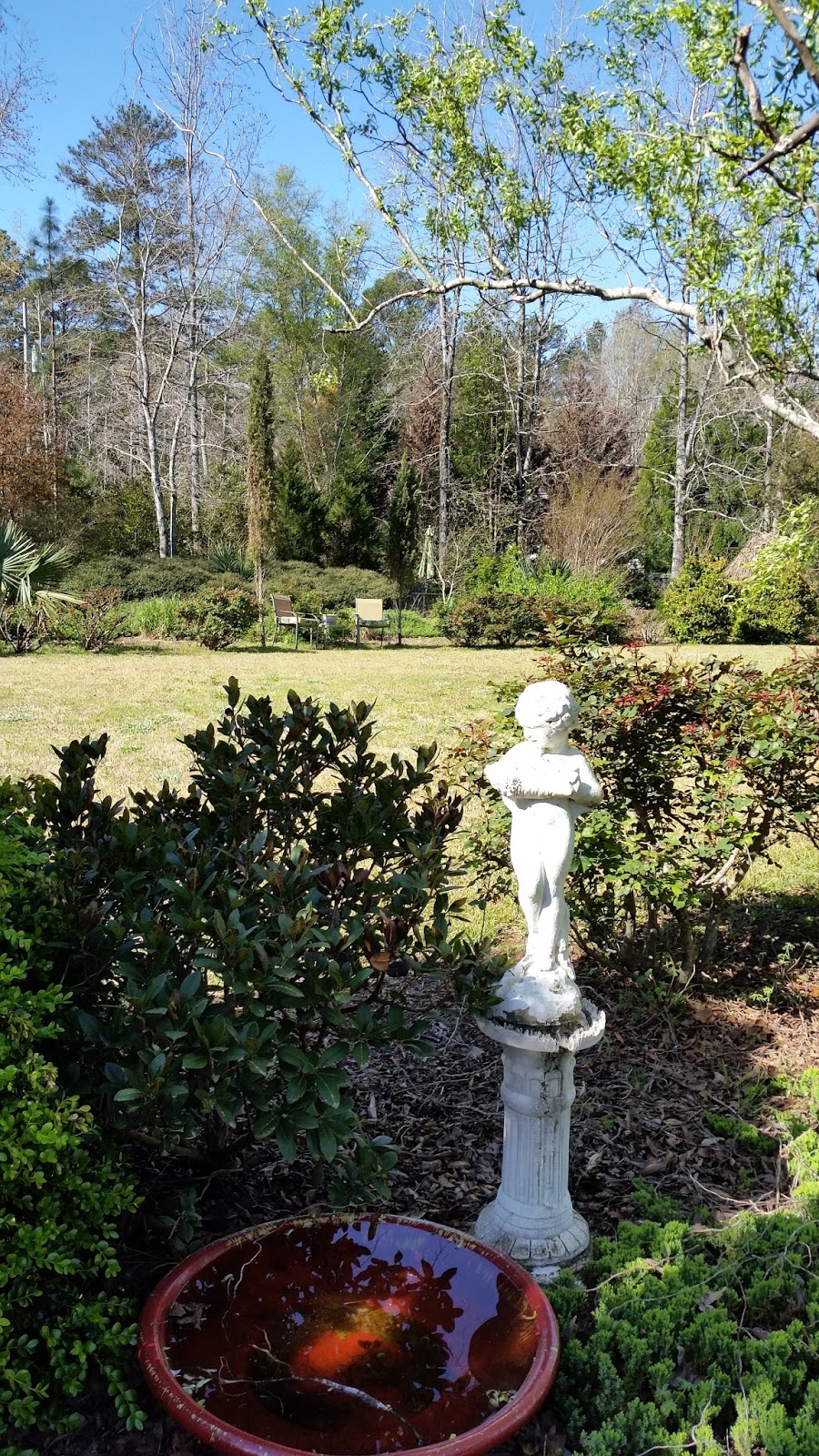
There is no piped water in my garden, so as my water feature, I have pots out here and there for birds and butterflies (with mosquito pellets applied). The shrub to the left of the figure is "Strawberry Bush" (Arbutus unedo 'Compacta') One summer I nursed it all the way back from California in the car. It grows naturally along the central coast of California. This one is perfectly happy in Alabama and rewards me with blooms that resemble strawberries. Most of my plants are ordinary ones common in the southeast, but I do have an eclectic collection I have amassed from Florida, my home state, to California, where my granddaughter lives.


One of these days, the tragic schism in South Carolina will be over. The unpleasantness will come to an end, I suspect sooner rather than later if the U.S. Supreme Court does as I think it will do. The 29 parishes will return to the Episcopal Church and the two dioceses will have closure in the federal court. When all is said and done, all people should be able to say they behaved in ways to honor the name their bear. That is my thought and wish on this glorious Easter day.

May you and yours know the full joy of this day and season.


Friday, March 30, 2018


A GOOD FRIDAY


Today is Good Friday 2018. It certainly was not a good Friday to the people who witnessed the gruesome execution of the young charismatic preacher/teacher/prophet/healer who in just three years had stirred up so much affection and hatred in his homeland and irked the Roman authorities who did not like anyone to disturb law and order. In fact, they purposefully reserved the highly visible penalty of crucifixion for themselves. It was meant to be a lesson for all. Little did Jesus' faithful few followers know at that point the glorious aftermath that would come from that most terrible day. Easter is right around the corner, the happiest day in the year. The life-death-resurrection of Jesus Christ was the greatest event in the history of the world. Salvation came for all. Life defeated death. The light banished the darkness. So, it is indeed a good Friday after all.

Here in Jacksonville, Alabama, Holy Week goes on just as it does all around the world. People are preparing for a great Easter which in this neck of the woods means churches packed with people and fragrant Easter lilies, Easter egg hunts galore to work off the sugar highs induced by overindulgent grandparents' Easter baskets, eat-until-you-drop feasts of the best cooking in the world, and new clothes. It also means a lot of heartache this year. The destruction of the March 19th storms is still all around us. It is too sad to post many pictures of the town as it looks today. Besides, the local newspaper provides enough heartbreaking pictures, at this link . 

I will provide one picture. Merrill Hall is the home of the college of business at Jacksonville State University, the most architecturally interesting structure on campus. It is 1960's modern with a stunning domed rotunda and several wings. In the storms, the dome collapsed, most of the windows shattered, roofs peeled off, and at least one of the wings (on the left) was gutted. I do not know the condition of the interior since no one is allowed in the building, but photos in the newspaper show the inside in shambles. Here it is today after a week's clean-up:


Since it housed the business departments, this building had a great deal of electronic equipment such as computers, no doubt much of which was ruined. In all, 23 buildings were damaged at J.S.U. including several that lost their roofs exposing the interiors to water. In the town of Jacksonville, 42 houses were destroyed, 146 heavily damaged, and 371 left with minor damages. It is astonishing that no one was killed. One church, a pretty Baptist edifice, was completely destroyed and several others damaged including substantial harm to the Roman Catholic church. Regardless, the weary congregations are preparing to celebrate the greatest day of the year the best way they can. No weather can stop that.

Meanwhile spring goes on in my garden. At the risk of seeming insensitive to the destruction fickle nature has caused all around me, I will share with you some of the beauty in my garden this week. I like to end the week on an uplifting note. As it does every year at this time, the "snowball" bush steals the show in my garden. I have it planted along the central lawn in full sun. The sight of this awesome and magnificent shrub commands everyone's attention.

Japanese Snowball (Viburnum plicatum "Sterile'). The plant tag said it would grow to 10 feet. This one is about 15 feet high and wide. Although the well-named snowball bushes are common across the south, I have never seen one as large; and I have never seen one with so many blooms. And, I have no idea why it is so happy here. I neglect it most of the time. There are countless hundreds of pure white flower pods.


Among the other flowering plants now showing, the Lady Bank's rose bush is still in full bloom:


The grass in the lower part is Japanese Silver Grass. The small tree on left is Grancy Greybeard. The tall evergreens in the background are Japanese Cedars. 

My best regards to all of you on this Good Friday. I am off to St. Luke's Church at noon thanking God it was spared from the storms. It is a somber day here in more ways than one. However, we know that in all ways the darkness will give way to a new day, in Jacksonville AL, and everywhere else. Evil doers cannot stop goodness just as the worst of nature cannot vanquish the human spirit. 


Wednesday, March 28, 2018


SUPREME COURT GRANTS TIME EXTENSION TO APRIL 30


On March 27, the U.S. Supreme Court granted TEC/TECSC's request for an extension of time to submit their response to DSC's February 9 petition for cert. The deadline had been set for March 29, but on March 23, the TEC lawyers asked for a month extension, to April 30, 2018.

On March 27, SCOTUS responded:  "Motion to extend the time to file a response is granted and the time is extended to and including April 30, 2018 for all respondents."

SCOTUS usually ends its annual session by early July and begins the next on the first Monday in October. It is reasonable to assume the justices will take up DSC's petition and TEC/TECSC's response, plus any amici briefs, in the months of May and June. They will decide whether to grant or deny cert. If they deny, the matter before SCOTUS ends and the SC supreme court decision stands as the law. If they grant the petition, I would assume it will be put on the docket for the court session of 2018-19.

The U.S. Supreme Court website gives the details of the case at this link .

Monday, March 26, 2018


CHURCH LAWYERS ASK U.S. SUPREME COURT FOR TIME EXTENSION 


On March 23, 2018, the lawyers representing the Episcopal Church and the Episcopal Church in South Carolina formally requested the U.S. Supreme Court for an extension of their deadline for submitting a response to DSC's appeal to the court. The new asking date is April 30, 2018. The court had set the date of March 29 for a response from the Church side.

The lawyers also announced they have learned that one or more "amici" are preparing briefs in support of the DSC petition. Amici are "friends" of one side who submit supporting arguments and documents although they are not parties of the case. TEC is asking for extra time to prepare a response to the DSC amici presuming their papers will appear soon. The letter asks a deadline of April 30 for all respondents.

Find the lawyer's request to SCOTUS here . 

Saturday, March 24, 2018


KNOW THE TRUTH


Want to know the truth about the schism? Want to know the differences between the leaders of the Diocese of South Carolina and the Episcopal Church? Simple. The truth is readily available in my book, A History of the Episcopal Church Schism in South Carolina. It is available on Amazon and other Internet outlets. It is the result of four years' research and writing in which I consulted 2,500 sources, 900 of which are cited in 2,200 footnotes. The book contains 300,000 words. This is as close as anyone can get to the whole truth about why the DSC voted to split off from the Episcopal Church and the differences between the post-schism DSC and TEC. As the 29 parishes prepare to return to the Episcopal Church, I highly recommend that every communicant read it. You need to know what happened and why it happened. If you do not want to buy a copy, get your local public library to order it, or borrow a copy from someone. Read it!

Ever since the South Carolina Supreme Court denied DSC's appeal for rehearing, on Nov. 17, 2017, the DSC leaders have been busy preparing to remove communicants from the 29 parishes that almost certainly will return to control of the Episcopal Church diocese of South Carolina. They held a meeting in December in which they disseminated a secret plan to the diocesan clergy and lay leaders. The plan outlined a process for removing congregations from their buildings. Just recently, Bishop Lawrence addressed the diocesan convention about going out. There are two large parishes in particular that the DSC leaders seem to be focusing on now: St. Michael's and St. Philip's, of Charleston, the great historic downtown churches where no doubt many members will remain with their ancestral buildings, cemeteries, endowments, and furnishings. DSC leaders are apparently trying their hardest to take out as many communicants from these two churches as possible. Word is that St. Michael's has already arranged to move people to a Methodist church down the street. It is almost certain that a considerable number of the faithful in these parishes will not leave the buildings. They will return to TEC.

First St. Michael's. This month, the Revs. Kendall Harmon and Al Zadig conducted a three week campaign of criticism of the Episcopal Church for the benefit of the St. Michaelites. It was entitled, "Why the Battle? Different God and Gospel?" The announcement of this has already been taken down from the online edition of "The Messenger," the St. Michael's newsletter, but can still be found on the Issuu online edition. The blurb for the "course" advertised it "will help you understand the theological divide that exists between the Episcopal Church and the Anglican Church in North America...So, this is not about politics and sexuality, it is about our core beliefs, theology and discipleship." As it turned out, it was indeed all about politics and sexuality. On Mar. 14, Zadig and Harmon advertised a talk, "Is Our Gender Really Up for Grabs?" It does not take much imagine the answer. On Mar. 21, Harmon posted a talk on "Can We Redefine Marriage?" Once again, I think we can guess his answer.

Now we move to St. Philip's. Harmon and Bishop Lawrence will be presenting a campaign called "Basic Christian Theology" in seven weeks, five at St. Philip's and two back at St. Michael's. It will begin on April 4. They promise a study of a book by Bruce Milne called Know the Truth: A Handbook of Christian Belief. I have not read this book, but the reviews reveal it to be a highly evangelistic (Calvinist) theological primer apparently close to fundamentalism. As we have already seen, the DSC leaders have moved their diocese into a fundamentalist-leaning sect as exemplified in the Marriage Task Force dictates of 2015 that forced the diocese into a narrow fundamentalist framework far from the mainstream of traditional Anglicanism. This featured a literal interpretation of the Bible, authoritarianism, intolerance, exclusively vertical theology, and homophobia.

The schism happened five a half years ago, yet here we are with the DSC leaders still trying to rationalize the schism. Although homosexuality was the direct cause of the schism, DSC leaders have been trying ever since the schism to convince their people it was all about theology, that is, that the Episcopal Church no longer believed in "the uniqueness of Jesus Christ" while DSC and ACNA did. Interesting that they kept the TEC Book of Common Prayer for their services. Any assertion that the Episcopal Church has abandoned Jesus Christ as the Saviour of the world is outrageously shameful nonsense. TEC certainly has not changed its theology and any implication it has is just wrong.

In time, and I suspect sooner rather than later, St. Michael's and St. Philip's will return to their ancestral home in the Episcopal Church. We so not know, cannot know, at this point how many people will stay and how many will leave the properties. So, only time will tell how effective the DSC campaign of propaganda against the Episcopal Church at St. Michael's and St. Philip's this spring will be. I for one will be praying for the communicants of these old parishes as they struggle to discern their true identities. They have been put, are still being put, in a very difficult position.  

So, everyone should "Know the Truth," indeed. The truth about the schism in South Carolina is readily available to anyone who wants to know it. 


(P.S. I did not have the heart to post pictures of my garden this Friday. However, my local newspaper The Anniston Star is supposed to feature it in Sunday's edition. It seemed insensitive to me to revel in the beauty of nature when my town lies devastated by the ugly side of nature. I drove around town today for the first time since the tornado and was shocked at the ruin even though I could not see the side streets. They are still blocked off. The destruction was overwhelming, much worse than I had thought. Please pray for the people of Jacksonville AL. Palm Sunday will go on tomorrow as usual. Even the worst of times cannot suppress the hope of Easter.)


UPDATE. March 25, a.m.:
Today's edition of The Anniston Star has a full page spread on my garden. One can find the same in the online version at this link . Meanwhile, the newspaper is reporting that some 2,000 volunteers, and perhaps that many chainsaws have arrived in Jacksonville to help in the clean up. This is humankind at its best, doing God's work. God is here, with every volunteer, and every chainsaw. God was also with us in church today as Palm Sunday went on as it has in our building every year since 1856.

Monday, March 19, 2018


TORNADO


March 19. 11:00 p.m.
Many of you readers know that I live in Jacksonville, Alabama, where I am professor emeritus at Jacksonville State University. You  may see on the news that violent thunderstorms struck the town and campus tonight at about 9:15. They included at least one tornado. I want to assure everyone that my family, my house, and my garden all avoided damage.

The twister, and accompanying high winds, tore across the campus leaving significant damage to important buildings, such as the coliseum that holds several thousand people, uprooting ancient trees, and knocking down power lines. Some apartments, houses, churches and stores are heavily damaged. The campus is just north of the town center. We do not know yet the full extent of the damage. Fortunately the 9,000 students were away on Spring Break.

There has been a good deal of property damage on the campus and the north side of town and injuries although as of yet no deaths announced. Rescues are going on now. I ask for your prayers for the injured.

To my knowledge, St Luke's Church, at the town square, an 1856 architectural treasure designed by Richard Upjohn, was not damaged. We will know for sure at first light.

I live about two miles south of the campus. As far as I know there was no wind damage in my area. We did not even lose electricity. My wife and I huddled in our central hallway for an hour as weather sirens blared non-stop outside.


UPDATE. Mar. 20, 8 a.m.     Morning light reveals extensive property damage in Jacksonville including the university. Many campus buildings, houses, churches, stores heavily damaged or destroyed. Reports of injuries but no deaths. Countless trees and power lines down. Some streets closed. Authorities asking everyone to stay inside while first responders and clean-up crews do the necessary work unhindered. Most of town without electricity. Water supply running low. Many work crews arriving from as far away as Birmingham.

One or two tornadoes reported with wind as high as 165 mph. The twisters touched down around 9 p.m. just north of us. My family, house and garden untouched (except for frayed nerves).

Apparently St. Luke's Church, just off the town square, was undamaged but have not received first-hand report yet.

For news reports see this link .


UPDATE. Mar. 20, 8:45 a.m.     Delighted to relay first-hand report that St. Luke's Church buildings sustained no damage at all. Thanks be to God!


THE STATUS OF THE LITIGATION, 
A BRIEF REVIEW


The next event in the litigation between the two dioceses is to be The Episcopal Church/The Episcopal Church in South Carolina's response to the Diocese of South Carolina's appeal to the U.S. Supreme Court, due March 29, Thursday of next week. TEC/TECSC had originally chosen to forego a response, presumably on the belief that the court would easily deny DSC's appeal. However, the court requested a written response from TEC/TECSC and gave a due date of Mar. 29.

While we are awaiting the response, I thought it would be a good time to review, at least briefly, the status of the litigation between DSC and TEC/TECSC.

There are three active avenues of litigation at present, the U.S. Supreme Court, the circuit court, and the federal court. Let take them one at a time.


U.S. SUPREME COURT

On Feb. 9, 2018, DSC filed an appeal to SCOTUS. This is what TEC/TECSC must respond to by Mar. 29.

DSC is asking SCOTUS to review the South Carolina supreme court decision of August 2, 2017 that recognized 29 of 36 parishes, and Camp St. Christopher, as under trust control of TEC/TECSC. DSC is claiming that SCSC did not strictly adhere to the neutral principles guideline and that only SCOTUS can clarify how lower courts must handle neutral principles. What DSC wishes, of course, is for SCOTUS to overturn the SCSC decision.

One should recall that on Sept. 1, 2017, DSC petitioned SCSC for a rehearing, for Justice Hearn to recuse herself, and for her part of the Aug. 2 decision to be "vacated" (removed). On Nov. 17, 2017, SCSC denied the rehearing by 2-2 vote and Hearn's recusal unanimously.

What next?
After TEC/TECSC's response, the  clerks of SCOTUS will prepare reviews of the case and circulate them among the justices who will meet and vote on whether to grant "cert," that is, to accept the appeal from DSC. Four of the nine justices must agree. The vote usually comes several weeks after the papers are submitted. If the vote fails, the matter ends for good. The SCSC decision stands as the law. If the justices grant cert, they will hold a hearing in the grand courtroom of the Supreme Court building and then decide the issue by majority vote.

I think chances are very slim that SCOTUS will take the case, for several reasons. In the first place, the DSC lawyers' entire argument in the circuit and state supreme courts was on state law (corporate and property law). SCOTUS is not concerned with state law except as it may impact on important constitutional issues. The constitutional issue involved here is the First Amendment. It strictly forbids the civic state from interfering in a religious institution. Thus SCOTUS tends to be hesitant to get involved in church cases. Indeed, it has turned down one after another of the Episcopal Church cases sent to it over the past several years.


CIRCUIT COURT

On Nov. 19, 2017, just after SCSC denied DSC's rehearing, DSC filed a new lawsuit in the circuit court of Dorchester County, the same court that had handled the trial of July 2014. This time, however, the case was given to Judge Edgar Dickson.

DSC claimed that TEC/TECSC owed money payments to DSC under the "Betterments Statute." This holds that people who occupy property in the mistaken belief they own the property, are due, from the owner, payment for the improvements they made on the property. DSC asked for a jury trial.

TEC/TECSC then asked the court to dismiss the suit on the grounds of untimeliness (filed too late), and the fact that the parish itself is the legal owner of the property. TEC/TECSC are not the deed holders but merely the trust beneficiaries. Besides, the law says that only a Defendant can bring a case under Betterments, not the Plaintiff, which is what DSC was.

There has been not a word from this court in three months. What is going on there is anyone's guess.

My best guess is that the court will hold a hearing then dismiss the suit.


FEDERAL COURT

This is now the center of action in the litigation. This is where the whole business is to be settled.

This is the case vonRosenberg v. Lawrence that TECSC originally filed in March of 2013. The suit claimed that Lawrence was in violation of the Lanham Act, a federal act that protects federally registered trademarks such as those of the Episcopal Church. vonR asked the court to declare himself to be the rightful bishop of the Episcopal diocese and to stop Lawrence from pretending to be the Episcopal bishop. In other words, this suit asked the court to recognize the Church diocese as the legal heir of the pre-schism diocese.

(The SCSC did not address this issue for resolution. It decided only on the parish properties. The second big issue, the legal rights of the old diocese, they left to be settled by the federal court. In the meantime, circuit court judge Goodstein's Injunction of January 2013 recognizing DSC as the legal diocese, remains in place.)

Judge C. Weston Houck handled this case but refused to process it choosing to defer to the ongoing circuit court proceeding. When Houck died last July, he was replaced by Judge Richard Gergel.

On Aug. 30, 2017, Gergel ordered a mediation between the two sides and placed a stay on the federal case in the meantime. The mediation went on from Oct. of 2017 to Jan. of 2018 and failed to reach agreement. TEC/TECSC proposed a protocol for the Church side to meet with the 29 parishes to discuss settlement. Apparently, DSC rejected TEC/TECSC's proposal. Gergel then lifted the stay on Feb. 14, 2018 and the case is now ongoing.

On Feb. 20, 2018, Lawrence filed a motion for dismissal of part of the charges against him. On Mar. 7, 2018, Gergel denied the  motion.

On Mar. 1, TEC/TECSC filed motions virtually to consolidate the whole of the litigation into the federal suit. They asked that the Board of Trustees and the parishes in question be included as parties.

At present, we are awaiting Gergel's response to TEC/TECSC's petitions of Mar. 1.

We can expect a period of several  months of "Discovery." That is the time the lawyers do their homework to prepare for the trial. The trial will be held afterwards, my guess before the end of this year.

Odds are in favor of TEC/TECSC. Federal courts historically favor the national church as a hierarchical institution. Besides, in this particular case, the decisions and opinions of the state supreme court, in favor of TEC/TECSC, are bound to influence Gergel.


In sum, there are three avenues of the litigation at this moment. They are separate but still related. They will be disposed as individual cases.

In my view, DSC's appeal to SCOTUS and suit in the circuit court are weak and most likely to fail.

It looks as if the federal court will indeed finally settle the legal issues between the two sides. 

In the meantime, there are clear signs that DSC has already accepted the loss of the 29 parishes. First and foremost, DSC's suit of Nov. 19, 2017, in the circuit court implicitly recognized TEC/TECSC's rights over the 29 properties. The DSC leadership has been underway since last December on preparing people to move out of their church homes. Bishop Lawrence's address to the diocesan convention earlier this month dripped with the theme of "going out." It appears to me that DSC leaders are doing everything they can to keep people away from TEC and to create churches in exile in order to keep their failed experiment afloat.

One of the two big issues at stake, local property, has been settled for TEC/TECSC, in my opinion, for good. The other big issue, the rights and assets of the pre-schism diocese will be resolved by the federal court. The end is in sight. 

Friday, March 16, 2018


GOING OUT INTO THE GARDEN


It is Friday and that means garden pictures. I am constantly amazed at how popular my garden posts are (over 424 hits on last Friday's) and am delighted to share my botanical garden with all of you. We are fortunate to live in the South. It is a gardener's paradise: lots of sun, short and mild winters, plenteous rainfall (usually), and fertile soil, if a bit acidic. I live midway between Atlanta and Birmingham on the line of zones 7b and 8a but try to choose plants comfortable in 7b. I am able to have some tropicals and some northern plants. For instance, I have two dwarf apple trees near a palm tree. One could not do that far south or north of here.

We continue to enjoy a beautiful springtime across the South. However, it is March and that means fluctuations between warm and cold with some rough weather thrown in. Right now, the stars of the garden are the flowering fruit trees. Let us go out and walk around the garden today:  


 Lady Bank's Rose (Rosa banksiae). Perhaps "Lutea." It seems that every garden wall in Charleston is decorated with Lady Bank's rose and for good reason. This one is not on a support. I have trained it to be a bush and that means pruning the long whips that grow out. This is the yellow form. There is also a white version.


"Adams" Crabapple Tree (Malus 'Adams'). "Adams" is a very good cultivar of crabapple. It has a profusion of dark pink flowers.


The smaller side of the garden. Large tree is elm. Slim evergreens are Italian Cypress. Tall evergreens are Japanese Cedar (Cryptomeria). The small sprawling tree on the right is a Corkscrew Willow. Its branches are weirdly contorted.


Yoshino Flowering Cherry (Prunus x yedoensis). The same Japanese cherry that famously grows along the tidal basin in Washington D.C. and in Macon, GA. There is nothing more elegant and beautiful at this time of the year.


An archway trellis on the small side of the garden. Boxwoods flank the trellis. Yellow shrubs on left are Francis Mason Abelia (Abelia x grandiflora 'Francis Mason'). I keep them pruned.


Carolina Cherry Laurel "Cherry Ruffles" (Prunus caroliniana 'Cherry Ruffles'). These shrubs grow large, to 20' and, make a good screen. The leaves are "ruffled." It is in full bloom now.

I hope you have enjoyed this little walk about and I hope you are making the most of this glorious season we are blessed to have. The beauty and comfort of God's grand creation helps us put everything else into perspective. I think we all need that now as much as ever. I know I do.