Sunday, January 30, 2022


THE REV. ROB DONEHUE MOVING TO GRACE CATHEDRAL, CHARLESTON


The Grace Church Cathedral annual parish meeting is underway now. The presider, Dean Michael Wright, just announced that the Rev. Rob Donehue will become a new canon of the Grace Cathedral starting on April 1, 2022. He will replace the Rev. Caleb Lee who left last year to become rector of St. Paul's in Wilmington NC. Donehue has been for several years at St. Anne's in Conway. He guided that group of refugees from schism into becoming a parish and moving into a new church home. The people of St. Anne's will certainly miss him greatly. At the same time, the people of Grace will rejoice at the return of their native son.

Wednesday, January 26, 2022


MISINFORMATION CONTINUES


It took a federal court Injunction and two contempt of court findings to make the officials of the breakaway contingent stop claiming to be the historic diocese of South Carolina. So, it strikes me that today's e-newsletter from the Anglican Diocese of South Carolina continues on in the traditional vein of misinformation coming out of that organization. Several points caught my eye in today's letter.

In the first place, the letter states that Mark Lawrence was consecrated bishop on January 26, 2008. It is true that he was consecrated a bishop at that time. However, the clear implication is that Lawrence was made bishop of the present Anglican diocese of SC. This is wrong. 

In 2008, Lawrence was consecrated bishop of the Episcopal Diocese of South Carolina, aka the Diocese of South Carolina. This diocese was, and still is, part and parcel of the Episcopal Church. He verbally and publicly renounced his association with the Episcopal Church in November of 2012 and on Dec. 5, 2012, the Presiding Bishop of the Episcopal Church issued a formal Release and Removal to Lawrence removing him as bishop of the Diocese of South Carolina. The majority of the clergy and laity of the DSC left the Episcopal Church in October and November of 2012. They formed a new diocese that is now called the Anglican Diocese of South Carolina. Is is entirely and wholly separate from the Diocese of South Carolina which continues on in the Episcopal Church. If the majority of the people who left the Diocese of South Carolina recognized Lawrence as their bishop, they did so on their own, not from the authority of any higher institution. After ADSC joined the Anglican Church in North America, Lawrence was recognized as a member of the College of Bishops of the ACNA.

It would be misleading to claim that Lawrence became bishop of the Anglican Diocese of South Carolina in 2008. He did not. He became "bishop" of the ADSC in 2012 after he left the Episcopal Church. The Anglican Diocese of South Carolina did not exist before 2012; and this has been established by the United States District Court, in Charleston.

The second point may not be calculated. The letter says Edgar will be consecrated "our Diocesan Bishop" on March 12. In fact, Edgar was elected Bishop Coadjutor. He will serve alongside Lawrence. Only when Lawrence retires will Edgar become the diocesan bishop. That is expected at the end of this year. I suspect this error was just sloppy editing.

Another thing that amazes me is all this business about contributing to a "Bishop's Purse" for Lawrence. Has anyone paid attention to how much Lawrence has raked in during these fourteen years? His salary and benefits come to around a quarter of a million dollars a year. Moreover, he has had virtual free use of the multi-million dollar bishop's residence on Smith Street. If you add the value of this housing, the value of his yearly income would be around a third of a million dollars a year. Presumably he would entitled to receive other income as retirement in  the Episcopal Church system and Social Security.   

Lawrence's tenure has been quite expensive for his followers. They are paying two sets of lawyers, one for the diocese and one for the local parish. God only knows how much this schism and epic litigation has cost the trusting faithful of the ADSC. Now, on top of this, to ask them to hand over even more money to a man whom they have maintained most generously strikes me as between insensitive and shamelessly materialistic.

Thursday, January 20, 2022


NOTES,  20 JANUARY 2022


Greetings, on Thursday, January 20, 2022. My favorite photo from last year summarizes my feelings right now:


I'm a grumpy old man. I am cold and tired. But, darn it, I am here, mask on, social distancing, and doing what I am supposed to do and doing it with the snazziest mittens! As Bernie Sanders at Biden's inauguration, we keep on doing what we know we should do because we would not want it any other way, and if we can do it with a little pizzazz, so much the better.

Let's check in on the subjects we have been following of late.


PANDEMIC. If one looks at the charts, as this one , one sees we are in the fourth great surge of the COVID-19 pandemic. In terms of spread, this one is by far the worst. The trend is skyrocketing. To see this present explosive spread, let us compare the last two ten-day periods using Worldometers' data.


The world. New cases: 19,476,410 (Jan. 1-10); 32,021,300 (Jan. 10-20).

New deaths: 52,227 (Jan. 1-10); 78,478 (Jan. 10-20).


The United States. New cases: 5,566,530 (Jan. 1-10); 8,545,320 (Jan. 10-20).

New deaths: 12,451 (Jan. 1-10); 14,208 (Jan. 10-20).


South Carolina. New cases: 72,931 (Jan. 1-10); 188,480 (Jan. 10-20).

New deaths: 110 (Jan. 1-10); 283 (Jan. 10-20).


Alabama. New cases: 82,116 (Jan. 1-10); 109,638 (Jan. 10-20).

New deaths: 169 (Jan. 1-10); 132 (Jan. 10-20).


Charleston County. New cases: 7,286 (Jan. 1-10); 14,852 (Jan. 10-20).


These figures show sharp rises in almost every category. Notice especially the enormous jumps in the spread of Covid in South Carolina and Charleston. The rate of infections more than doubled in these two ten-day periods. As we know, the Omicron variant is highly contagious, and the data bear this out. Covid is now spreading as wildfire; and we are still in the depths of winter with another two months to go before spring. There is no reason to think this fourth surge is going to end anytime soon. Meanwhile, only about half the people in SC (53%) and AL (48%) are fully vaccinated.

The world has been in the grips of this plague for two years now. How much longer and how many more variants will appear is anyone's guess. Nevertheless, we have no choice but to keep up the good fight for the foreseeable future. This microscopic virus is a most persistent bug. It has already killed more than 5 million people worldwide including nearly 900,000 in the U.S. We will get through this, but I am afraid there is much more suffering and loss to come.

The federal government is now offering four free Covid tests, to be mailed to your address. Find the site for this here .


SCHISM. Not surprisingly, there is no word yet from the SC Supreme Court. Let's not hold our breaths on this. The last time, it took the justices 22 months to issue their written opinion.

Meanwhile, both dioceses that came out of the break are forging ahead even in the dark days of Covid. The new Anglican diocese is set to have its annual convention on March 11, at St. James's, on James Island. On March 12, Chip Edgar is to be consecrated the bishop coadjutor of the ADSC at the Cathedral of St. Luke and St. Paul, Charleston. When Mark Lawrence retires, supposedly at the end of this year, Edgar will take over as the II diocesan bishop of ADSC. He will face a host of major challenges, to say the least. The very independent existence of the entity that withdrew from TEC is in doubt.


THE ADVENT. The scene at the Episcopal Cathedral Church of the Advent, in Birmingham, has been quiet of late. Today, the search committee, for the new dean, issued a letter promising they were making progress. They said they had 51 candidates originally and were now winnowing. Meanwhile, the Interim Dean, Craig Smalley, is doing an admirable job keeping tensions down and the parish together even as the previous dean is busy building a new non-Episcopal church in Birmingham.


Let's face it. We are in a hard time that just does not want to stop. However, as a student of history, I can assure you this is small potatoes compared with some of the enormous challenges of the public health catastrophes of the past (think Black Death in the 14th Century) even if that does not make us feel any better right now. People have survived worst than Covid; we can survive too, and not only survive but thrive in some ways, e.g. the upward boost of wages in the U.S. along with an unprecedented abundance of jobs. So, like Bernie, let's bundle up, put on our masks, and make our defiant stands, with verve, against the slings and arrows (and deadly viruses) that life throws against us. Peace.   

Monday, January 17, 2022


MUSINGS ON MLK DAY


Today is Martin Luther King Day, a federal holiday in the United States. This puts me in a reflective mood because racism was fundamental in the world in which I grew up. You see, I grew up in the Jim Crow south. Any native southerner of my age can tell you all about how pervasive racism was then; and if you did not live through it, you really cannot know now just how important racism was to life in the south.

Looking back on growing up in Pensacola, Florida, in the 1940s and 50s I marvel at how stoic were the "coloreds," as African Americans were called then in polite company (the "n" word was usually reserved for private conversations). The discrimination was embedded deeply all around us. When my wife Sandy first got her drivers license, this must have been in the late 1950s, she decided on a whim to take her maid, whom she loved, to McDonalds for lunch. The maid knew what was going to happen but she said not a word. They stopped and Sandy went to the counter to get the food to take back to the car (no inside dining in those days). Back in the car, the manager came out and told them they would have to leave because they did not serve "coloreds" there. Sandy was mortified with embarrassment but the maid was not. She said to Sandy, "Don't fret, honey child, I am used to it." That little incident changed Sandy's life. It brought home the inexcusable unfairness of racism.

I did not need any such jolt myself as I saw the awful racism all around me every day. The city bus had a sign painted over the driver, "Whites sit from front to rear, coloreds sit from rear to front." If there was any question, the "colored" person gave up the seat. The railroad car had a partition behind which "coloreds" had to sit. There were two waiting rooms in every station. No black person could sit at the luncheon counters. If they wanted anything, they had to stand at the end of the counter, order, pay, and take the food off. It seemed that everything imaginable was separated with the "coloreds" getting the short end. It was humiliating.


The Saenger Theater in Pensacola, about 1938. The Saenger was the premier movie house in town. The Colored Entrance was on the side of the building. "Colored" customers had to climb an outside staircase to sit in the balcony where they were confined. This entrance was removed in the 1960's but the last time I checked the staircase was still there. There were theaters on Palafox Street which did not admit "coloreds" at all.

It would take a book to describe all the aspects of daily life under Jim Crow. Looking back now, racism was unbelievably pervasive in society and culture. And, the mindset was just as present in my family's church as anywhere else. So, I grew up assuming this was the way it was everywhere, that is, until I was in the Sixth Grade. Most of my little friends were like me, in families that had come from rural northwest Florida, Alabama, Georgia, Mississippi. Racism was a given among these people. However, I always had classmates whose fathers were in the Navy (armed forces were integrated in 1948) and they told me about the wonders of the world in exotic places as Hawaii, the Philippines, Guam and the sort. In the Sixth Grade, a bunch of us were sitting in the cafeteria having lunch and the subject of "coloreds" going to school with us came up. A Navy girl said loudly, "Well, why shouldn't they go to school with us?" We all fell silent. No one had an answer. That started me to thinking that she had a point and we ought to change our ways for the sake of fairness. I have forgotten the girl's name but I never forgot the impact she had on me.

Racism is still with us, unfortunately. For instance, Alabama is now in an election campaign for governor and senator. George Wallace may be gone, but what he represented is not far below the surface. It seems that the candidates are vying with each other to denounce "critical race theory" curriculum even though it has never been in the schools. This is thinly veiled racism. Moreover, all sorts of laws have been passed to restrict voting. In Jim Crow, it was practically impossible for blacks to vote.

So, MLK day is always bitter sweet for me. Too much of the awful anti-Christian and anti-democratic racism of the old days is still with us, and not just in the south. Yet, I can promise you what we have now is very, very far removed from what we had under Jim Crow. We have progressed light years; and if you have trouble believing that, talk with a southerner of my age and learn what daily life was like before 1960.

As I keep saying on this blog, America had a great democratic revolution after the Second World War and that revolution is still going on. What we are seeing now is the clash between that revolution and the people, mostly white men, who feel threatened by it all. Judging from what has happened in my lifetime, I would say democracy will win out, but it will be far from easy. It will win because of brave people like the Rev. Dr. Martin Luther King, Jr. and the countless good people who also gave their lives to improve life for their fellow human beings. I am also remembering today Blessed Jonathan Daniels, the patron saint of the Episcopal dioceses in Alabama.  

Thursday, January 13, 2022


ACNA BISHOPS APPROVE EDGAR AS BISHOP OF ADSC


The bishops of the Anglican Church in North America, meeting on January 12, 2022, in Melbourne, Florida, approved the election of Chip Edgar as the bishop coadjutor of the Anglican Diocese of South Carolina. The vote totals were not revealed, but the ACNA rules require a 2/3 vote of the bishops to approve an election of a new bishop. The ACNA is an authoritarian institution in which power is controlled by the (all male) bishops. As opposed to the Episcopal Church, the diocesan standing committees have no say in approving a new bishop. In TEC a simple majority vote of bishops and standing committees approves new bishops. 

Edgar was elected by an election convention of the ADSC on October 16, 2021, at Christ Church, Mt. Pleasant SC. He was the dean of the cathedral church of the ACNA Diocese of the Carolinas, in Columbia SC. Edgar had never been a clergyman in the ADSC. He was chosen over two internal candidates.

He is to be ordained and consecrated bishop coadjutor of the ADSC on March 12, 2022, at the Cathedral of St. Luke and St. Paul, in Charleston.

Find the ACNA article about yesterday's action here .

Mark Lawrence is expected to retire as diocesan bishop of ADSC at the end of this year. With that, Edgar will become the diocesan bishop.

Lawrence was released and removed as bishop of the Diocese of South Carolina by the Presiding Bishop on Dec. 5, 2012 after he had publicly announced his departure from the Episcopal Church. Meanwhile he was recognized as bishop by the people of the new diocese which later took the name Anglican Diocese of South Carolina. The new diocese joined the Anglican Church in North America. Edgar will become the II bishop of the ADSC. 

A federal court injunction forbids the breakaway contingent from claiming to be in any way the historic Diocese of South Carolina. All of the historic titles and emblems are reserved for the ongoing Diocese of South Carolina which is part of the Episcopal Church.

There has been some speculation that Edgar's election may well signal the union of two ACNA dioceses in the lowcountry, the Diocese of the Carolinas, led by Steve Wood, and the Anglican Diocese of South Carolina.

Monday, January 10, 2022


NOTES,  10 JANUARY 2022


Welcome, blog reader, on Monday, January 10, 2022. My best wishes to you. It is time to check in on the topics we have been following for some time now even though we may not want to face the painful facts. I have always believed in the principle of the ancient Greek philosophers---it is better to know the truth even if it hurts because truth leads to understanding and wisdom. So, here goes.


PANDEMIC. Two years. Two years we have been enduring the worst health crisis in the world in the last century! Moreover, it is no where near ending. Quite the contrary, new cases are skyrocketing as never before. The Omicron variant is far more contagious and is spreading as wildfire. Even people with all the shots are contracting "break through" cases. Some say it is like the worst head cold you ever had, others like the worst case of the flu. 

The numbers of the last ten days are horrifying. According to our usual metric, Worldometers, there were nearly 20m new cases, to 308m in the world. That is a 7% rise, in just 10 days! If there is a "good news" side of all this, it is that death rates are low, just 1% rise in the last 10 days (52k deaths, for a total of 5.5m in the world).

The United States continues to be the world's epicenter of this plague as it has been all along for the two years. The U.S. has had by far the most cases and deaths from COVID-19. In the last 10 days, new cases shot up by 5.5m, a whopping 10% rise. Some one in five Americans has contracted the virus. Some 1,000 Americans die every day from the virus, 12.5k in the last ten days. The total number of dead Americans now stands at 859,356, far exceeding the dead from the great flue epidemic of 1918-19 and from any war in American history. 

Our southern states continue to suffer along. In South Carolina, new cases are soaring far above any period before now. In the last ten days, SC reported a jump of 7% to some 1m cases. In these ten days, 110 South Carolinians died of COVID, for a total of 14,746 in the pandemic. Just over half the population is vaccinated (53%).

The plague is spreading in Charleston County faster than in the state as a whole. In the last ten days, the county reported 7,286 new cases, up a stunning 10% (in 10 days!). Six more people died in the county for a total of 761.

Alabama is faring even worse. In the last ten days, new cases were off the charts, three times as many as any earlier ten day period. New cases stood at 82k, up 9%. There were 169 deaths, up 1%, to a total of 16,624. AL has one of the lowest vaccination rates in the country, at just 48%. In both SC and AL hospitals are overwhelmed with incoming cases.

Bottom line---we are in the fourth great surge of this pandemic. It is the worst of all for new cases. The only "silver lining" is that the percentages of deaths are falling drastically reflecting improved medical treatments the professionals have learned by trial and error over two years. BTW, we should all take a moment and say a silent prayer for the angels in the forms of the medical professionals (from the CEOs to the custodians) who are risking their lives every day to save the lives of others. I thank God for each and every one of them. They, and the first responders, are the heroes of the day and we all owe them a great deal.


SCHSIM. Nothing new to report. We are in a holding pattern awaiting the SC Supreme Court's written opinion on the Episcopal Church's appeal of Judge Dickson's nullification of the SCSC order of 2017. Judging from the hearing in the SCSC of Dec. 8, 2021, there is no way to tell how the justices will land on this. They were all over the place. 

Meanwhile, both parts that came out of the schism of 2012 are moving on with new leadership and struggling with the effects of the pandemic. 


POLITICAL. In the big picture, we Americans are seeing the clash between the predominate historic force of developing democracy in America and the backlash against this. Given the history of American society, this struggle is based on race. White men are reacting desperately against the rising tide of a multi-racial society and culture. In short, democracy is under assault by the forces of anti-democracy. Democracy has two underlying principles: equal rights, and majority rule. In the last seventy years, the U.S. has moved dramatically more and more to both of these and at the same time a large minority had developed and is taking action to stop this process. History tells me democracy will win but may come out badly battered and wounded in the process. The minority will not surrender power quietly, e.g. assault on the Capitol of Jan. 6, 2021.


Today, for one day, none of the above matters in the state of Alabama. Once again, football is the topic of the day. Yet again, the people of Alabama are setting everything else aside in anticipation of another national championship. Alabama is fiftieth or nearly in virtually every category among the American states except in one field---college football. A state that has little else to point with pride can revel in the glow of being the best in something. I say, go for it. Forget everything else for the day. Win or lose, Alabama is in a good spotlight. We need this respite. We need this diversion from the world of hurt all around us. I for one will enjoy tonight's game. Peace.


Thursday, January 6, 2022


OUR WALL IS NOT IMPREGNABLE


I have been thinking a lot lately about the problem historians have wrestled with forever, why civilizations and nation-states rise and fall. Specifically: Is the United States still on the rise, or has it begun its fall? Today is the first anniversary of the mob attack on the U.S. Capitol, and the U.S. Constitution. This is an appropriate time to reflect on this question.

No civilization/state has been studied more than the Roman empire. Lasting some two thousand years, it had a definite rise and clear-cut fall. The "rise" issue among historians is not controversial, but the "fall" one is, very much. Even during the time of the decline and fall, writers mused at length about the causes of it all. Ever since the fall, there had been wide agreement on what happened, but much disagreement on why it happened.

Actually, the Roman empire did not decline and fall altogether. In the Fourth Century C.E., the empire was divided and the Emperor Constantine transformed an old Greek trading town into a magnificent city called Constantinople, as the seat of the eastern half. It soon became the largest, most beautiful, and richest city in the western world. Constantinople was on the tip of a peninsula. As Rome was being overrun time and again by invading tribes, the emperors at Constantinople constructed the greatest defensive wall system in the world across the neck of the peninsula. It was designed to be impregnable.


The walls ran for several miles. There was a thirty foot moat, an outer wall, in intermediate wall, then a high wall with 90 sixty-foot towers. The walls were made of white limestone decorated with red bricks. There are still large remnants of the walls standing. Walls ringed the entire city, but those on the land side were the most elaborate.


The people of Constantinople believed their immense walls were impregnable. They rested secure behind them in the belief that no invader of any size or strength could ever break through. Indeed, many a would-be invader turned away just at the sight of the gleaming and incredibly formidable walls. From time to time, numerous attackers actually tried their hands at charging the walls, to no avail. Even relatively few defenders could fight off waves of attacks. Century after  century, the people of Constantinople rested secure behind their incomparable defenses.

Invaders did get into the city, once, in 1204, in the Fourth Crusade when the crusaders decided it would be easier to loot the fabulous wealth of Constantinople than to risk death in the Holy Land. That time they came in by sea, into the harbor. They did not attack the land walls. The eastern Roman empire (aka Byzantine Empire) survived this interruption and eventually restored its old rule, safe and secure behind its great walls.

In the Fifteenth Century, a new power arose in the region of Asia Minor and the Balkans, the Ottoman Turks. In 1453, the Ottoman sultan, Mehmet II, decided he would try his hand at capturing Constantinople, still the greatest and strongest city in the world. On April 6, he laid siege to the city. His forces outnumbered the defenders at least five to one. Over and over his men attacked the great walls, only to be repulsed every time, at bloody loss. The sultan actually contemplated calling off the assault. However, he had a "super weapon" that the defenders did not have. It was a huge bronze cannon (and many smaller ones), thirty feet long that fired enormous "shells" of marble. It was so heavy it could be moved only by sixty oxen. Day after day, the Turkish cannons fired and pieces of the walls crumbled. Still the massive walls held. After seven weeks, on the verge of withdrawal, the sultan decided on one last all-out assault with all the cannon power available. On May 29, the cannons blew a hole into a weak point of the walls and the Turks flooded into the city. The mighty walls fell to the cannon fire. Gunpowder, and guns, were new in Europe. These were things the builders of the walls never imagined. In the end, the supposedly impregnable walls of Constantinople failed because the defenders failed to keep up with the new technology of the day. 

The Ottoman capture of Constantinople in 1453 was the end of the Roman Empire. For a thousand years the people of Constantinople had lived in the confidence that their city was safe from invaders because of its fantastic defensive walls. In the end it was a false security.

Now, to the point of this wordy history lesson. Our "wall" is the U.S. Constitution. For more than two centuries we Americans have lived behind our wall of security believing that nothing could endanger us because the Constitution would always protect us. We had a terrible trial of that in the Civil War, but the Constitution held just as the great walls of Constantinople had held for a thousand years. 

We had a second assault on the Constitution one year ago today. The President of the United States incited a violent mob to attack the Capitol in order to overthrow the Constitution of the United States. The president and his followers wanted to overturn a legal and legitimate election in order to keep the losing candidate in power. The mob broke in and rampaged through those hallowed halls looking to do violence to the representatives of the people. The president refused to go but retreated to the White House to watch in glee on television. Four hours later, the National Guard arrived and restored order.

This was not the end of the story. Quite the contrary. All across the country anti-democratic forces are making assaults on the Constitutional process. Most Republicans continue to believe Trump actually won the election and the mob attack was nothing of importance. A large minority of Americans are willing to overthrow our Constitution in order to hold power.

The "wall" of the Constitution has been violently attacked and is still being attacked. The future of our constitutional democracy is at stake. The wall will stand only if a majority of the American people arise to defend it. The walls of Constantinople failed the people, after a thousand years. Whether the wall of the Constitution will save the democracy of the American people after only a couple of centuries is the existential issue facing our country today. 


Sunday, January 2, 2022


NEW DATA FROM THE ANGLICAN DIOCESE OF SOUTH CAROLINA SHOW CONTINUING DECLINE


The Anglican Diocese of South Carolina has published its membership data for the year 2020, the most recent empirical information we have about the life and health of the ADSC. Find it here . The questions at hand are: What is the trajectory of membership change in the diocese? What effect did the schism of 2012 have on membership in the ADSC? What do the data suggest to us about the future of the ADSC?

There are several sets of metrics provided by the ADSC that will help us answer these questions.


BAPTIZED MEMBERS. (This is not a reliable measure of church membership because it counts every baptized person who had any connection to the parish whether he or she ever attended church.) Nevertheless, here are the ADSC figures for the end of the year:

2012---23,455

2013---23,181

2014---22,953

2015---22,149

2016---21,953

2017---20,602

2018---20,763

2019---20,195

2020---19,597

Thus, in the 8 years after the schism of 2012, ADSC reported a loss of 3,858 baptized members, or -16.45%. 

The trajectory is clear even though these numbers are not accurate. They are inflated as effects of the schism. The actual numbers of baptized members are much lower.


COMMUNICANTS. A "Communicant" is defined as anyone who took communion at least once in the year. This is a more reliable metric than "baptized membership." "Communicants" is sometimes called "active members." Here are the numbers of communicants reported by the ADSC:

2012---17,812

2013---17,798

2014---16,361

2015---15,556

2016---14,694

2017---13,291

2018---12,126

2019---11,457

2020---11,337

Thus, in the 8 years after the schism of 2012, ADSC reported a loss of 6,475 communicants, or -36.6%. This means ADSC lost a third of its active members since the schism. 


AVERAGE SUNDAY ATTENDANCE. "Baptized members" and "Communicants" measure membership. What about the numbers of people sitting in the pews on Sundays? This is measured by Average Sunday Attendance (ASA). Here are the ASA numbers as reported by the ADSC:

2012---9931

2013---9292

2014---9325

2015---9085

2016---9014

2017---8905

2018---8875

2019---8980

2020---8215

Thus, in the 8 years after the schism, ASA of the ADSC fell 1,716 or -17.28%. 


The figures above are for the diocese as a whole. What about the individual churches of the ADSC? How has their membership changed? Let us look at "Communicants," the most meaningful measure of active membership in a parish. For this, we will look at the number of Communicants in 2011, just before the schism of 2012, and compare it with the latest figures, of 2020.

Numerous parishes lost around half, or more, of their active membership.

ST. PHILIP'S, of Charleston. 2,677 (2011)---1,393 (2020). -1,284; -48%.

ST. MICHAEL'S, of Charleston. 1,847 (2011)---976 (2018, last report). -871; -47%.

ST. HELENA'S, of Beaufort. 1,737 (2011)---849 (2020). -888; -51%.

HOLY CROSS, Sullivans Island. 2,540 (2011)---945 (2020). -1,595; -63%.

CHRIST CHURCH, Mt. Pleasant. 935 (2011)---334 (2020). -601; -64%.

OLD SAINT ANDREW'S, West Ashley. 962 (2011)---413 (2020). -549; -57%.

ST. LUKE'S, Hilton Head. 951 (2011)---247 (2020). -704; -74%.

ST. JOHN'S, Johns Island. 566 (2011)---265 (2020). -301; -53%.

HOLY COMFORTER, Sumter. 525 (2011)---203. -322; -61%.

TRINITY, Myrtle Beach. 595 (2011)---156 (2020). -439, -74%.


Numerous other local churches lost between 10 and 50% of their active memberships between 2011 and 2020. Examples:

Church of the Cross, Bluffton. -11%.

Good Shepherd, West Ashley. -50%.

Trinity, Edisto. -34%.

St. Paul's, Summerville. -22%.

Christ/St. Paul's, Yonges Island. -26%.

St. John's, Florence. -25%.

St. Bartholomew's, Hartsville. -26%.

St. Paul's, Conway. -18%.

Resurrection, Surfside. -11%.

Redeemer, Orangeburg. -31%.

Trinity, Pinopolis. -42%.

St. Matthias, Summerton. -41%.


What reasonable conclusions can we draw from these empirical data of the ADSC? Here are the conclusions I see:

---The Anglican Diocese of South Carolina is in severe and relentless decline. It has lost a third of its active membership since the schism of 2012.

---The ADSC is in decline in virtually every other metric. 

---All of the large parishes suffered serious to severe losses of active memberships.

---Most of the medium and small local churches saw minor to severe losses of membership.

---Only a handful of parishes reported membership gains.

---There is no reason to believe the alarming and relentless decline of the diocese and the parishes will abate.

---The ADSC and most of its parishes will soon start experiencing, if they have not already, the consequences of the sharp declines in sources of support.

---The assertion that the schism was a popular event is highly doubtful.

---A great many people have voted with their feet. They have rejected the schism of 2012.

---The ADSC has failed to draw in enough new people to offset the loss of members. It is not attractive to the people of South Carolina as a whole. 

---ADSC's long-term viability as an independent entity is highly dubious. Judging from the recent election of bishop coadjutor in the ADSC, one may reasonably expect the ADSC to merge with the Anglican Diocese of the Carolinas.


Nine years out now from the schism of 2012, we can make the reasonable assessment that the schism was a failure by every empirical measure. The aftermath has been a tragedy, for both sides, but mainly for the people who put their trust in wrong-headed leadership. The people of ADSC have paid a high price to support the bad decisions their leaders made in their names. They are paying two sets of lawyers, diocesan and parochial, so far with nothing to show. The SC supreme court ruled in favor of the Episcopal Church as did the federal court. Even if ADSC should prevail in both of these, the people of ADSC will still face the problem of propping up collapsing institutions. Fewer people will pay more. Even if ADSC should win in both state and federal courts, the schism would still be a disaster of bad choices freely made. 

It is remarkable the capacity of some people to inflict pain on others when there is so much unavoidable pain in the world.


Of course, in the bigger picture all of this is just a lot of bickering about how to rearrange the deck chairs on the Titanic. The ship of organized religion is sinking. We are all going down. One after another, the Pew Research Center studies show precipitous drops in popular attachment to churches, and religion in general. Moreover, this is generational. People under thirty nowadays are fleeing like mad from organized religion. The "nones" is growing much faster than any other measure, particularly among the young. Church membership is collapsing across the board. So, in a generation or two, the schism of 2012 may well be irrelevant. The issues of it are already archaic to most people. To break up a church in order to keep gays and women from equality and inclusion in the life of the church seems ludicrously antique in the broader culture of modern America.

What a waste. What a shame. What a tragedy. Why did the schism happen? Because some people failed to follow the Great Commandment. They did not love their neighbors as themselves. They choose instead to be like the Pharisees. 

But nothing is beyond redemption. Minds can change. Hearts can change. We have seen glimmers of hopeful change among the people in the ADSC in the recent diocesan self-study and in the actions of some clergy. The schism of 2012 was not a popular uprising. It was an event planned and carried out by a small group of the old diocesan leadership and presented to the people. 

We see now the schism was a failure. The people of the ADSC could redeem that failure if they should have the will.

Friday, December 24, 2021


HAPPY CHRISTMAS, 2021


"Glory to God in the highest and on earth peace, good will toward men."


The Tiffany window, "Madonna and Child," one of the priceless treasures of the Episcopal Church of St. Michael and All Angels, Anniston, Alabama.


My warmest wish is that you find new hope and joy this Christmas. The darkness of the troubles of life all around us cannot extinguish the light of God's love for each of us. Peace.


Wednesday, December 22, 2021


NOTES,  22 DECEMBER 2021


Greetings, blog reader, on Wednesday, December 22, 2021. My best wishes to you as we await the celebration of the Nativity of Our Lord.

At this moment in our lives, we are besieged with woes and burdened with fears. There is no need to go through a litany of the troubles of the day. We all know, all too well, what they are. We all wonder anxiously what tomorrow will bring. Will it be even worse that what we have already?

To celebrate light and life in what is now late December has been a natural inclination among human beings from before records began. All prehistoric and early ancient societies worshiped the sun in some way. It was the primary deity. People knew instinctively it was the source of life on earth.


Ra, the sun god, was the greatest of the gods of ancient Egypt. He holds in his right hand the symbol of eternal life.


People in the northern hemisphere could see the sun declining in the sky in autumn. Prehistoric people commonly believed evil forces were trying to devour the sun in order to extinguish life on earth. They could see too, on what is now 21 December, that the sun reached its low point and then began to revive, or rise again, in the sky therefore vanquishing evil. Life defeated death, year after year. This brought hope for a better life.

By the time of the Roman Empire, Eastern Mystery Religions had become popular throughout the western world. The  most popular one among the soldiers of the Roman army was the Cult of Mithras which celebrated the birth of its mythical deity on present-day December 25, soon after the new "birth" of the sun. No one knows how December 25 became the Christians' day of birth (the Gospels did not give a date) but late December was the common time for such celebrations of birth in the ancient world.

The winter solstice was yesterday, 21 December, when the sun reached its low point in the sky. Starting today, it will "rise" again. We now know what prehistoric and ancient peoples did not know, that it would rise again naturally. Yet, crowds of people descended on Stonehenge, in England, to celebrate the day, as the builders of that phenomenal homage to the sun did thousands of years ago. I celebrate too, in my own little way.


Dawn at my house this morning, from my back deck. Today is the first full day after the winter solstice. I arose early to begin my own little celebration of new life in my garden.

In just three days we will celebrate another new life, that of our Lord. It will be Christmas Day, 2021. Christians around the world will be comforted by the new life, once again, as they have been for nearly two thousand years. God knows, we need it now.


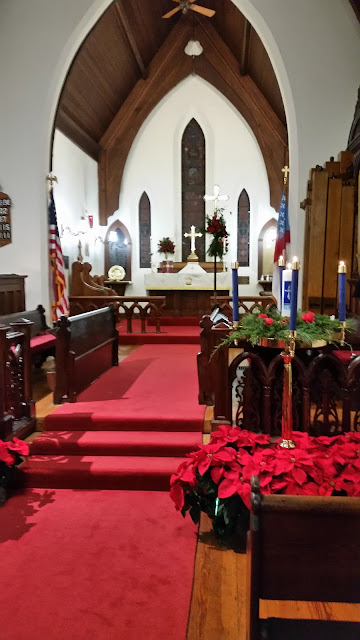
Churches in every part of the world are dressing up now to celebrate new life. This is a recent Christmas at St. Luke's, of Jacksonville AL (an Upjohn church, 1856). 

What would Christmas be without poinsettias? Did you know they are named for Joel Poinsett, the South Carolinian who was minister to Mexico? An avid botanist, he introduced the "Christmas" plant to the U.S. in the 1830's. He died in 1851 and is buried in the Holy Cross church graveyard, Stateburg SC. This gardener hopes someone will go by Poinsett's grave this Christmas and leave a poinsettia.

My point of the day is that whatever is going on in our lives, we should celebrate light and life today. This is the time that was given to us for the living of our lives. It is precious beyond measure. We must not be vanquished by the natural and man-made troubles that beset us, seemingly without end. Troubles come and go, but just as the sun rebounds in the sky, Christmas comes every year bringing with it the joy of a new day and the certainty of God's love for us as it is displayed spectacularly in the wonders of creation all around us. Peace.  


Thursday, December 16, 2021


NOTES,  16 DECEMBER 2021


Greetings blog reader, on Thursday, December 16, 2021. It is time to check in on the issues we have been following for a long time. 


PANDEMIC. Just when we thought we had turned the corner to see the decline of the COVID-19 pandemic, here it is surging yet again. New, more potent variants and winter weather seem to be causing a fourth surge. Numbers are ticking up almost everywhere. It is still too early to jump to any conclusions about a surge. However, the warning signs are there.

The United States remains the epicenter as it has been all along, almost two years now. Some 800,000 Americans have died in this pandemic, making it historic (in a bad way). The national FIGURES for the past two weeks are alarming. Cases are up 40%, hospitalizations 21%, and deaths 34%. This is mainly in the northeast and mid-west. This is true even though 61% of Americans are now fully vaccinated.

Compared with the national numbers, our southern states are not doing well. In SOUTH CAROLINA , cases are up in the last two weeks by 72%, hospitalizations by 28%, and deaths 21%. Approximately 20% of the population of SC has contracted the coronavirus. The total number of deaths in SC stands at 14,431. The percentage of fully vaccinated in SC stands at 52.

Likewise, ALABAMA is showing worrying signs in the last two weeks. There cases arose 87%, hospitalizations 14%, and deaths 146%. As in SC, approximately 20% of the population has been infected with the virus. The total deaths in AL amount to 16,304. The percentage of fully vaccinated in AL stands at 47%, one of the lowest in the nation.

Unfortunately, the whole U.S. may be in the early stage of a fourth great surge of this pandemic. Time will tell, but right now the telling is not good. I do not know about you, but I have had my booster shot and even thought it left me with debilitating light-headedness for a week, the temporary unpleasantness was well worth it to get the protection the vaccine offers.


THE ADVENT. Nothing new to report here after the brouhaha last week over the ordination of a non-celibate homosexual in the Cathedral Church of the Advent, in Birmingham. This caused quite a stir in the parish and beyond. I do not know as a fact, but I believe it may be true that after the news broke, the bishop met with the leadership of The Advent to smooth over things. Whatever happened, matters have calmed down, at least in public and I have nothing new to add except to say that the Rev. Craig Smalley, the interim dean is working hard to keep the ship on an even keel. This is quite a challenge considering the circumstances.


THE SCHISM IN SC. It has been a week and a day now since the hearing and I am still completely flabbergasted and disoriented by what happened in the hearing of Dec. 8. I come from an academic background where people deal with empirical evidence and sort it into logical sequences to arrive at reasonable conclusions. So, I am having a lot of trouble trying to process what the South Carolina Supreme Court has done, and particularly the part of the Chief Justice. It did not agree on empirical evidence. It has made nothing logical. And, it has refused to say the conclusion it had reached was reasonable. So, I am as lost about all this as anyone. 

I have wracked my aging brain to try to understand why the Chief Justice apparently made a stunning volte-face from his written opinion of 2017. I have gotten nowhere. It sounded to me as if he recanted everything he said in the 2017 paper and praised Judge Dickson, to boot, for overturning the 2017 decision ("He did everything we expected him to do.") Unless I am completely misunderstanding what the Chief Justice said in last week's hearing, he is now repudiating his 2017 written decision, and for no discernible reason.

The Chief apologized at the end of the hearing for the "confusion" the court had left. Well, what he had just said in the hearing greatly added to that confusion. And, reading other blogs, I would say that is a universal opinion. 

Where does this leave us? Nowhere. We shall just have to wait for the court's written decision to know what the five justices have decided. I am hoping that between now and then they find empirical evidence, use logical sequence, and arrive at reasonable conclusions. Is that too much to hope for in the state's highest court? I do not think so.


Meanwhile, life goes on. It is mid-December, but one would not know it today when it is sunny and in the mid-70's at my house. Even so, my garden is in its winter mode. Other than the glorious camellias, there are some plants that bloom in winter. These are some pictures of my garden made today:


Compact Strawberry Bush (Arbutus unedo 'Compacta') is an evergreen shrub that blooms in winter. These little bell shaped flowers will turn into "strawberry" fruits. This specimen came from California where it grows naturally in the mountains along the coast. The bare tree on left is corkscrew willow so called for its contorted limbs. 


Chinese Fringetree (Chionanthus retusus) is beautiful all year around. It is the last deciduous shrub/tree in my garden to drop its leaves. They turn golden in early December.


Camellia, Professor Sargent, is an old standard favorite of southern gardeners, and for good reason. It puts out many red flowers from November to May. I have a wide variety of some two dozen camellia bushes. They form the radiant glory of my garden in "the bleak mid-winter." 


All palmettos put out flower stalks that produce black seeds the size of English peas. Certain birds love them. I have numerous tree and bush forms of palms in my garden. When they were young I pruned off the flower stalks to promote overall growth. Recently, I have been leaving the stalks for bird food. This is a form of dwarf palmetto called "Louisiana Palmetto," a cold-hardy type. This bush is six feet tall.


One of the birds' favorite roosting places in my garden is this large wax myrtle bush. The birds dropped enough seeds of dwarf palmetto on the ground that quite a large patch of volunteers has sprung up under the limbs. I keep telling myself I should cut them down but this native Floridian has a hard time moving to kill a palm. Besides, the seedlings brighten up this corner of the garden.


Alas, we remain besieged by woes all around us, some man-made and some natural. We did not ask for them. That choice was not ours to make. They were given to us for the living of our lives. We are all in this together and we will get through it together. Meanwhile, let us rejoice in this Advent. It is a new year. Peace. 

Sunday, December 12, 2021


THE BISHOP OF ALABAMA RESPONDS TO THE CRISIS AT THE ADVENT


The Rt. Rev. Glenda Curry, Bishop of Alabama, released a letter yesterday concerning the ordinations she conducted at the Episcopal Cathedral Church of the Advent, in Birmingham last week. Find the letter HERE .

Curious that both the letter from the interim dean/vestry and the letter from the bishop refused to use the word homosexual when the subject was homosexuality. They both used euphemisms as "theological expressions." Let's be honest and forthright and confront the real issue at hand. The brouhaha at the Advent now started with the news of the ordination of a non-celibate homosexual person. This is not a theological issue. It is a social one.

The Advent should get the memo that the Episcopal Church resolved the question of the ordination of non-celibate homosexuals a long time ago. What the bishop does about
ordinations is her business, not that of the Advent. Furthermore, the Advent is her cathedral church. She is the authority there. That is why she gets to sit in the big chair and wear the big hat.


Friday, December 10, 2021


THE NEW BLACK FLAG AT THE ADVENT


A figurative black flag has been hoisted at the Episcopal Cathedral Church of the Advent, in Birmingham, Alabama, the place that is famous, or infamous, for hoisting a real black flag over its front door in 2003 when the Episcopal Church affirmed the first partnered homosexual person as a bishop of the church. A new storm is roiling the waters at the Advent and it is still about the issue of the place of homosexuals in the church. Ironically, this is in a city that has been ground zero in the struggle for human rights in contemporary America. Unfortunately, the clerical and lay leadership of the Advent is still swimming against the tide for human rights in their city and in their church. The Advent has been in crisis all year long; and just when one thought the waters were calming, this new storm hit.


To recap what happened:

---Dec. 7, 2021, at 5:30 p.m., the bishop of Alabama, Glenda Curry, ordained to the priesthood, in the Episcopal Cathedral Church of the Advent, four people. One was reported to be a partnered homosexual person. See the diocesan announcement about the ordination HERE  . The two hour and twenty minute video of the ordination is available on Youtube.

---Dec. 8, AnglicanInk, a website often critical of TEC, posted a report from a "John Jenkins" describing the ordination of a partnered homosexual person in the Advent the evening before. The author was not identified but was obviously someone who knew in detail the recent history of the Advent. No source was given for the report. It caused an explosion at the Advent. The next day, the mysterious posting was removed from the AnglicanInk site. It is no longer available (Google it and see).

---Dec. 9, "Craig Smalley, Interim Dean and Rector; and The Vestry of the Cathedral Church of the Advent" sent a letter to the Advent email list.


The letter (click on image for enlargement):


Note that yesterday's letter does not use the word homosexual. The reference is covert. The overt is found in the 2006 Report "Speaking the Truth in Love" which the letter mentions. Find the Report HERE . As far as I can tell, this Report was first posted on the Internet yesterday in order to bolster the content of the letter. The Report condemns homosexuality outright. So, all of this brouhaha is basically about the issue of homosexuality.

The people of the Advent need to know that equality for and inclusion of homosexuals in the life of the Episcopal Church was settled by the church in the 1990's through a church court and various resolutions and canonical changes by General Convention. Since 1996, no one can be denied ordination in the Episcopal Church on the basis of sexual orientation. The clerical and lay leadership of the Advent are entitled to their opinions, but they are not entitled to dictate what the Episcopal Church can and cannot do about ordinations. 

Whether the Episcopal Cathedral Church of the Advent holds ordinations in the future, of any new priests, is up to the church and the diocese. The Advent is not a congregational or independent church. It is the cathedral church of a diocese that has accepted the national leadership on questions of ordination. The bishop and the dean will have to deal with holding ordinations at the Advent in the future.

I suspect that a couple of factors are at work here in this week's crisis. One must bear in mind that the last dean left the Advent to start his own church (in ACNA). It is now meeting in a synagogue on the south side, near five points. This is not far from downtown. Certainly, the former dean would want as many communicants as he can get for his new endeavor. It is in his interest to get people to follow him. Recently he was reported as saying he had a couple of hundred people in his new congregation, about half from the Advent. If only 100 communicants of the Advent followed him out, that amounts to about 3% of the membership, not exactly a stampede out.

Another factor is that the Advent is right in the middle of the process of finding a new rector/dean. Certainly the different viewpoints are vying for influence in finding the new leader. It is in the conservatives' interest to keep the issue of homosexuality alive in the parish. 

There is much that we do not know about what happened this week. Who is "John Jenkins"? What was the source of his letter? Why did AnglicanInk post it? Why did they delete it the next day? It challenges credulity that the leadership of the Advent did not know about the ordinands beforehand. Why did not they make an issue of this then? And, most of all, why is this an issue now?

The Advent has certainly had more than its share of troubles this year. On that, everyone must have sympathy. Obviously the issue of homosexuality remains highly contentious in the Advent, even after all these years. It just does not want to go away. I do not know that there is a solution or that there will ever be a consensus. I do know that we are called to love our neighbors as ourselves and not to stand in judgment on them. Perhaps the Advent needs to get back to the most basic truths of the Gospels and stop worrying about what is wrong with other peoples' behavior.

Thursday, December 9, 2021


MORE REFLECTIONS ON YESTERDAY'S HEARING


Let's face it. Yesterday's hearing in the South Carolina Supreme Court was a mess. Everyone on both sides is still trying to figure out what happened and what it meant. The lawyers were fairly well focused and did well, but the justices were all over the place. Throwing out questions from one subject to another, they all seemed to be thrashing about looking for the life raft that never came. So what are we to make of this confusion? Where are we now in the church case that has dragged on for nearly nine years? Whatever next?

I must note that what I offer here is only my opinion and I speak for no one but myself. Having said that, here are my thoughts on the day after.

First, we must keep in mind the specific issue before the court. It is Judge Edgar Dickson's Order of June 19, 2020, in which he found all in favor of the secessionist diocese and parishes. The Episcopal side appealed this order to the SCSC. They are asking the SCSC to vacate, or overrule, Dickson in favor of the SCSC decision  of August 2, 2017. The other side, the Anglicans, are asking the SCSC to affirm Dickson and leave it as the final order. 

In the course of the hearing yesterday, these were the issues and questions that stood out. I offer them with my answers:


---Were there majority decisions in the SCSC collective opinion of Aug. 2, 2017? 

Yes. There were three majority opinions in the written decision. This was clearly affirmed even by the justices who dissented in part or in whole to the majority. 

First, the then Chief Justice Jean Toal assigned herself oversight of the case and wrote a lengthy summary of the court's decision at the end of the paper. On the last page, 77, she listed the three majority decisions and who voted for each.


All of the other justices wrote into their opinions that there were majority decisions. Justice Beatty wrote on p. 37: I agree with the majority as to the disposition of the remaining parishes because their express accession to the Dennis Canon was sufficient to create an irrevocable trust.


---Was the majority opinion in 2017 that 28 parishes had acceded to the Dennis Canon and 8 had not?

Yes. This was clearly summarized by Toal on p. 77.


---On what basis did the majority decide on accession?

Two factors. 1-the court record from the trial court which had conducted a trial in 2014; and 2-the concept of "minimal burden" on the Episcopal Church in enforcing its property trust. 

1-The court record held the acts of the individual parishes in regard to accession. Judge Goodstein had not discussed in the courtrrom the accessions of the individual parishes in the trial. She held that the Dennis Canon had no effect in SC because the parishes had never expressly set up trusts and the parishes, and diocese, had legally seceded from the Episcopal Church, property in hand.

The justices of the SCSC had the court record and studied it. The record had the actions of each of the 36 parishes in question. Four (Pleicones, Hearn, Kittredge, and Beatty) agreed, from the content in the record, that 28 of the 36 parishes had acceded to the Dennis Canon. Kittredge wrote (p. 39) While I agree the national church could not unilaterally declare a trust over the property of the local churches, I would join Chief Justice Beatty and hold that the local churches' accession to the 1979 Dennis Canon was sufficient to create a trust in favor of the national church. 

This showed that Kittredge and Beatty joined with Pleicones and Hearn in agreeing that the evidence in the court record was enough for them to declare the 28 had acceded to the Dennis Canon.

The same court record passed to Judge Edgar Dickson. As Goodstein, he did not hold discussions in any of his several hearings on the individual parishes' accessions. I do not know whether the lawyers on one or both sides submitted additional information to him on this matter.  Dickson ruled in his 2020 order that no parish had acceded to the Dennis Canon thus directly contradicting the majority in the SCSC decision.

Thus, on the issue of accession to the Dennis Canon there was a direct conflict between the SCSC decision and Dickson's order.

2-Minimal burden. This raised the question of what constituted the formation of a trust in the context of a religious institution. Goodstein, and the Anglican side, insisted that SC law required the property owner to make an explicit document in writing to form a trust for another party and that none of the parishes had done that. Judge Dickson agreed and used that as justification of his finding.

The majority in the SCSC followed the minimal burden guide. This held that the U.S. Supreme Court had ruled that religious institutions could not be held to an undue burden on property but must be given "minimal" burden. Minimal was not defined.

Even though Justice Kittredge went on to hold that the parishes revoked their accessions to the Dennis Canon and to dissent from the majority, he did advance the minimal burden concept. He wrote (p. 40):

I believe where there is a dispute involving a local church's property rights vis a vis a national religious society and an affiliated local religious body, constitutional considerations require courts to analyze and resolve property dispute through the framework of a "minimal burden" on the national religious organization.

He went on that even though a local parish had not explicitly set up a trust for the national church, its construction of trust could be construed by other means under a minimal concept. He wrote on p. 42:

given the Supreme Court's imprimatur concerning the minimal burden that may be imposed on a religious organization, I conclude that a trust was created in favor of the national church over the property of the twenty-eight local churches that acceded in writing to the 1979 Dennis Canon. 

So, under minimal burden, the majority ruled that parishes had only to accede to the Dennis Canon instead of making explicit documents of trust formation for the Episcopal Church. Goodstein had disagreed. Dickson was to disagree.

Thus, the majority of the SCSC (Pleicones, Hearn, and Beatty) agreed that the 28 parishes were property of the Episcopal Church because they had acceded to the Dennis Canon. Although Kittredge had agreed they acceded to the Canon, he went on that they revoked their accessions at the moment of the schism. He and Toal dissented from the majority on the issue of final ownership of the properties of the 28 parishes.


---Did the SCSC refuse a rehearing after its Aug. 2, 2017 decision?

Yes. The court voted 2 (Pleicones and Beatty) against and 2 (Toal and Kittredge) for a rehearing. This tie vote denied a rehearing which required a majority vote. 

Note that Beatty voted against a rehearing. 


---Did the SCSC remit or remand its Aug. 2, 2017 decision to the lower court?

Remit. On November 17, the SCSC issued a formal order of Remittitur to the circuit court, the court of origin. 

A remit is an order to the lower court to implement a higher court decision. A remand is an order to the lower court to reconsider, or retry, the issues at hand.


---Was the secessionist party deprived of "due process" by the SCSC?

No. The issue of accession to the Dennis Canon came up in the circuit court trial of 2014 but not in courtroom discussion. Judge Goodstein ruled that the parishes had not set up trusts for the Episcopal Church and thus retained their properties. The Anglican side did not complain about "due process" at that time.

As I recall, the Anglican side did not bring up due process in the hearing before the SCSC in 2015. They only brought it up after the SCSC issued its written decision in 2017. Then they said they had been deprived of due process because the SCSC had decided the accession issue without allowing the parties to present more evidence.

When Judge Dickson issued his order in 2020, the Anglicans declared they had found due process and this should be the end of the issue. In the hearing yesterday, when pressed about this, Runyan said the issue should not be reopened.

In fact, the Episcopal side could make a good case that they had been deprived of due process both by Judge Goodstein and Judge Dickson both of whom had kept the accession issue out of their trial/hearings. 

In my view, due process is a moot issue. The litigation process is over. The question now is which of the two decisions is final: the SCSC or Dickson. It is too late in the game to re-litigate any part of this case. Anyway, I do not see how the Anglicans can say they had due process under Goodstein but not under the SCSC. The court record was the same.


---Did Judge Dickson recognize the majority decisions in the SCSC collective opinion of 2017?

Dickson recognized and implemented the third majority decision from the 2017 opinion. In one of the hearings, he asked the lawyers to agree (they did) to allow the eight parishes to have uncontested ownership of their local properties.

Dickson ignored the first and second majority decisions.


What happens now?

The justices will vote to affirm (uphold) or vacate (reverse) Judge Dickson's order of 2020. They will prepare written opinions supporting their views. There is no time frame for this. The last time it took nearly two years for the court to release its collective opinion.

It is possible there could be partial affirmation and reversal, that is, the court could agree with some of Dickson's findings and not others. 

If they uphold Dickson completely, the secessionist side will gain uncontested ownership of the local properties and Camp St. Christopher.

If they vacate Dickson completely, the Episcopal Church will regain the local properties and cede them to the Episcopal diocese and the Episcopal trustees will regain ownership of the Camp.


Finally, the integrity of the SC Supreme Court is at stake. They issued majority decisions that became the law. They directed the lower court to implement their majority decisions. The lower court refused and instead reversed the majority decisions of the state's highest court. If the SCSC allows this to stand, they will set a most dangerous precedent that the lower courts do not have to honor SCSC decisions. Beyond all the issues involved here, this is the paramount one the five justices in Columbia should be considering today.