Friday, March 11, 2022


BISHOP LAWRENCE'S SWAN SONG


The Anglican Diocese of South Carolina is holdings its annual meeting today, 11 March 2022. This is its tenth annual session. The ADSC was formed in 2012 when the majority of clergy and laity of the Diocese of South Carolina left the diocese, and the Episcopal Church, to form a new denomination resolved to keep non-celibate gays and women from equality and inclusion in the life of the church. By federal court order and injunction of 2019, the ADSC is not allowed to claim to be in any way the pre-schism diocese. The Episcopal diocese is the only legal and legitimate heir of the old diocese.

I can find no mention of a livestream on the ADSC website of today's meeting, so I assume there will be none. 

The highlight of today's conference will be Bishop Mark Lawrence's swan song address, his last as bishop. This address will be posted on the ADSC website at some time. Afterwards, I will return with comments on it. I expect it to be a review of his fourteen years as bishop, nine as head of the breakaway contingent. It will be interesting to get his take on the monumental events of these years and what he sees as his legacy and the future of the new denomination.


On tomorrow, "Chip" Edgar will be ordained and consecrated a bishop by ADSC's parent, the Anglican Church in North America. This will be a self-generated event since the ADSC and ACNA are not in the Anglican Communion and are not recognized by the Archbishop of Canterbury. Tomorrow's event will be livestreamed. I expect to make a report on it here.

Apparently, Lawrence will resign as bishop by the end of this month and Edgar will become the diocesan bishop of ADSC. This makes Lawrence's address of today all the more germane.


NOTE. 12 March, 6 p.m.   Lawrence's address still has not been posted on the ADSC website. I expect we will have to wait a few more days until we have it. I will return with comments after it appears. Interesting to note that Lawrence played only a minor role in today's consecration and said nothing on his own. He stepped aside and allowed Edgar to take the bishop's throne. I did not hear the word "coadjutor" once in today's proceeding. 

Monday, March 7, 2022


CHRISTIAN LEADERS AND THE EVIL OF WAR,

Part II


On Feb. 25, 2022, I posted a piece on this blog, "Christian Leaders and the Evil of War." Eleven days have elapsed now since the start of the Russian invasion of Ukraine. It is time to revisit the topic. How are Christian leaders doing in their reactions to this war?

First, before we talk about "the evil of war," it is useful to go back to the concept of good and evil and its corollary, moral and immoral. What do we mean by these terms? When we call something such as war "evil," what are we saying?

In my view, in its most simplistic sense, "good" is what was defined and described in the first chapter of Genesis. The word "good" appears in the KJV  chapter a total of seven times. At the end of each day, God looked around and called creation "good." At the end of the sixth day, in Verse 31, we read, "And God saw every thing that he had made, and behold, it was very good. And the evening and the morning were the sixth day." Each day was "good," but the totality was "very good."

Two points about this. Firstly, the term, "very good," in Verse 31, is unqualified. It is unconditional. Secondly, the concept of evil does not appear in the story of the creation in the first chapter of Genesis. God's creation is entirely and purely good.

So, when does evil appear and why does it appear? The word evil first appears in Genesis 2:9 in the description of the tree of the knowledge of good and evil. Evil does not come from God but rather from humans who know the difference between good and evil and choose to do evil.

Now, for definitions. Following Genesis, I would describe "good" as that which defends, enhances, and promotes God's creation, all of it. "Evil" I would describe as the opposite, that is, whatever threatens, diminishes, and destroys God's creation.

Enacting these forces comes from moral and immoral behavior. Moral behavior would be acts that strive for the good. Immoral behavior would be choosing to do acts that promote evil.

War is a dilemma in the context of good and evil. Not all wars are evil. Since people have a right of self-preservation, a defensive war is not evil and waging it is not immoral (although there can be a fine line between what is defensive and what is offensive; e.g., was dropping two atomic bombs on Japan defensive?). All other kinds of war are evil because they are the wanton destruction of God's creation.

The choice to do good and evil is just that, choice. Even Jesus had to make the choice as we read in Sunday's Gospel lesson. Satan tempted him as much as he could and offered him all sorts of worldly benefits if he would follow evil. Every time, Jesus spurned the devil and rejected evil. Every one of us has to choose every day between good and evil.

Russia's present war on Ukraine is a flagrant, blatant case of an evil and immoral war. It is an unprovoked, unjustified, aggressive, and vicious war against a peaceful neighbor. It is evil in its most naked form because it is wholesale destruction of God's creation.

There is no need to describe here the events of this satanic war. We all see the sickening horrors on our televisions and computers. We all see in graphic detail the murderous attacks and the heartbreaking sufferings of the innocent people. Anyone with a shred of decency longs to help the helpless and innocent victims. In sum, the evil (so far) is: unprovoked and aggressive war, indiscriminate attacks on civilians, refusal to honor safe passages, and the shelling of nuclear power plants. These are all war crimes punishable under international law.

Having described good and evil, moral and immoral, and shown the Russian war against Ukraine to be evil, the question turns to how people who want to do good should react to evil. What should people of faith do now? I see two possible categories of reactions, passive and active. Passive would be a person calling on God to intervene and bring an end to the immoral acts of other people. Active would be a person taking direct action to defeat the evil and aid the good. The Scriptures give us both of these.

In the Gospels, the first active response that jumps to mind is Jesus' cleansing of the temple in Jerusalem. Seeing that money changers and merchants had made the temple "a den of thieves," Jesus made a whip of cords, poured out the money of the changers, overturned their tables, and cast out the pigeon sellers. John 2:13,16, Matthew 21:12-13. In other words, Jesus did not stand passively bewailing this evil and calling on God to change the hearts of the wrongdoers. He took upon himself to get rid of evil. This was active morality. Interesting to note that this was such an important event that it was recounted in all four Gospels. In fact, there is some speculation that this was so powerful that it stirred up opposition that led to Jesus' execution.

Thus, in regard to the war in Ukraine, good people can act passively and actively. We have had plenty of passive with countless prayers for "peace." The problem I see with calling on God to intervene is that God is not a puppeteer pulling the strings of human action. That would negate free will that is a central tenet of ethical religion. People must be free to make their own choices between good and evil and be held accountable for their choices. This is the lesson of Adam and Eve. If we put every event as God's choice, we would have to blame him for the Holocaust. God did not make the Holocaust, immoral human beings making evil choices on a colossal scale did.

While we are praying for "peace," what can we do actively to counter evil? Hard to tell since the situation is rapidly changing drastically. I would start by sending material aid directly to the victims of evil in Ukraine. Every bit of humanitarian goods should be rushed in by train and truck to wherever the deliverers can take it. The people who are suffering the most need our help the most. I am sure you can think of other ways of direct action for good.

As for direct action to make the Russian government stop the war, I cannot see it at this point. Diplomacy should be pursued as much as possible, of course. However, President Putin has shown absolutely no interest in scaling down or stopping this war, quite the opposite. The very heavy sanctions western countries have put on Russia will likely not move Putin.

So, back to the point of how Christian leaders are doing in response to the evil of this war. Overall, I would give them a "B," good but not great. The pope, the Patriarch of Constantinople, and the Archbishop of Canterbury have all spoken out forcefully condemning the war. Find the latest from the pope here , the Patriarch here , and the Archbishop here . Each is finding passive and active roles to play. The three leading figures in the Christian world today have been remarkably strong in their condemnation of this war, and for that we should all be proud.

Adding to the complication of the day is the fact that the church in Ukraine has a peculiar history and is now divided into three unfriendly parts. More than a thousand years ago, the people of Ukraine adopted the Eastern Orthodox version of Christianity from Constantinople. The Patriarch of Moscow came to control the church. Along the way, some Ukrainian bishops transferred their allegiance to the pope in Rome while keeping the Orthodox forms of worship becoming "Uniates," or Ukrainian Catholics. This remains an important force. After Ukraine became an independent country some thirty years ago, the Orthodox church pushed to gain independence from Moscow. In 2018, the Patriarch of Constantinople, head of the Eastern Orthodox churches, recognized the independence of the Ukrainian Orthodox Church. This is now the largest of the three branches. However, Kirill, the Patriarch of Moscow, refused to go along. He insisted on his primacy in Ukraine and recognized his own church under the Moscow patriarchy.

There has been speculation that Kirill encouraged President Putin to invade Ukraine as a way of his (Kirill) regaining control over the Orthodox church there. We do not know yet how much truth there may be in this. What we do know about Kirill does not dampen the speculation. Find a his recent statement here . In my opinion, any church official who would incite, or even encourage, a war for his own benefit would forfeit his right to represent the Prince of Peace.

The independent Orthodox patriarch in Ukraine has spoken out very strongly against the Russian invasion. Find his statement here . There has been a report that he called President Putin the "anti-Christ." Although the emotion is understandable, I do not think we need go that far while we condemn Putin's actions.

Interesting to note that Kirill's patriarch in Kyiv has also condemned the Russian invasion in no uncertain terms. Find his address here . If Kirill aims to restore his authority in Ukraine, he is not getting much help from his own people there.

The farther away from Ukraine one gets, the less interest there seems to be in addressing the war. I have been disappointed by the lackluster response of the Episcopal Church. An institution that has devoted its life to human rights for decades now seems lukewarm toward a most violent assault on human rights. To be sure, Bishop Woodliff-Stanley has issued appropriate statements in support of Ukraine. 

The Anglican dissidents seem even less interested in what is happening in Ukraine. I have seen no response at all from GAFCON which claims to be founded on principles of morality. There has been a mild response from the Anglican Church in North America. Find it here . I have seen no response at all from Bishop Lawrence or bishop-elect Edgar of the Anglican Diocese of South Carolina. Thankfully, someone among the beakaways is speaking out. The Rev. Al Zadig, of St. Michael's, Charleston, condemned the war as "evil." Find it here .

It has been gratifying to see practically the whole world uniting to condemn this war and support the victims. In a recent vote in the United Nations General Assembly, only 4 of the 193 nations voted with Russia against a resolution on the war. NATO and the European Union are resolutely united in support of Ukraine. Along with the Americans, they have imposed harsh sanctions on Russia for this war.

And in the midst of the horrors of this war we see amazing acts of grace, mostly from ordinary, everyday people who know the difference between good and evil and are choosing to do good. Just look at the countless thousands of average citizens in neighboring countries who have rushed to the borders to welcome in the desperate refugees. They are offering food, drink, clothing, rides, jobs, housing, you name it. If this does not warm your heart, nothing will. And, what about the heroic doctors and nurses staying behind to tend the sick and dying, at their own peril? God is with them. Too, as a big railroad fan, I want to give a shout out to the RR staff in Ukraine who are keeping the trains running 24/7 taking out thousands of people free of charge. Without the trains, these people would be left to suffer and die in this war. Anyone who thinks we do not need trains anymore should think again. Moreover, what about the thousands of ordinary Russians who are braving persecution and prison by speaking out against the evil of this war? Plus, what about the diminutive president Zelensky of Ukraine, "the Jewish Churchill"? He has arisen to the occasion.


All in all, we should all be inspired by the vast moral reaction to the egregious horror of immorality now transpiring in Ukraine. People all around the world are arising to denounce and oppose evil. In this dark hour, amazing grace abounds. 

Sunday, February 27, 2022


CHRISTIAN LEADERS AND THE EVIL OF WAR


The Christian church in general had two major moral failings in the Twentieth Century world. One was inadequate response to the evils of the totalitarian regimes, including aggressive war and the Holocaust. The other was child abuse and its cover up. There are two general categories of sin identified in the prayer book: the sin of omission and the sin of commission (by what we have done, and by what we have left undone). The church managed to commit both of these sins in the Twentieth Century. Failure to condemn the perpetrators of evil aggressive war was the sin of omission. Abusing children and covering it up was the sin of commission. If the church is to survive and thrive in the future, it must accept, repent, and atone for these enormous sins. Whether the church has actually done so, or will do so, remains to be seen. 

In the face of the monstrous and deadly aggression now being directed by the Russian President against the innocent and independent nation-state of Ukraine, it is appropriate to revisit the first item. How should the Christian church respond today to Putin and the unprovoked Russian attack on Ukraine?

On September 1, 1939, Nazi Germany launched an all-out attack against its innocent neighbor, Poland, in a move to gain control over the country (thus starting WWII). Within a month, the ferocious blitzkrieg killed countless thousands of military and civilian Poles and all but destroyed the great cities, as Warsaw. How did the leaders of the Christian churches respond to this evil? Tepidly. The pope, and others, issued generic calls for peace but failed to lay the blame where it was, on Germany and Hitler. They refused to confront and condemn the national and personal perpetrators of the most heinous crimes against humanity. They failed in their moral duty. This was to continue through the Second World War. The Catholic Church did not reprimand arguably the most evil man in modern history, Adolf Hitler, let alone excommunicate him. He had been baptized and reared in the Catholic Church.

So, the question now is, how are the Christian leaders of the world responding to the monstrous evil of our day? Will this be September 1939 all over again? Will the church commit another colossal sin of omission? 

So far, the leaders of the three largest branches of the Christian church have responded decisively and forcefully to the Russian invasion of Ukraine. Pope Francis used the word evil,  "war is...a stinging defeat before the forces of evil." He even took the unprecedented measure of going personally to the Russian ambassador to the Vatican and pleading with the Russians to keep the peace.

Even more blunt was the Archbishop of Canterbury. He denounced the Russian attack as "an act of great evil."

Bartholomew, the Patriarch of Constantinople, and prime leader of the Eastern Orthodox churches condemned the acts of Russia against Ukraine. Find his remarks here . 

Curiously enough, the response from America has been much more reserved that that of the Europeans. The Presiding Bishop of the Episcopal Church, Michael Curry, participated in an online vigil with other church leaders on 23 February. They made a generic call for peace, but I have seen no direct condemnation of Putin, or Russia. Even more tepid has been the reaction of Foley Beach, the archbishop of the Anglican Church in North America. The only response I could find from him was a general prayer for peace posted on Facebook. Find it here . As far as I can tell, neither Curry nor Beach has publicly condemned Russia, or President Putin. The same is true of GAFCON. If this continues on indefinitely in the face of such obvious evil, it would be indeed the sin of omission, just like that of 1939.

Not surprisingly, Kirill, the Patriarch of Moscow and head of the Orthodox church in Russia pointedly refused to condemn Russia or Putin. He is the lonely outlier here. Apparently, Kirill has not accepted the fact that the Ukrainian Orthodox church became independent of the Russian church by recognition of the Patriarch of Constantinople in 2019. Find Kirill's statement here .

In conclusion, 2022 is not 1939 all over again. The most important Christian leaders in the world have condemned in no uncertain terms Russia for its evil war on its neighbor Ukraine. This is a step in the right direction of reestablishing the church's moral authority after the battering of its failures of the Twentieth Century. 

However, as a word of caution, this war could very well get much uglier and deadlier and the church could have a much greater challenge on its hands. According to news reports, the Russians have some new fearsome weapons, as the fire agent that vaporizes human bodies; and of course, as Putin has just reminded everyone, Russia has nuclear weapons. 

Saturday, February 26, 2022


NEW BISHOP OF UPPER SOUTH CAROLINA CONSECRATED


"We are all in this together," exclaimed the Presiding Bishop, Michael Curry, as he looked back and forth today to the bishops of the upper and lower dioceses of South Carolina. We, together, indeed. South Carolina is a small state but it is split roughly west and east between two dioceses which, although they separated in 1922, remain closely tied in many ways. In fact, on Curry's right today sat Ruth Woodliff-Stanley, bishop of lower SC, and on his left, Andrew Waldo, bishop of upper SC. How fitting.

The ordination and consecration of Daniel Richards today as the next bishop of the Diocese of Upper South Carolina was a joyous festival of the modern Episcopal Church at its best, the place for all people. The scene was in Trinity Cathedral, Columbia SC. 


The Rt. Rev. Daniel Richards will replace the Rt. Rev. Andrew Waldo as diocesan bishop of Upper South Carolina. Other shots from the livestream:


The bishop-elect stands before the Presiding Bishop to make the oaths. Bishop Woodliff-Stanley is on PB Curry's right.


The new bishop lies prostrate before the altar as a sign of humility and obedience to God. Bishop Waldo is on Curry's left.


The Very Rev. Rebecca McClain, of Trinity Cathedral, in Phoenix AZ, delivered the homily tracing Richards's extraordinary journey of faith and giving hints at what the people of SC may expect as he continues his journey.


A crush of bishops provides the Laying on of Hands bestowing the Apostolic Succession to the new bishop, a succession of nearly two thousand years.


A gospel choir lifts everyone's spirit.


The new bishop celebrates his first Eucharist as bishop before the packed house. If he were nervous, he certainly did not show it. He was cool, calm, and collected. This speaks volumes about what kind of bishop he will be.


At the conclusion, the new bishop gives his first blessing as bishop.

Upper SC and the whole Episcopal Church are fortunate to have this new bishop, a young and dynamic man of faith and vision. He will certainly guide the diocese along the right path.

Episcopalians everywhere should rejoice. Ours is the church of, by, and for the people, all the people, white, black, men, women, gay, straight, young, old. All are included, all are welcomed at the table, and all treated as equal children of God.

Yet, I could not help being struck by the poignancy of the last hymn, "The Church's One Foundation,"  Tho' with a scornful wonder the world sees her oppressed, by schisms rent asunder...

A few blocks from Trinity Cathedral in Columbia stands another "cathedral" that is a product of a schism of the Episcopal Church. In a few days, the dean of this cathedral will be consecrated as the bishop of the new schismatic diocese in South Carolina. One may expect this to be a very different kind of service then we witnessed today in Columbia.  

Regardless of oppressions and schisms, the Episcopal Church still stands, still fights for human rights, and still has much to offer for all of us. True enough, it lies badly wounded and bleeding from the slings and arrows of those who wish to destroy it. Doing the right thing is sometimes, often, costly, but we do it anyway because it is the right thing and in the long run right prevails. Today's festival was confirmation of the vibrant spirit of the Episcopal Church.


Thursday, February 24, 2022


MARK LAWRENCE TO RETIRE IN FLORENCE SC


Mark Lawrence, bishop of the Anglican Diocese of South Carolina for the past nine years, revealed in a recent interview he has bought a house in Florence, South Carolina, presumably for retirement. Find the interview here . One  might have thought he would go off to Pennsylvania, where he served for years and where he keeps ties to Trinity seminary, or to Bakersfield CA, his home. Apparently, the Lawrences will retire in the Pee Dee of SC. Make of this what you will. [Lawrence's son-in-law the Rev. Jason Hamshaw is rector of All Saints, in Florence, a parish that is one of the 29 to be returned to TEC.]

He also confirmed that he will resign as bishop next month, certainly after Edgar is consecrated on March 12.

I found this interview to be quite interesting because we really have not heard much from Lawrence about the schism since it happened. For instance, he confesses that from 2008 to the schism of 2012, he led the diocese in "a resistance movement" within the Episcopal Church. At the time, leaders of the diocese painted a picture that he was the innocent victim of aggression from the national church, particularly the presiding bishop, and that the PB tried to remove him while he was trying to make peace.

His interpretation of the litigation is also interesting. He fails to mention, for instance, that it was his organization that initiated the lawsuits when they sued the Episcopal Church on Jan. 4, 2013. He also does not mention that TEC offered a compromise settlement in June of 2015 in which he would have gotten all of the parishes if he had agreed to hand over the entity of the diocese. Imagine how much that deal would have saved everyone.

He calls the SC Supreme Court ruling of 2017 "very confusing." Au contraire, it was as clear as possible. It spelled out very explicitly three majority decisions.

He calls TEC the "threatening adversary" trying to move "our people back into the Episcopal Church." Nonsense. TEC did not threaten anyone. It was, and is, simply trying to enforce the Dennis Canon, which, incidentally, Lawrence's predecessor had worked long and hard to do in regards to All Saints of Pawleys Island. Under the Canon, the church properties, not the people, belong to the Episcopal Church.

I was a bit surprised at Lawrence's tone about the future of the litigation. He did not sound at all sure that the breakaways would wind up with the properties.

Anyway, this interview is worth one's time to read because it gives us some entry into the mindset of the man who headed the largest schism in the Episcopal Church in modern history. I will return later with reflections on the Lawrence years.

Tuesday, February 22, 2022


NOTES ON 2-22-2022


Greetings blog reader. It is the 22day of the 2nd month, of the year 2022. Numerologists are having a field day, as are the astrologers. Along the Gulf coast none of this matters because they are in the midst of Mardi Gras fun. They have a week to go and will make the most of it. It's too bad we uptight Protestants above the coast never learned to join in the levity of the pre-Lent period. I think a little silliness might do us good especially now in this day and age of darkness.

I really have nothing new to report today. Since I have not made a posting in nine days, this is just to let you know I am still here and keeping an eye on things and will relay significant news as it occurrs.

As for the plague, the fourth great surge seems to be over. There has been a big decline in new cases, hospitalizations, and deaths in the last two weeks. The nation is slowly edging back to "normal" even though the pandemic is still going on. In the U.S., there have been 78m cases and nearly 1m deaths. In the country as a whole, 65% of the people are fully vaccinated, in SC 56%, and in AL 50%. Barring a new variant, there is good reason to hope the pandemic is finally waning.

As for the South Carolina Supreme Court, I remain mystified at their doings. It has been 13 days since the Episcopal lawyer Utsey asked for guidance from the SCSC on how to respond to Runyan's opposition to the submission of the 1987 diocesan convention journal. In the 13 days, there has been no reply from the SCSC on the sccourts website. Your guess at what is going on in the SCSC is as good as mine. I am still trying to wrap my head around that strange hearing last December 8, and I am not getting very far.

The new diocese that split off from the Episcopal diocese of SC is about to put on a big show. On 12 March at 10:00 a.m., they will hold an ordination and consecration of a bishop coadjutor. It will be livestreamed. Foley Beach will preside at the Cathedral of St. Luke and St. Paul, in Charleston. "Chip" Edgar is set to become the II bishop of the Anglican Diocese of South Carolina upon the retirement of the first diocesan bishop, Mark Lawrence. Interesting to note that Steve Wood, the bishop of the ACNA Diocese of the Carolinas, and rector of St. Andrew's of Mt. Pleasant, will be prominent in the service. Since Edgar is dean of the cathedral church of Wood's diocese, there has been speculation of a merger of Lawrence's and Wood's dioceses. They are overlapping units of the ACNA.

According to the ADSC proposed 2022 budget , Mark Lawrence will be on the diocesan payroll until March 31, 2022. Edgar began drawing bishop's salary on February 1, 2022. Perhaps one may assume from this that Lawrence will retire and Edgar will become the diocesan bishop in the month of March, a very brief coadjutor period. This means double salary for only two months. Last year, the talk was that Lawrence would retire by the end of 2022. Apparently, Lawrence is resigning as bishop next month. This may explain the mystery of why the ADSC public relations people have been refusing to call Edgar bishop coadjutor when, in fact, he was elected bishop coadjutor. The "coadjutor" period will be so short as to be insignificant. Lawrence's address to the diocesan convention on March 11, will, apparently, be his farewell address. It appears that he will exit the stage as bishop shortly thereafter. (I will have much more to say about the Lawrence years later.)  

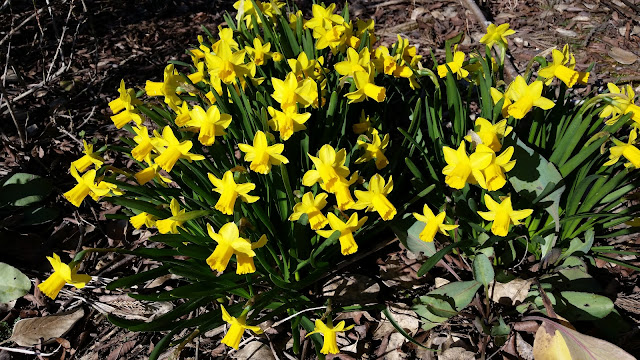
Perhaps symbolizing the state of the pandemic, there are signs of spring in the south. The bulbs are blooming in my garden. Rainy weather has kept me from making pictures in the last few days, but here are two from last year at this time. Peace.


Sunday, February 13, 2022


GABRIEL JOHN BATARSEH (1932-2022), R.I.P.


The sad news was released on 9 February of the death of Gabe Batarseh, a mainstay of St. Catherine's Episcopal Church, in Florence SC. Our thoughts and prayers go out to his widow, Lillian, and the family. The good people of St. Catherine's, and the world beyond, will miss his lively presence. I did not know him very well, but I did know him, and every time I visited my daughter, Elizabeth, in Florence, I made my way to talk with him at St. C's. He was full of fascinating information and views of life in the Middle East, and especially Israel where he still had a large extended and important family. He was born in Jaffa which was then (1932) in the British Mandate of Palestine. He had seen a great deal of history and he was eager to share it with me and many others. I am grateful that he shared his thoughts with me. 

Find an informative obituary here .

Friday, February 11, 2022


WHAT'S THE DEAL 

WITH THE SC SUPREME COURT?


A popular comedian of the 1990's, Jerry Seinfeld, was fond of starting his stand-up routines with the question, "What's the deal with...?" This was his lead-in to a moment of hilarity about some absurdity or other of daily life. This is the question I am now asking myself about what is going on with the South Carolina Supreme Court, "What's the deal with the SCSC?" The difference is, this is no laughing matter. A huge amount of highly serious business rests on what the SCSC does in the future. Yet, signs coming from the court make me wonder whether the justices get the deal. They should get the deal; they must get the deal to make this case wind up properly.


First, let's review the basic facts on how we got to where we are:

---in 2017, the SCSC issued an opinion holding that 1) 28 of the 36 parishes in question were property of the Episcopal Church, 2) 8 of the parishes owned their own property, and 3) Camp St. Christopher belonged to the Episcopal diocese. The majority of justices also agreed that the Episcopal Church was hierarchical and the Episcopal diocese was the heir of the pre-schism diocese.

---the 2017 decision became the final law after the SCSC denied a rehearing and the U.S. Supreme Court denied cert.

---in November of 2017, the SCSC issued a Remittitur Order to the circuit court (a remittitur is a direction to implement a decision).

---in a separate case, the U.S. District Court, in Charleston, ruled in 2019 that the Episcopal Church was hierarchical and that the Episcopal diocese was the only legal heir of the historic diocese. Judge Gergel issued an Injunction barring the breakaway contingent from claiming to be the historic diocese. This decision is now on appeal with the U.S. Court of Appeals, in Richmond.

---in 2020, circuit court judge Dickson issue an order that all local properties belonged to the local churches and the Camp belonged to the Anglican diocese.

---in 2020, the Episcopal Church and its local diocese filed an appeal of Dickson's order with the SC Supreme Court.

---on Dec. 8, 2021, the SC Supreme Court held a hearing on the appeal.

---on Feb. 3, 2022, the Court requested, unless a party objected, the text of the 1987 journal of the diocesan convention that showed the diocesan adoption of a Canon declaring that all property was held in trust for the Episcopal Church and its diocese.


Thus, what the SCSC justices have on their desks at this moment is TEC's appeal of Judge Dickson's Order of 2020.

As I see it, they have 3 choices:

1-Affirm all of Dickson's order.

2-Deny all of Dickson's order.

3-Affirm and/or deny parts of Dickson's order.

If they affirm all of Dickson's order, they would be rejecting the set law of the SCSC decision of 2017. If they deny Dickson's order, they would be upholding the 2017 decision. Picking out parts of Dickson to affirm and parts to deny would be problematical since there is no plausible way to divide the assets in question. Either the Episcopal Church or the breakways own the properties. It would not make sense to give part(s) to one and part(s) to another.

From my view, what the SCSC justices should not do is to re-litigate the issues that were settled in the 2017 decision. That decision clearly spelled out three majority decisions of the high court. Any claim that the SCSC published opinion of 2017 was indecisive is disingenuous. It is as clear as can be.

This is what was so bothersome about the Dec. 8 hearing. Some justices spent a good deal of time musing over whether certain parishes had acceded to the Dennis Canon when that had been settled in 2017.

Whether a parish acceded to the Dennis Canon is not the issue before the court. It is irrelevant. The issue now is whether to affirm or deny the Dickson order. Dickson directly contradicted the majority of the state supreme court. The majority had ruled, in a final decree, that 28 parishes had acceded to the Canon. Dickson ruled that no parish had acceded to the Canon and therefore they owned their local properties, and the ADSC owned the Camp.

If re-litigating who owned the property was irrelevant and distracting in the hearing, the justices' seeking documentation on property ownership is also questionable. The issue of the property is no longer open. I do not see how the justices can reopen a closed case. A case finally closed cannot be re-litigated.

As I see it, Judge Dickson had no right to 1-deny a Remittitur that had been issued to him by the state supreme court, and 2-re-litigate the issues that had been settled by the state supreme court. Yet, he apparently did both.

What all this matter boils down to is the integrity of the state court system and the authority of the SC supreme court. A majority opinion of a state supreme court has to be final unless it is reheard or taken up by the U.S. Supreme Court. A lower court cannot be allowed to overrule a final state supreme court decision. If Dickson is affirmed, the precedent would be set that no SC supreme court decision would ever be final and no litigation would ever come to an end. 

Let us reconsider the real issue at stake today. Judging from the chaotic hearing and the strange request for the journal, I am concerned that the SCSC has lost its focus of the case. The South Carolina Supreme Court must deny all of Dickson's order in order to defend the principle of the rule of law in South Carolina. The issue is not whether a parish adhered to the Dennis Canon. The issue is whether the SC supreme court is supreme. We should hope this is what the justices of the SCSC also see as the matter at hand. A great deal rests on it.


Thursday, February 10, 2022


BERT UTSEY RESPONDS TO RUNYAN'S LETTER


On yesterday, February 9, 2022, Bert G. Utsey, III, lead lawyer for the Episcopal Diocese of South Carolina in its appeal before the SC Supreme Court, issued a letter to the SCSC Court Clerk of the Court responding to Alan Runyan's letter of objection dated 8 February. Utsey asked for direction from the court on whether he should present arguments opposing Runyan's claims:

We disagree with Mr. Runyan's position but do not know whether the Court desires additional argument on that topic. Please advise whether the Court would like for us to respond.

Thus the wording of the letter from the Clerk of the Court of February 3, 2022, has set up a peculiar situation. The letter started out, "Unless either party objects..." This was an invitation for one party to object; and it did, obviously the party that had the most to lose by the documentation requested. Does that phrase, and Runyan's objection, now close the court's request?

However, the letter also revealed that the court record included references from both sides about the 1987 journal in the hearing before Judge Dickson of November 26, 2019. So, obviously the journal was an issue raised in the lower court. What the justices of SCSC were asking in their letter of 3 February was the actual content of the journal that had been cited in Dickson's court. This is what Utsey provided and Runyan objected to. Any claim that the 1987 journal was not brought up in earlier court proceedings is manifestly untrue. The SCSC justices know it was mentioned in a hearing of 2019. What they wanted was the specific wording of the journal that is, after all, entirely germane to the issue at hand.

Now, the SCSC will have to decide whether Runyan's objection is sufficient to close the court's request for the 1987 journal (which they now have anyway) or Utsey is allowed to argue against the assertions Runyan made in his letter of objection in hopes of having the court overrule the objection.

This is yet another strange twist in a long, long strangely twisting legal war that never should have happened in the first place.

Stay tuned. We shall see if the SCSC will clarify this mess.

Wednesday, February 9, 2022


ALAN RUNYAN OBJECTS


C. Alan Runyan, lead lawyer for the Anglican Diocese of South Carolina, has officially objected to the submission to the South Carolina Supreme Court of the proceedings of the diocesan convention of 1987. He sent a letter to the SCSC yesterday, 8 February 2022, that was posted on the sccourts website this morning. Runyan concluded:

In summary, the documentation [1987 journal] by counsel for Appellants was: 1) not admitted into evidence and is not in any appellate record; 2) expressly not referenced by Appellants as part of any argument to Judge Dickson to bind any parish; 3) was not an issue on appeal by Appellants of the rulings of Judge Dickson; and 4) the significance, if any, of its presence and then removal 2 years before the Respondents withdrew from TEC was not considered by Judge Goodstein or Judge Dickson on the issue of accession by any parish to a trust. For all these reasons, Plaintiffs-Respondents [ADSC] respectfully object to its consideration in this matter.

Thus, Runyan argues that the 1987 journal was not part of the record of the case and should not be introduced now.

One should wonder at the timing of the objection. Why did not Runyan object immediately instead of waiting until after TEC submitted the requested documentation?

The ADSC's goal in this case is to get the SCSC to affirm Judge Dickson's order that awarded all to the breakaway contingent.

We will see if the Episcopal Church side responds to Runyan's letter of objection.

Much of the discussion in the hearing of last 8 December in the SCSC centered on whether the parishes had acceded to the Dennis Canon. TEC argued that 29 of them had. ADSC countered that none of them had. So, the question of accession to the Dennis Canon is central to the case as framed by the justices two months ago.

Another layer of the case concerns whether the Episcopal Church is hierarchical. The majority of the SCSC justices ruled, in their 2017 opinion, that it was. Federal court judge Richard Gergel declared it was. (Even the Texas supreme court held TEC to be hierarchical as they handed over all to the breakaways.) If TEC is hierarchical, which is the near universal opinion, the national church has authority over the local dioceses and the diocese has authority over the local parishes. 

If the Episcopal Church is hierarchical, the Dennis Canon is effective over all the church. It does not matter if a diocese, or a parish, accedes to the Canon because it is automatic. The Diocese of South Carolina bolstered the Canon when it adopted an explicit version of the Dennis Canon in 1987. The breakaways now claim that the diocese revoked its accession to the canons of the Episcopal Church by vote of the diocesan convention in 2010. If TEC is hierarchical, the diocese had no right to do that and its action was null and void. Likewise, a parish had no right to reject the 1987 canon. 

Thus, if the SCSC justices are now trying to sort out who owns the local properties, it is entirely appropriate for them to consider all the evidence available. Ironically, it was the Anglican side that sought long and hard to get the case back to the SC Supreme Court. They succeeded. Therefore, it rings a bit hollow at this point for the ADSC lawyers to oppose the justices' request for documentation. Of course the material is detrimental to the ADSC side, but it is a bit late to cry foul. 

Monday, February 7, 2022


SURPRISE DEVELOPMENT IN THE CASE BEFORE THE SC SUPREME COURT


There has been a sudden and unexpected development in the case of the Episcopal Church's appeal to the South Carolina Supreme Court of Judge Dickson's order. This may well signal a crucial turn in the attitudes of the justices considering this case.

On last Thursday, 3 February 2022, the Clerk of the Court sent a letter to the lawyers on both sides:

Unless either party objects, the Court would like the parties to provide to the Court the minutes of the 1987 Annual Convention of the Lower Diocese in South Carolina, or any other documentation showing the proceedings of that Convention. Both parties referenced the 1987 Annual Convention and the actions that took place at the Convention at a hearing in front of Judge Dickson on November 26, 2019. See (App. 4911-12; 4956). If the request cannot be fulfilled within ten days of receipt, then the parties should inform the Court of the status of the request.

Thus, the justices of the SCSC sought the original documentation showing that the Diocese of South Carolina had adopted its own version of the Dennis Canon. That Canon, adopted by the national church in 1979, had declared that all local church property was held in trust for the Episcopal Church and its local diocese, and that if a local church left the Episcopal Church, it would forfeit its property to the trustees, the national church and its local diocese.


On today, 7 February 2022, Bert G. Utsey, III, sent an e-mail and a letter to the Clerk of the SCSC Court, providing the requested material. Utsey was the primary attorney representing the Episcopal Church side in the hearing before the SCSC on December 8, 2021. 

Utsey forwarded the entire Journal of the convention meeting of 1987. Pages 90-91 give the proposed resolution on Canon XXVIII of the diocesan constitution and canons. 

Page 91 of the Journal states:

All real and personal property held by and for the benefit of any Parish, Mission, or Congregation is held in trust for the Episcopal Church and the Protestant Episcopal Church in the Diocese of South Carolina. The existence of this trust, however, shall in no way limit the power and Authority of the Parish, Mission, or Congregation existing over such property so long as the particular Parish, Mission or Congregation remain a part of, and subject to, the Episcopal Church and the Protestant Episcopal Church in the Diocese of South Carolina.

This resolution was approved by two-thirds vote of both orders in the meeting.

Thus, the Diocese of South Carolina explicitly adopted a canon recognizing that all local church property was held in trust for the Episcopal Church and the local Episcopal diocese.


The justices' request for the information may well indicate their concern about hierarchy and legal accession to the Episcopal Church's Dennis Canon. If so, this would indicate a shift of the focus from whether a local parish had acceded to the Dennis Canon to whether the entire diocese had acceded to the Canon. Much of the discussion in last December's hearing concerned whether the local churches had actually acceded to the Canon. Justice Few, for instance, spent a great deal of time on this point.


Judge Richard Gergel, a U.S. District judge in Charleston, ruled in 2019 that that Episcopal Church was hierarchical and that the diocese affiliated with the national Episcopal Church remained the one and only legal heir of the historic diocese. He even issued an Injunction forbidding the breakaway contingent from claiming to be in any way the historic diocese. In 2017, the majority of the justices of the SC Supreme Court had also ruled that the Episcopal Church was hierarchical and that the Episcopal Church diocese was the historic diocese. 

If the present SCSC justices agree 1-that the Episcopal Church is hierarchical (the national church has authority over the local dioceses), and 2-that the Diocese of South Carolina adopted its own Dennis Canon in 1987, twenty-five years before the schism, the reasonable conclusion would have to be that the properties of the 29 parishes in question unquestionably belong to the Episcopal Church and the Diocese of South Carolina.

Without jumping to any premature conclusions, one would have to see that the surprise developments of the past few days may very well signal a new focus on the SCSC that would probably improve the chances of the Episcopal Church side. Hierarchy and the Dennis Canon are the aces in the hands of the Church side. Now, it may well be that the justices agree these win the game over the cards played by Goodstein and Dickson. We shall see.


All of the documents above are readily available on the Internet. Go to www.sccourts.org/ACMS/  .  The Appellate Case # is 2020-000986.  

__________________

UPDATE. Feb. 9, a.m.     As of late yesterday, the sccourts website had not posted any response from the Anglican diocese. Note that the letter of 3 Feb. from the Clerk of the Court said "unless either party objects." There has been no word that the Anglican side has objected. Neither has there been any word from them about the contents of the 1987 journal of the convention. The Episcopal Church lawyer submitted the requested material to the Court on 7 Feb., so there is really no need for the Anglican lawyers to respond. Anyway, it is not in the new diocese's interest to show that the Diocese of South Carolina officially incorporated the Dennis Canon in its own constitution and canons long before the schism occurred.

So far there has been no response at all from the Anglican side to the letter of 3 Feb. We shall see what happens within the ten-day window the letter states.

Sunday, January 30, 2022


THE REV. ROB DONEHUE MOVING TO GRACE CATHEDRAL, CHARLESTON


The Grace Church Cathedral annual parish meeting is underway now. The presider, Dean Michael Wright, just announced that the Rev. Rob Donehue will become a new canon of the Grace Cathedral starting on April 1, 2022. He will replace the Rev. Caleb Lee who left last year to become rector of St. Paul's in Wilmington NC. Donehue has been for several years at St. Anne's in Conway. He guided that group of refugees from schism into becoming a parish and moving into a new church home. The people of St. Anne's will certainly miss him greatly. At the same time, the people of Grace will rejoice at the return of their native son.

Wednesday, January 26, 2022


MISINFORMATION CONTINUES


It took a federal court Injunction and two contempt of court findings to make the officials of the breakaway contingent stop claiming to be the historic diocese of South Carolina. So, it strikes me that today's e-newsletter from the Anglican Diocese of South Carolina continues on in the traditional vein of misinformation coming out of that organization. Several points caught my eye in today's letter.

In the first place, the letter states that Mark Lawrence was consecrated bishop on January 26, 2008. It is true that he was consecrated a bishop at that time. However, the clear implication is that Lawrence was made bishop of the present Anglican diocese of SC. This is wrong. 

In 2008, Lawrence was consecrated bishop of the Episcopal Diocese of South Carolina, aka the Diocese of South Carolina. This diocese was, and still is, part and parcel of the Episcopal Church. He verbally and publicly renounced his association with the Episcopal Church in November of 2012 and on Dec. 5, 2012, the Presiding Bishop of the Episcopal Church issued a formal Release and Removal to Lawrence removing him as bishop of the Diocese of South Carolina. The majority of the clergy and laity of the DSC left the Episcopal Church in October and November of 2012. They formed a new diocese that is now called the Anglican Diocese of South Carolina. Is is entirely and wholly separate from the Diocese of South Carolina which continues on in the Episcopal Church. If the majority of the people who left the Diocese of South Carolina recognized Lawrence as their bishop, they did so on their own, not from the authority of any higher institution. After ADSC joined the Anglican Church in North America, Lawrence was recognized as a member of the College of Bishops of the ACNA.

It would be misleading to claim that Lawrence became bishop of the Anglican Diocese of South Carolina in 2008. He did not. He became "bishop" of the ADSC in 2012 after he left the Episcopal Church. The Anglican Diocese of South Carolina did not exist before 2012; and this has been established by the United States District Court, in Charleston.

The second point may not be calculated. The letter says Edgar will be consecrated "our Diocesan Bishop" on March 12. In fact, Edgar was elected Bishop Coadjutor. He will serve alongside Lawrence. Only when Lawrence retires will Edgar become the diocesan bishop. That is expected at the end of this year. I suspect this error was just sloppy editing.

Another thing that amazes me is all this business about contributing to a "Bishop's Purse" for Lawrence. Has anyone paid attention to how much Lawrence has raked in during these fourteen years? His salary and benefits come to around a quarter of a million dollars a year. Moreover, he has had virtual free use of the multi-million dollar bishop's residence on Smith Street. If you add the value of this housing, the value of his yearly income would be around a third of a million dollars a year. Presumably he would entitled to receive other income as retirement in  the Episcopal Church system and Social Security.   

Lawrence's tenure has been quite expensive for his followers. They are paying two sets of lawyers, one for the diocese and one for the local parish. God only knows how much this schism and epic litigation has cost the trusting faithful of the ADSC. Now, on top of this, to ask them to hand over even more money to a man whom they have maintained most generously strikes me as between insensitive and shamelessly materialistic.

Thursday, January 20, 2022


NOTES,  20 JANUARY 2022


Greetings, on Thursday, January 20, 2022. My favorite photo from last year summarizes my feelings right now:


I'm a grumpy old man. I am cold and tired. But, darn it, I am here, mask on, social distancing, and doing what I am supposed to do and doing it with the snazziest mittens! As Bernie Sanders at Biden's inauguration, we keep on doing what we know we should do because we would not want it any other way, and if we can do it with a little pizzazz, so much the better.

Let's check in on the subjects we have been following of late.


PANDEMIC. If one looks at the charts, as this one , one sees we are in the fourth great surge of the COVID-19 pandemic. In terms of spread, this one is by far the worst. The trend is skyrocketing. To see this present explosive spread, let us compare the last two ten-day periods using Worldometers' data.


The world. New cases: 19,476,410 (Jan. 1-10); 32,021,300 (Jan. 10-20).

New deaths: 52,227 (Jan. 1-10); 78,478 (Jan. 10-20).


The United States. New cases: 5,566,530 (Jan. 1-10); 8,545,320 (Jan. 10-20).

New deaths: 12,451 (Jan. 1-10); 14,208 (Jan. 10-20).


South Carolina. New cases: 72,931 (Jan. 1-10); 188,480 (Jan. 10-20).

New deaths: 110 (Jan. 1-10); 283 (Jan. 10-20).


Alabama. New cases: 82,116 (Jan. 1-10); 109,638 (Jan. 10-20).

New deaths: 169 (Jan. 1-10); 132 (Jan. 10-20).


Charleston County. New cases: 7,286 (Jan. 1-10); 14,852 (Jan. 10-20).


These figures show sharp rises in almost every category. Notice especially the enormous jumps in the spread of Covid in South Carolina and Charleston. The rate of infections more than doubled in these two ten-day periods. As we know, the Omicron variant is highly contagious, and the data bear this out. Covid is now spreading as wildfire; and we are still in the depths of winter with another two months to go before spring. There is no reason to think this fourth surge is going to end anytime soon. Meanwhile, only about half the people in SC (53%) and AL (48%) are fully vaccinated.

The world has been in the grips of this plague for two years now. How much longer and how many more variants will appear is anyone's guess. Nevertheless, we have no choice but to keep up the good fight for the foreseeable future. This microscopic virus is a most persistent bug. It has already killed more than 5 million people worldwide including nearly 900,000 in the U.S. We will get through this, but I am afraid there is much more suffering and loss to come.

The federal government is now offering four free Covid tests, to be mailed to your address. Find the site for this here .


SCHISM. Not surprisingly, there is no word yet from the SC Supreme Court. Let's not hold our breaths on this. The last time, it took the justices 22 months to issue their written opinion.

Meanwhile, both dioceses that came out of the break are forging ahead even in the dark days of Covid. The new Anglican diocese is set to have its annual convention on March 11, at St. James's, on James Island. On March 12, Chip Edgar is to be consecrated the bishop coadjutor of the ADSC at the Cathedral of St. Luke and St. Paul, Charleston. When Mark Lawrence retires, supposedly at the end of this year, Edgar will take over as the II diocesan bishop of ADSC. He will face a host of major challenges, to say the least. The very independent existence of the entity that withdrew from TEC is in doubt.


THE ADVENT. The scene at the Episcopal Cathedral Church of the Advent, in Birmingham, has been quiet of late. Today, the search committee, for the new dean, issued a letter promising they were making progress. They said they had 51 candidates originally and were now winnowing. Meanwhile, the Interim Dean, Craig Smalley, is doing an admirable job keeping tensions down and the parish together even as the previous dean is busy building a new non-Episcopal church in Birmingham.


Let's face it. We are in a hard time that just does not want to stop. However, as a student of history, I can assure you this is small potatoes compared with some of the enormous challenges of the public health catastrophes of the past (think Black Death in the 14th Century) even if that does not make us feel any better right now. People have survived worst than Covid; we can survive too, and not only survive but thrive in some ways, e.g. the upward boost of wages in the U.S. along with an unprecedented abundance of jobs. So, like Bernie, let's bundle up, put on our masks, and make our defiant stands, with verve, against the slings and arrows (and deadly viruses) that life throws against us. Peace.   

Monday, January 17, 2022


MUSINGS ON MLK DAY


Today is Martin Luther King Day, a federal holiday in the United States. This puts me in a reflective mood because racism was fundamental in the world in which I grew up. You see, I grew up in the Jim Crow south. Any native southerner of my age can tell you all about how pervasive racism was then; and if you did not live through it, you really cannot know now just how important racism was to life in the south.

Looking back on growing up in Pensacola, Florida, in the 1940s and 50s I marvel at how stoic were the "coloreds," as African Americans were called then in polite company (the "n" word was usually reserved for private conversations). The discrimination was embedded deeply all around us. When my wife Sandy first got her drivers license, this must have been in the late 1950s, she decided on a whim to take her maid, whom she loved, to McDonalds for lunch. The maid knew what was going to happen but she said not a word. They stopped and Sandy went to the counter to get the food to take back to the car (no inside dining in those days). Back in the car, the manager came out and told them they would have to leave because they did not serve "coloreds" there. Sandy was mortified with embarrassment but the maid was not. She said to Sandy, "Don't fret, honey child, I am used to it." That little incident changed Sandy's life. It brought home the inexcusable unfairness of racism.

I did not need any such jolt myself as I saw the awful racism all around me every day. The city bus had a sign painted over the driver, "Whites sit from front to rear, coloreds sit from rear to front." If there was any question, the "colored" person gave up the seat. The railroad car had a partition behind which "coloreds" had to sit. There were two waiting rooms in every station. No black person could sit at the luncheon counters. If they wanted anything, they had to stand at the end of the counter, order, pay, and take the food off. It seemed that everything imaginable was separated with the "coloreds" getting the short end. It was humiliating.


The Saenger Theater in Pensacola, about 1938. The Saenger was the premier movie house in town. The Colored Entrance was on the side of the building. "Colored" customers had to climb an outside staircase to sit in the balcony where they were confined. This entrance was removed in the 1960's but the last time I checked the staircase was still there. There were theaters on Palafox Street which did not admit "coloreds" at all.

It would take a book to describe all the aspects of daily life under Jim Crow. Looking back now, racism was unbelievably pervasive in society and culture. And, the mindset was just as present in my family's church as anywhere else. So, I grew up assuming this was the way it was everywhere, that is, until I was in the Sixth Grade. Most of my little friends were like me, in families that had come from rural northwest Florida, Alabama, Georgia, Mississippi. Racism was a given among these people. However, I always had classmates whose fathers were in the Navy (armed forces were integrated in 1948) and they told me about the wonders of the world in exotic places as Hawaii, the Philippines, Guam and the sort. In the Sixth Grade, a bunch of us were sitting in the cafeteria having lunch and the subject of "coloreds" going to school with us came up. A Navy girl said loudly, "Well, why shouldn't they go to school with us?" We all fell silent. No one had an answer. That started me to thinking that she had a point and we ought to change our ways for the sake of fairness. I have forgotten the girl's name but I never forgot the impact she had on me.

Racism is still with us, unfortunately. For instance, Alabama is now in an election campaign for governor and senator. George Wallace may be gone, but what he represented is not far below the surface. It seems that the candidates are vying with each other to denounce "critical race theory" curriculum even though it has never been in the schools. This is thinly veiled racism. Moreover, all sorts of laws have been passed to restrict voting. In Jim Crow, it was practically impossible for blacks to vote.

So, MLK day is always bitter sweet for me. Too much of the awful anti-Christian and anti-democratic racism of the old days is still with us, and not just in the south. Yet, I can promise you what we have now is very, very far removed from what we had under Jim Crow. We have progressed light years; and if you have trouble believing that, talk with a southerner of my age and learn what daily life was like before 1960.

As I keep saying on this blog, America had a great democratic revolution after the Second World War and that revolution is still going on. What we are seeing now is the clash between that revolution and the people, mostly white men, who feel threatened by it all. Judging from what has happened in my lifetime, I would say democracy will win out, but it will be far from easy. It will win because of brave people like the Rev. Dr. Martin Luther King, Jr. and the countless good people who also gave their lives to improve life for their fellow human beings. I am also remembering today Blessed Jonathan Daniels, the patron saint of the Episcopal dioceses in Alabama.  

Thursday, January 13, 2022


ACNA BISHOPS APPROVE EDGAR AS BISHOP OF ADSC


The bishops of the Anglican Church in North America, meeting on January 12, 2022, in Melbourne, Florida, approved the election of Chip Edgar as the bishop coadjutor of the Anglican Diocese of South Carolina. The vote totals were not revealed, but the ACNA rules require a 2/3 vote of the bishops to approve an election of a new bishop. The ACNA is an authoritarian institution in which power is controlled by the (all male) bishops. As opposed to the Episcopal Church, the diocesan standing committees have no say in approving a new bishop. In TEC a simple majority vote of bishops and standing committees approves new bishops. 

Edgar was elected by an election convention of the ADSC on October 16, 2021, at Christ Church, Mt. Pleasant SC. He was the dean of the cathedral church of the ACNA Diocese of the Carolinas, in Columbia SC. Edgar had never been a clergyman in the ADSC. He was chosen over two internal candidates.

He is to be ordained and consecrated bishop coadjutor of the ADSC on March 12, 2022, at the Cathedral of St. Luke and St. Paul, in Charleston.

Find the ACNA article about yesterday's action here .

Mark Lawrence is expected to retire as diocesan bishop of ADSC at the end of this year. With that, Edgar will become the diocesan bishop.

Lawrence was released and removed as bishop of the Diocese of South Carolina by the Presiding Bishop on Dec. 5, 2012 after he had publicly announced his departure from the Episcopal Church. Meanwhile he was recognized as bishop by the people of the new diocese which later took the name Anglican Diocese of South Carolina. The new diocese joined the Anglican Church in North America. Edgar will become the II bishop of the ADSC. 

A federal court injunction forbids the breakaway contingent from claiming to be in any way the historic Diocese of South Carolina. All of the historic titles and emblems are reserved for the ongoing Diocese of South Carolina which is part of the Episcopal Church.

There has been some speculation that Edgar's election may well signal the union of two ACNA dioceses in the lowcountry, the Diocese of the Carolinas, led by Steve Wood, and the Anglican Diocese of South Carolina.