Sunday, May 22, 2016


EIGHT MONTHS


We are all anxiously awaiting the South Carolina Supreme Court ruling in the Episcopal Church case. Steve Skardon recently reminded us of this in his posting of May 18 at www.scepiscopalians.com .


Tomorrow, May 23, marks eight months since the hearing of the Church case in the South Carolina Supreme Court (Sept. 23, 2015). Six months is the average length of time between hearing and written decision in that court. Six months is average, meaning many cases run much longer. I have seen written decisions as much as 13 months after the hearing. Given the size and complexity of this particular case, it could even be more than 13 months to get a decision.


The justices take a break from hearings in the months of July and August. However, the court continues to issue written decisions in that time. Last year, more decisions were handed down in July (18) than in another other month. August had the next highest at 13. In short, there is no way to predict when the court will publish its decision on the Episcopal Church case.


Several factors make me think this will be a protracted wait. In the first place, the case before the state supreme court is an appeal of a circuit court decision, Judge Goodstein's "Final Order" of Feb. 3, 2015. First and foremost, the high court will have to address that Order. As we have seen, the justices all but threw Goodstein's Order out the window in the hearing of Sept. 23. Chief Justice Toal and Justice Hearn demolished it on both procedures in the trial and findings in the Order. Not one other justice arose to defend Goodstein's Order. By all appearances, it is dead.


I imagine if the court were going to affirm Goodstein, they would have done so already. Too, if they were ordering the case remanded to her for retrial on certain directions, they probably would have done that too. My guess is the court is following TEC's request of acting de novo, or making a whole new decision. That will require a great deal of time. If the court is split, the minority will be allowed to publish a dissenting opinion either as a group or individually. They have to be allowed time to do this.


In all probability, the justices made their decision in this case in early October of 2015, around two weeks after the hearing. Then, the real work began of writing the majority and minority opinions. No doubt the clerks and the justices will spend a great deal of time on this particular case. My guess is that former Chief Justice Toal will dominate this process as she did the hearing. After all, she has a big stake in this protecting her 2009 All Saints decision.


The circuit court trial in July of 2014 produced a colossal amount of recorded material. The trial lasted 14 days. The transcript ran to 2,523 pages. 61 witnesses took the stand. A whopping 1,342 pieces of written evidence were officially entered into the trial record, some running to hundreds of pages. The total number of pages of all the evidence would run into many thousands, I would guess at least 20,000. This is an enormous amount of material to reexamine. It was by far the largest court proceeding in the nation in any one of the five cases where the majority of a diocese voted to secede from the Episcopal Church.


Too, this case deals with some extremely important and fundamental issues of American constitutional and local law. First of all is the First Amendment requirement of the separation of church and state. A government court is absolutely forbidden from interfering in the internal structure of a religious institution. The basic question here: Is the Episcopal Church hierarchical or congregational in nature? TEC claims hierarchy. DSC claims the opposite. Goodstein ruled very clearly that TEC is congregational. The vast majority of courts have ruled that TEC is hierarchical.


If the Court is going to rule de novo, it has to decide some complicated and difficult issues. For starters, the justices will have to decide whether Goodstein conducted a fair trial, followed neutral principles properly, and arrived at reasonable and justifiable conclusions. In my view, Goodstein did none of this, and I suspect the justices have the same view. Then, a huge factor hanging over the court is its own 2009 All Saints decision. In that, written by Chief Justice Toal, the Court ruled that All Saints parish had legally separated itself from the diocese and that the Dennis Canon could not be applied in this case because the diocese had given the deed to the parish long before the Dennis Canon and the deed holder (the parish) had not made a trust for the diocese or national Church as required by state law. SC law required a deed holder to establish a trust; a trust could not be created by an external interest, only by the title holder. In the new case, the Court must decide on the relationship between the Church and the diocese as well as the function of the Dennis Canon. To be consistent, the Court will have to say that any parish holding its own deed before the Dennis Canon in 1979 and not establishing a trust for the diocese/national Church must be allowed to keep its own property, just as All Saints did. The most perplexing problem for the Court will be to figure out the legal relationship between the Episcopal Church and the Diocese. To say the least, this will not be easy, but it must be done.


South Carolina is the first state in the nation in which the state supreme court is deciding on the legal ties of Church and diocese. There is no precedent for the justices to follow. Of the five cases of seceding dioceses, two (Pittsburgh and Quincy) cases went to state supreme court only to be rejected in favor of lower court rulings. One other, San Joaquin, is now on appeal to the California supreme court, but it is unlikely that court will agree to accept it. The state supreme court that came closest to a decision was Texas.


In 2011, a local state court issued a decision entirely in favor of the Episcopal Church diocese of Fort Worth. The judge found the Church to be hierarchical and the diocese to be subordinate to Church law. This was the opposite of Goodstein's 2015 decision. The breakaway diocese appealed directly to the Texas state supreme court that agreed to take the appeal. That court held a hearing on 16 October 2012 and issued a written decision on 30 August 2013. That is ten and a half months between hearing and written decision (in SC this would put the written decision in early August 2016).


The Texas case took a long time, even though it was a much simpler matter involving a much smaller proceeding. The TX supreme court split 5-4. The majority issued a 13-page order overturning the lower court decision and remanding the case to the lower court for new proceeding under neutral principles. The majority decision was contradictory. It said a diocese had to accede to TEC's Constitution and Canons then said a diocese was free to organize as a separate corporation under state law free to govern itself. Thus, state property law would trump the accession. In a strange twist, the majority said the diocese could revoke the Dennis Canon because there was no provision in the Canon preventing it from being revoked. Under this pretzel logic, any provision of a contract could be thrown out at will by one party unless there were an explicit clause in the provision that it could not be revoked. This is strict construction in the extreme and strains common sense. The whole idea of a contract is to bind two parties together in a legal arrangement that cannot be revoked by one party alone. The irrevocable nature does not have to be expressly written in the contract; it exists in the very form of the contract. The majority directed the lower court to rehear the case under guidelines favorable to the secessionist side. The minority of four justices wrote a dissenting opinion, of 15 pages, holding that the case was not appealable to the state supreme court. This, of course, questioned the motives of why the majority would take the case in the first place.


The case went back to the lower court where the same judge issued a terse one-page decision reversing his first judgment. His last sentence practically called for an appeal. Sure enough, the Church side appealed to the state court of appeals. The recent hearing there showed some leaning toward the Church side, but one cannot tell at this point how this case will wind up.


The point for SC is that Texas does not provide a guideline. In fact, not one of the four other examples of secession have been decided in a state supreme court.


In the end, the SC supreme court has to be mindful of the significance of its work. This decision will define for the nation the relationship between Church and diocese until and unless it is overturned by the court above it, the U.S. Supreme Court. It will tell us whether a diocese has the right to secede from the Episcopal Church and keep the legal rights and property of the old diocese. This is not a question of religious freedom. Anyone can leave any denomination. The question is whether a group can leave and take with them the rights and assets of the previous arrangement.


Here are my best guesses on what has happened/is happening:
---the SC supreme court discarded Goodstein's Order
---the Court is writing a new decision
---the longer this goes on the more it favors the Church side
---the longer this goes on, the more it indicates a split decision with long, different opinions being written by the two sides
---former Chief Justice Toal has dominating the decision
---we are in for a long wait


Saturday, May 14, 2016


EPISCOPAL CHURCH WINS
IN SAN JOAQUIN, 4th Edition (14 May)


Original post, April 6:     The Episcopal Church Diocese of San Joaquin has completely prevailed in the California Fifth District Court of Appeals. The court handed down its decision on April 5. See the posting of March 3, "San Joaquin Hearing in Appeals Court, March 9."
The Anglican Diocese of San Joaquin appealed a lower court decision.

The appeals court affirmed the lower court's finding, particularly that the Episcopal Church is hierarchical.

The defendants have 30 days to ask for a rehearing. Afterwards they may appeal to the California Supreme Court.

See the article at the Episcopal Café website.


With this decision, the Episcopal Church has won the court contests in California between the competing dioceses. If the defendants appeal, there is little likelihood they will reverse the heavy weight of the body of opinion already entered by the California courts.

I will return soon with more thoughts on the April 5 decision.


SECOND EDITION, April 10:     For background, see the post of January 1, 2016, "Episcopal Diocese of San Joaquin---Court Victory at Hand."


Thoughts on the April 5, 2016, decision of the Appeals Court. Here are what I see as the most important points of this decision vis à vis South Carolina:


1-The CA court applied neutral principles and found all in favor of the Episcopal Church, and without getting involved in the internal matters of the Church. Obviously this means following neutral principles does not necessarily help the secessionist party.


2-The court issued its opinion "de novo." This is something the TEC lawyers asked the SC supreme court to do, rather than remanding to the lower court.


3-The decision said, as all California courts have consistently ruled, the Episcopal Church is hierarchical. A diocese must accede to the Constitution and Canons of the Episcopal Church. The Church is governed by the General Convention. The court ruled this although they followed neutral principles. Thus, in SC the justices could both follow neutral principles and judge TEC to be hierarchical.
The secessionist lawyers in SC argued that the diocese was always an autonomous and self-governing unit and free to disregard the Episcopal Church at will and to disassociate from TEC. The CA appeals judges directly rejected this argument in their view of hierarchy.


4-The appellate judges said the Quincy case, in Illinois, had no bearing on the case in California. The Anglican side had argued that the Quincy case set the standard for the whole country to follow. The Illinois state courts had ruled entirely in favor of the schismatic diocese and against TEC. The CA appeals court said the Quincy case involved Illinois law only and had no bearing on California law. It stands to reason the SC justices could follow the same view, that state law in one state is not necessarily applicable to another state. This kills a primary argument on the secessionist side, that the pro-schismatic Quincy decision set the precedent for the nation.


5-The CA courts ruled that Schofield was subject to TEC's Constitution and Canons, and once inhibited (Jan. 11, 2008) and deposed (Mar. 12, 2008), he had no right to act as the bishop of the diocese. All official acts of his after then were ultra vires, that is, illegal.
This is a problem for TEC in the SC case. The most controversial actions, Mark Lawrence's issuance of the quit claim deeds, occurred while he was the legal bishop of the Episcopal Church diocese. They also occurred after the diocesan convention had voted to end accession to the canons (but not the constitution) of TEC. Thus, whether Lawrence had the authority to do what he did is a problematical issue, as Chief Justice Toal expressed so well in the Sept. 23 hearing. San Joaquin was a simple case; Schofield had no authority after his removal when he tried to retitle the properties.
This will all return to the question of whether the Episcopal Church is hierarchical. If the SC justices rule it is, then they can judge the unilateral diocesan and bishop's actions to be in violation of TEC's C and C and therefore to be ultra vires. CA courts consistently ruled TEC to be hierarchical.


What happens next?
The Anglican Diocese of San Joaquin has 30 days to request a rehearing in the appeals court. To get this, they would have make a compelling case that something earlier was in error. After 30 days, ADSJ may appeal to the CA supreme court. Again, to get that court to take the case, they would have to make a good argument for review. It is unlikely either the appeals court or the state supreme court will take up this case again since it has been heard four times in CA state courts already and every outcome was virtually the same, completely in favor of the Episcopal Church and diocese. 
A stay is in place now freezing most of the properties and assets in the hands of the Anglican side. If they do not appeal, or if the high courts refuse to accept the appeals, the Anglican side will have to hand over the properties and assets forthwith to the Episcopal diocese.
On April 5, in announcing the appeals court decision, the Anglican diocese made no comment about what it would do next. They have until May 5 to do so.


What direct effects will the San Joaquin judgment have on South Carolina? It is hard to tell coming as late in the SC matter as it does. The hearing in SC was last September 23. As a usual practice, the justices meet in a couple of weeks afterwards and arrive at a choice by majority vote. Then one in the majority writes a decision for publication but all justices in the majority may have input. This may take awhile. Also, the dissenting justice or justices, if any, have the right to issue their separate opinions. This also takes time. Only after all the justices are satisfied with the finality of the written decision are they released to the public. No doubt this is where the SC supreme court is now, in the composition stage. This case is very large, complicated, and important. Surely the justices will be in no rush and will want to get it right. They know the significance of this decision, on SC and on the country. The California court cases may have some bearing on the final written orders, but I imagine the SC decision in the Church case was made months ago.


State court decisions in the issue of the relationship of Episcopal Church and the dioceses are all over the place. Pennsylvania and California were entirely favorable to the Episcopal Church side. They are probably settled for good. On the other end of the spectrum, the Diocese of Quincy case, in Illinois, was entirely in favor of the secessionist diocese and against the Church. Fort Worth has been mixed, but is still in the works and appears to be leaning to the schismatic diocese. This leaves South Carolina in an even more important place as, in a sense, the decider. It will be the first time a state supreme court will rule on this issue.


THIRD EDITION (April 21):  On 20 April, the Anglican Diocese of San Joaquin filed a "Petition for Rehearing" with the CA Fifth District Court of Appeals on the grounds the lower court did not follow neutral principles properly.


FOURTH EDITION (May 14):  On May 4, the Appeals Court denied the Anglican diocese's petition for a rehearing. On May 13, ADSJ filed a petition with the California Supreme Court on appeal of Judge Black's 2014 order deciding all in favor of the Episcopal Church side. The supreme court has until July 14 to announce whether it will accept the petition. If it refuses, Black's decision will be left standing as the law and ADSJ will have to turn over all rights and assets to the Episcopal diocese. It is unlikely the state supreme court will take the case that has already been rejected by the appeals court. Regarding Episcopal Church cases in the state, the CA Supreme Court has ruled time and again in favor of the Church diocese. 
  

Thursday, May 12, 2016


MY GARDEN, May 11, 2016


On April 9 and 23, I posted photos of my botanical garden. We are continuing to enjoy a beautiful springtime in the South. Now, in early May, the roses are in full bloom. They are the stars of the garden. Although they flower all the way until frost, usually in early November, they are never as full, lush, and colorful as in early May. I have numerous kinds of roses, but not many of the cultivated hybrid varieties. These require a great deal of care and really do not thrive otherwise in the hot and humid South where they are susceptible to all sorts of diseases, as black spot. In my opinion, the best rose garden in the world is in Portland, Oregon, the home of the American Rose Society. A couple of years ago, I spent five days on the train to get there. I enjoyed the ride (I am also a train enthusiast, also called a "foamer"--- one who foams at the mouth at the sight of a train), but was really blown away by the unbelievably spectacular and vast rose garden atop a high hill overlooking Portland. All gardeners should have it on their bucket lists. Take Amtrak's California Zephyr from Chicago to Sacramento, then Coast Starlight to Portland.

Here is some of what is in bloom in my garden now:


Red Knock Out Roses edge the central lawn. The two uprights are Italian Cypress. Behind them are two clumps of Japanese Silver Grass (Miscanthus sinesis condensatus "Cabaret'). The large tree is elm.


Red Knock Out Roses. Louisiana Palmetto. Grass on right is Zebra Grass (Miscanthus sinesis 'Zebrinus').

Spirea is one of the best families of shrubs for the South. Right now they rival the roses in color. This one is Spirea japonica 'Anthony Waterer.' I have more than a dozen kinds of spirea placed around the garden.

In the smaller garden, looking toward the central lawn. Japanese Silver Grass. Tall uprights are Italian Cypress. Ground cover on left is Japanese Garden Juniper (Juniperus procumbers 'Nana').

A hidden refuge in the larger part of the garden. Delightful, especially in early morning and late afternoon.

 Along the edge of that seating area is Rose "Coral Drift," a shrub rose.

Along the lawn on the larger side of the garden. The uprights are Skyrocket Junipers.

A spreading groundcover rose, Each bloom is about an inch across.

Among the other plants in full flower now, the most eye-catching is Clematis 'Polish Spirit.'

Now is the time to enjoy the beauty of the living things all around you. March, April and May are the best months for gardens in the South. June and July will bring the intense sun, heat, and humidity that put so many plants to the test (not to mention people).


Tuesday, May 10, 2016


THE ANGLICAN CONSULTATIVE COUNCIL AND THE 'CONSEQUENCES'


The Anglican world is in a bit of a turmoil now about what the recent Anglican Consultative Council did and did not do regarding the "consequences" imposed on the American Episcopal Church (TEC) by the January gathering of the Anglican primates at Canterbury.

Mary Frances Schjonberg has summarized it well in her post yesterday "Group of ACC Members, Secretary General Dispute Meaning of Resolution," http://episcopaldigitalnetwork.com/ens/2016/05/09/group-of-acc-members-secretary-general . Everyone should read this.

The problem boils down to whether or not the ACC supported the primates' punishment of TEC. It seems perfectly clear to me they did not.

On January 27 I posted a note "Chaos in the Anglican Communion" pointing out the confusion resulting from the vote in the primates' meeting to impose "consequences" on TEC.

On April 11 I made a post "The Collapse of the Anti-Episcopal Church Movement in the Anglican Communion" showing how the AC as a whole had rejected the GAFCON move to replace TEC with the Anglican Church in North America as the legitimate Anglican province in the U.S.

On April 16 I posted an article "Breaking News--Anglican Consultative Council Rejects Primates' 'Consequences.'" This brings us to the crux of the problem today. In the ACC meeting last month, the delegates accepted Resolution C34 which was the Archbishop of Canterbury's report on the primates' gathering in January. Then, Resolution C35 was withdrawn. That resolution would have endorsed the "consequences." In other words, the ACC accepted delivery of the ABC's report but refused to endorse its treatment of TEC.

It seems to me we are arguing over the meaning of the word "accept." The ACC accepted delivery of the ABC's report but did not accept the conclusions of the report. This leaves both sides to claim a different interpretation of what happened. The anti-TEC party can claim the ACC accepted the "consequences." The pro-TEC people may claim the ACC rejected the "consequences."

The second is the actuality. The ACC made it very clear it did not agree with the punishment for TEC. In effect, then, the ACC did not really "accept" the decision of the primates' gathering.

The ACC is not required to "accept" anything of the primates. The Anglican Communion has no central government. It has "Four Instruments of Communion" (1-ABC, 2-primates, 3-ACC, 4-Lambeth conference) that are separate and equal. One Instrument does not have authority over any other one Instrument or over any province of the AC, all of which are independent and self-governing. The ACC was perfectly within its rights to reject an imposition from the primates, or from the ABC for that matter.

The ABC and the General-Secretary are insisting the ACC agreed with the primates' consequences. It seems to me this is stretching the case beyond reality.

See also Steve Skardon's post of May 8, "Welby's Stumbling..." ( Click here.  )

In my view, the bottom line is that the Anglican Communion continues "walking together" as 38 independent churches with widely differing views on homosexuality. It is not a "confessional" church that demands one "orthodox" position to the exclusion of all others. The ACC made this abundantly clear in its acceptance and non-acceptance of the ABC's report last month. The fact that 35 of the 38 provinces of the AC were present at the ACC and in full agreement should end the confusion.

The Episcopal Church prevailed in the Anglican Communion. The GAFCON/ACNA side collapsed.   

Sunday, May 1, 2016


TEN REASONS
 WHY THE DIOCESE OF SOUTH CAROLINA SHOULD RETURN
 TO THE EPISCOPAL CHURCH


The independent Diocese of South Carolina (DSC) is now in "discernment" about affiliation. Most of the leadership and communicants left the Episcopal Church (TEC) in 2012 then announced an unclear oversight scheme with some of the primates of Global South. Now the independent diocese is considering whether to join the Anglican Church in North America. The diocese should not join the ACNA. It should return home to the Episcopal Church. Here are ten reasons why:


1---SCHISMS AND LAWSUITS ARE UNCHRISTIAN.

A schism is a man-made and willful rupture in the Body of Christ. DSC made a schism in 2012 against TEC. Lawsuits of Christians against Christians are scandals and should be avoided according to St. Paul. DSC sued TEC in state court in January of 2013. DSC acted wrongly in both cases. DSC can now make it right.


2---MOST CONSERVATIVE EPISCOPALIANS HAVE REMAINED IN TEC.

DSC was one of 12 ultra-conservative dioceses in TEC. Ultra-conservatives were those who refused to accept the legitimacy of TEC's reforms for the equality of women and homosexuals. About a third of TEC was conservative, that is, in opposition to the reforms but eventually accepting of them. The "ultras" were about a third on the far right of the conservatives. The dozen ultra dioceses formed the Anglican Communion Network in January of 2004 and demanded alternative primatial oversight. Five of the 12 make schisms against TEC (San Joaquin, Pittsburgh, Fort Worth, Quincy, and South Carolina). The majority of the ultras remained in TEC: Central Florida, Springfield, Dallas, Albany, Northern Indiana, Rio Grande, and Western Kansas. If the majority of like-minded Church people could stay in TEC, the minority could too.


3---THE REASONS GIVEN FOR THE SCHISM OF 2012 WERE NOT VALID.

DSC leaders gave misleading reasons to their followers to justify their decisions to break away from TEC. They said TEC had abandoned orthodox Christianity by denying the uniqueness of Christ and turning against Holy Scriptures. In truth, the General Convention of TEC has never done any such thing and never would. In actuality, the DSC leaders took the remarks of certain leaders of TEC, and took them out of context, as evidence. Classical Anglicanism/Episcopalianism has never been a "confessional" religion with a fixed "orthodox" viewpoint to the exclusion of all others. The assertion of the "ultras" that they were the true Anglicans and the others were in error is itself outside the bounds of Anglicanism. Anglicanism is a broad and tolerant religion balancing differing viewpoints as equally valid. 

DSC leaders opposed the blessings of same-sex unions under the sincerely held belief that God assigned gender. No problem. In 2012, TEC gave option to all dioceses and clergy on whether or not to allow the blessings. DSC was always free to ban the blessings within its own diocese if it wished. The leaders gave the false impression that TEC was cramming down the throats of all communicants the acceptance of homosexuality. In fact, it was a delegate from DSC at the 2012 General Convention who got the GC to accept the local option; and this was repeated in 2015 when GC voted to change the canons to allow same-sex marriage and kept the option. Ironically, it was DSC that was responsible for TEC toleration of all views on homosexuality.

Historical facts show that TEC did not initiate the schism by an "attack" Bishop Lawrence or the DSC. By issuing the quit claim deeds, Lawrence ignored the canons of TEC giving the Church no choice but to charge him with abandonment of the communion. Facts also show the DSC leaders conspired to make a schism from TEC at least several weeks beforehand.

The schism of 2012 was premeditated and unjustified.


4---DSC SHOULD NOT JOIN ACNA.

When digging oneself into a hole, the first rule is to stop digging. Joining ACNA would be digging a bigger hole.

Every communicant of DSC should read the Constitution and Canons of ACNA, available on the ACNA website.

ACNA is a top-heavy authoritarian system that will deprive DSC of much of its freedom. Power is controlled by the archbishop and the College of Bishops. The clergy control every part of the ACNA structure. The laity control nothing.

DSC will lose its freedom to choose its own bishop. DSC can elect a bishop, but he must be confirmed by two-thirds of the ACNA bishops. That means only one-third plus one of the bishops can block any choice. This gives the ACNA bishops virtual dictatorial power over the choice of bishops. A case of this just occurred in Pittsburgh where the convention wanted to choose a local candidate (Millard) but was told he would be rejected by the College of Bishops because he was (gasp) divorced. The convention wound up choosing the one the bishops wanted rather than the one the delegates really wanted. This will happen in DSC too.

ACNA C and C also discriminate against women and homosexuals. DSC might not care about the homosexual part, but the women in DSC should care about how they will be treated. ACNA is a male-controlled regime. Women are excluded from authority. Do the women in DSC really want to be treated as second-class citizens in this day and age?

Another problem with ACNA is that it already has a diocese called the Diocese of the Carolinas under Bishop Steve Wood, rector of St. Andrew's in Mt. Pleasant. No one has yet explained how the DSC is to mesh with the ACNA diocese.


5---TO BE IN THE ANGLICAN COMMUNION, DSC MUST RETURN TO TEC.

TEC is the only province of the Anglican Communion in the United States. When DSC left TEC in 2012 it also left the AC. It remains outside of the AC.

Joining ACNA will not put DSC in the Anglican Communion. ACNA is not in the AC and will never be in the AC. ACNA was created in 2009 by an alliance of anti-homosexual-rights African prelates and anti-homosexual former and present Episcopal bishops in the U.S. GAFCON "recognized" ACNA. The Archbishop of Canterbury and the AC have never recognized the ACNA. In last January's primates' gathering in Canterbury, the GAFCON/Global South primates (the majority of the 38 primates) abandoned the ACNA on the spot. They refused to press for ACNA to be admitted to the AC. In fact, the primates adopted a communiqué stating that should ACNA desire admittance to AC it would have to apply to the Anglican Consultative Council and also stating that ACC should not admit ACNA if they applied. In street parlance, GAFCON threw ACNA under the bus. This abandonment continued in the ACC meeting in Lusaka last month. Only 3 of the 38 provinces boycotted the meeting which treated the American delegates as stars. GAFCON made no mention of the ACNA in that meeting. This virtually guarantees that ACNA will never be in the AC.

ACNA's original goal was to become the replacement church to take the place of TEC in the AC. It is all but certain now that this will never happen. Even most of the conservative prelates who set up ACNA have abandoned it.


6---REUNIFICATION WILL END LITIGATION.

Only God knows how much money has been spent on legal expenses. And, just think of all the good that fortune in money could have done. Everyone knows the litigation has been very expensive. Millions have been spent. For what?

The South Carolina Supreme Court will render a written decision in the foreseeable future. That is not likely to be the end of litigation. There is the possibility of appeal to the U.S. Supreme Court. More millions. The Church side has the insurance program on which to rely but DSC has to pay its own way. It has two sets of lawyers to pay, those for the diocese and those for the 35 individual parishes involved in the lawsuits. Who is paying? That is a good question. DSC keeps its accounts secret. The ordinary DSC communicants-in-the-pews have probably been maxed out on contributions.

Much more than the money is the personal cost of the schism. People have had to leave almost every one of the 70-odd parishes and missions of the old diocese. I cannot tell you the number of e-mails I have received from the sad people who were victims of this needless division. It has been especially hard on the people outside of Charleston who may not have convenient alternatives. The people who made this schism ought to know the harm they have done to so many of the good people of the old diocese for whom they were supposed to be caring. Enough. End the litigation and end the divisions.


7---TEC AND THE EPISCOPAL CHURCH IN SOUTH CAROLINA WANT RECONCILIATION.

They have even offered a compromise in which TEC would give the local deeds to the parishes for the return of the legal rights of the old diocese. The leaders of DSC refused offhand. It is not TEC and its diocese that have blocked reconciliation.


8---RECONCILIATION WILL BE EASY.

In many ways, DSC has kept itself an Episcopal diocese. This is particularly true in form and substance. For instance, only the TEC prayer book may be used in DSC services even though ACNA has a separate prayer book. Although DSC left the institution of TEC, it could not pull itself away from the religion of TEC.

Bishop Mark Lawrence voluntarily left the Episcopal Church by telephone announcement to the presiding bishop on October 17, 2012, retroactive to Oct. 15. Upon his announcements of abandonment of TEC in the special convention of 17 November the presiding bishop accepted Lawrence's renunciation of Holy Orders in TEC and granted him an official Release and Removal on Dec. 5. She "released" Lawrence from his office. Lawrence was not removed by the House of Bishops. He was not "deposed" by the authorities of TEC. This would make it easier for Lawrence to be reconciled with his old Church. Lawrence must think of his legacy. Does he really want to be remembered in history as the bishop of the schism?

Likewise, when Bishop vonRosenberg dealt with the 103 DSC clergy who had abandoned TEC, he granted them a release and removal rather than deposing them. This will make it easier for them to return to the Holy Orders of TEC.

TEC has the door wide open for the return of the clergy and laity of DSC who left TEC.


9---THE EPISCOPAL CHURCH IS THE ANCESTRAL CHURCH OF DSC.

South Carolina was one of the nine founding states that established the Episcopal Church in 1789. SC sent delegates to Philadelphia with the intent that they help draw up the Constitution of the Church and adopt it for SC by signing it. Done. SC has reaffirmed its adoption of the TEC Constitution and Canons numerous times since then.

SC played an important role in the growth and development of TEC in the nineteenth and twentieth centuries. For instance, it was a key backer of the General Theological Seminary in NYC.

SC has had two schisms, both of which were resolved. After the Civil War started, SC helped set up the Episcopal Church in the Confederate States out of necessity. This ended promptly after the War. Again, in 1887, white racists demanded a whites-only diocese and made a schism to get it. The schism ended when the diocesan leaders agreed to keep the black members apart. This wrong-headed segregation ended in the 1950's and 60's when long-suffering African American communicants were fully integrated into the diocese. Since the diocese has worked through its differences twice before, they can do it again.

The Episcopal Church has been the home of the planter-professional-commercial elite of the Lowcountry forever. Many a generation of the old families have been proud to call themselves Episcopalians. Many churches in SC have graveyards filled with these ancestors who must have turned over in their graves in 2012 when their descendants decided to abandon their ancestral church.

DSC has only one home. It is the Episcopal Church.


10---REUNIFIATION WILL RESTORE THE HEALTH OF THE DIOCESE.

The data published by DSC in its annual journals of the convention show that DSC lost a quarter of its communicants in the first two years after the 2012 schism. That was after 10,000 members fled from DSC in the schism.

Decline has been apparently true in all of the five schismatic diocesan cases. For instance, figures show that in Pittsburgh, the old diocese had about 19,000 members. Now the Church diocese has about 10,000 while the breakaway diocese lists about 8,000, some of whom are actually outside the boundaries of the diocese.

Loss of members also means loss of income. Balancing budgets is a problem. This is magnified by the rising cost of the litigation.

The membership and income figures of DSC show ill health. Reunification would restore good health.

Demographic studies show a dim future for DSC. SC society is moving rapidly to full equality and inclusion for homosexual persons. Long ago, SC as well as the rest of American society accepted the principle of equal rights for women. A religion founded on discrimination against gays and women is doomed to decline, even in conservative South Carolina.


It is time for DSC to reconcile with the Episcopal Church. Schism may have seemed like a good idea to most people at the time, but hindsight shows us something else. It was not a good idea. It was not justifiable. It was not necessary. It has broken a one grand and great prime diocese. It has brought immeasurable harm and hardship to many innocent victims. It has divided friends, neighbors, and parishes. It has led to decline, even of its own body. It has accomplished nothing good.

In a broken and hurting world, it is our job as Christians to bring healing, reconciliation, and peace. The best place for that to begin is in South Carolina.

Let us end with a prayer for reconciliation (taken from the ECSC website):

Gracious and loving God of justice and compassion: We pray for your church caught in a crushing schism in South Carolina. We believe that you favor reconciliation in all situations; and we ask you to be with all parties involved in the case...Give all of us strength and courage to act and pray in ways that can lead toward reconciliation. Help us to be agents of your reconciliation with our friends on both sides of this dispute. We ask all this in the Name of the Holy Reconciler. Jesus your Son. Amen. 


Thursday, April 28, 2016


A CAUTIONARY NOTE FOR
THE DSC


The schismatic diocese of South Carolina (DSC) is supposedly in "discernment" about whether to join the Anglican Church in North America. A special convention is expected to be called this autumn to pass the first approval. The second and last vote will come in the regular convention of March 2017. Since the committee on affiliation is recommending joining ACNA, and the committee was personally named by Mark Lawrence, it is a foregone conclusion that DSC will join ACNA. (See my post of March 23, 2016, "South Carolina and the Anglican Church in North America.")

The recent election of a new bishop in the schismatic diocese of Pittsburgh should be a cautionary note for the folks in South Carolina. See the excellent description in EpiscopalCafé: www.episcopalcafe.com/holy-spirit-stirring-in-acna-pittsburgh-diocese/ and the comment of blogger Mark Harris: www.anglicanfuture.blogspot.co.nz/2016/04/let-this-be-sign-unto-youacna-and.html .

On April 23, the Anglican Diocese of Pittsburgh (ADP) (of the Anglican Church in North America, ACNA) held an election for a bishop to replace retiring Robert Duncan. Originally eight candidates were presented but three dropped out leaving five, all from outside the diocese. Another candidate was nominated from the floor, the Rev. Jonathan Millard, a popular rector in the diocese. He was obviously the first choice of the clergy and laity of the diocese, but just before the election, Duncan issued a dire warning to the assembly that Millard might not get approved by the College of Bishops of ACNA because he was divorced. (Ironically Duncan had been elected bishop of Pittsburgh after being nominated from the floor). On the first ballot, Millard led the field with clearly the highest votes in both clergy and laity. The Rev. Jim Hobby, rector of an Anglican church in Thomasville GA, trailed. The same was true on the second ballot as Millard remained the clear favorite among both clergy and laity. On the third ballot, three candidates remained and votes shifted toward Hobby. By the fourth ballot, Hobby was ahead and Millard dropped away. Hobby was elected on the fifth ballot. In the end, the diocesan convention elected a person who was not the leading favorite of the assembly.

Under the Constitution and Canons of ACNA, power is concentrated at the top, in the archbishop and the College of Bishops. A bishop is nominated by election in the diocese but must be approved by a two-thirds vote of the College of Bishops. In TEC, bishops are normally approved by a majority of the Standing Committees of the dioceses. The ACNA C and C also spell out the approval of sexual relations only within a permanent and lifetime matrimonial union of one man and one woman. This sets a very high bar indeed as it would presumably disqualify anyone for bishop who ever had any kind of sexual relations outside of legal, heterosexual marriage as well as divorced men (only men can be bishops in ACNA). Even so, the delegates in Pittsburgh wanted to elect, and almost did elect, a man outside the narrow bounds as laid out in the ACNA C and C.

Before the good people of DSC go headlong into the ACNA, they should be aware of what joining will mean to their selections of their own bishops. They will have to follow out-of-date and very narrow guidelines that will eliminate many good candidates, as Millard. They will also have to submit to near-dictatorial rule of the ACNA hierarchy. A two-thirds vote is tantamount to a veto among the bishops of ACNA. This will leave DSC, as it has ADP, at the mercy of the ACNA archbishop (who alone can convene the College of Bishops) and bishops. DSC will be very highly constricted in whom it can choose as its own bishop. This is a cautionary tale for a "diocese" that for years before the schism of 2012 railed long and hard against the supposed tyranny and dictatorship of the Episcopal Church. In reality, ACNA is far more undemocratic than TEC ever was. DSC may have to learn this the hard way, as the good people of Pittsburgh have just learned.


The schism in Pittsburgh has not gone so well for the planners, not only in the defiant vote mentioned above. State courts ruled entirely in favor of the Episcopal diocese. Some local churches that initially broke away, returned to TEC. The Episcopal diocese now lists 36 local churches and about 10,000 members while the Anglican diocese lists 40 churches and 7,937 members with many in these numbers being beyond the geographical boundaries of the old diocese. 


Saturday, April 23, 2016


MY GARDEN, APRIL 23, 2016


Two weeks ago (April 9), I posted photos of my garden. Since many people appreciated seeing the garden, I am posting more photos showing what is blooming in the garden today, Saturday, 23 April. As any gardener knows, plants change daily, and show off at different times in different ways. This year is providing an unusually beautiful springtime here in the South. As one sees I am fond of trees, shrubs, and perennials. My motto is: "Low Maintenance." One will also see weeds. My philosophy is a garden that does not grow good weeds is not much of a garden. I pull the weeds as I can but do resort to Round-Up although I hate putting poison in my garden.


I hope you enjoy this garden as well as the gardens in different forms all over the place. They are everywhere if one will only look. Every now and then it is best to forget about everything else and just soak in the incredible beauty of God's creation all around us.

 Deutzia (Deutzia gracilis) is an old fashioned Southern favorite shrub. You can see why.

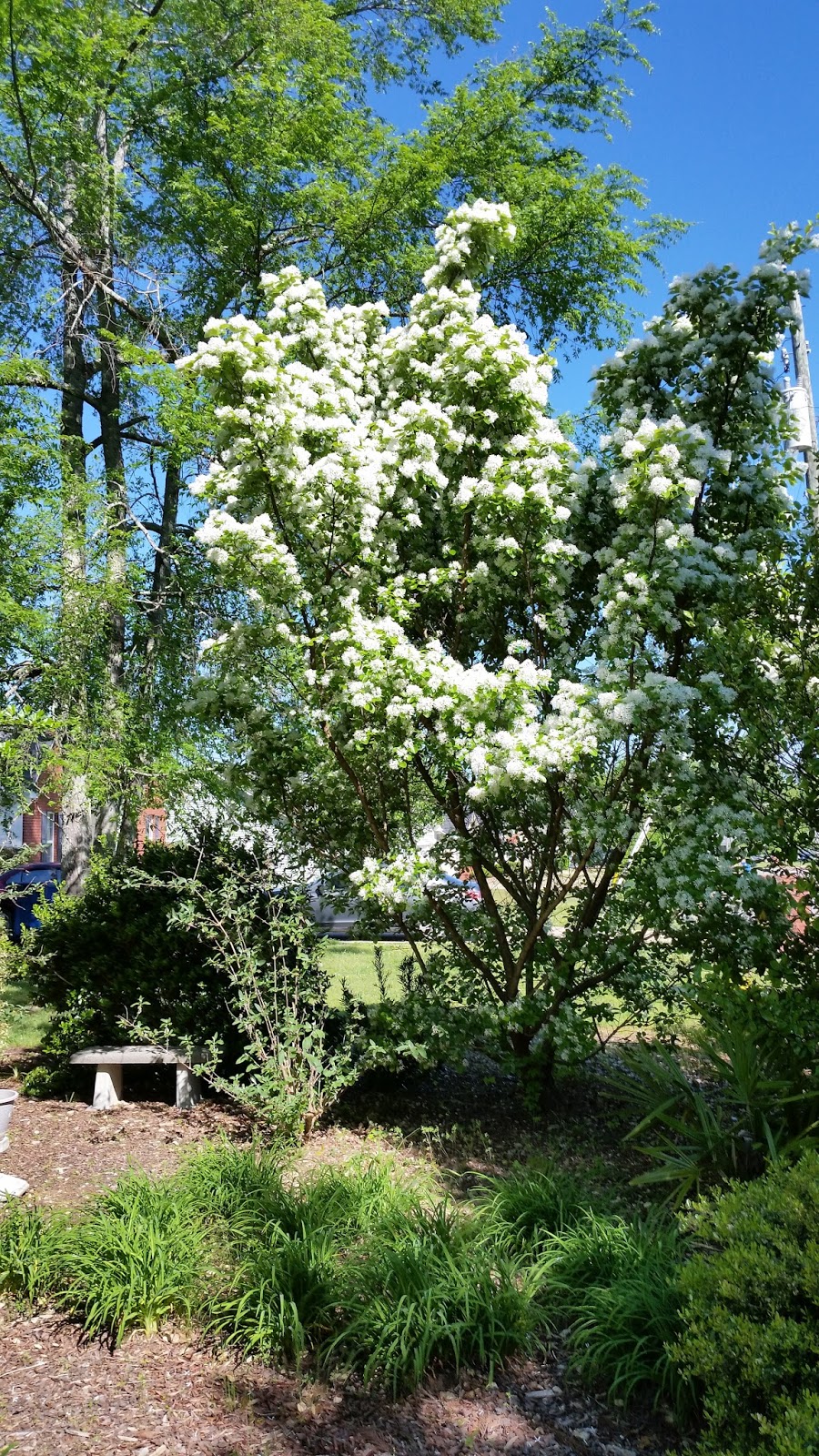
Chinese Fringe Tree (Chionanthus retusus) is covered with white "fringe." It is nearly full grown at about 15'. The star of the garden at the moment (Snowball bush is fading out).

Clematis is one of the most common vines anywhere, and for good reason. This is 'Polish Spirit.'

Red Knockout Rose is my favorite rose because it is low care and blooms prolifically from frost to frost. Japanese beetles arrive in late May early June but do not last as they are favorite food for some of the birds that inhabit my garden. I have 32 Red Knockout Rose bushes. I prune them in winter, give them a little fertilizer and then leave them alone. They reward me in abundance.

Blue Wild Indigo (Baptisia australis 'Purple Smoke') is another favorite perennial shrub.

Blue Wild Indigo with banana trees in foreground. Every southern garden should have banana trees.

Eve's Necklace (Sophora affinis) is a small tree, eventually to 15'. It has long blooms resembling necklaces. This is one of the most unusual plants in my garden. In fact, I have never seen one growing anywhere else. I ordered this as a seedling from a nursery in Texas.

Clematis 'Duchess of Edinburgh'.

Bananas on left. Foreground is Bluestar (Amsonia hubrichtii). Middle ground is Wild Indigo, yellow (Baptisia 'Screaming Yellow'). Large bush in background is a camellia.

Weigela is another common southern shrub. This one is an unidentified cultivar. It is also quite large, over 7'.

Crossvine (Bignonia capreolata var. atrosanguinea). The vine is on a trellis but I let it tail as it likes. In gardening, as in life, I am a democrat. I believe society should incorporate Liberty, Equality, and Fraternity. I give the plants freedom as long as they are not invading other's spaces (BIG exception=poison ivy). I treaty them equally. and I give them an environment of brotherhood and harmony, hundreds of very different species living together happily. I suppose my garden is my own little metaphor for my worldview. Crossvine is one of many plants feeding the many hummingbirds in my garden.

Spiderwort (Tradescantia virginiana 'Concord Grape') in foreground. Back is Louisiana Palmetto (Sabal minor "Louisianaises"), my favorite bush-type palmetto, very cold hardy and producing large blue-green fronds. The weeds are evident.


Where did you get your plants? I have heard that a lot. I have over 800 individual plants representing over 300 different species ranging very widely. Most of my plants came from nurseries local to me, others from my travels, or other people's trips. For my readers in South Carolina, I can tell you my two favorite nurseries in SC. One, Woodlanders, in Aiken, is primarily a mail-order business. They have a huge variety of native and unusual plants. For a walk-through nursery, my favorite in SC is Nurseries Caroliniana in North Augusta. It is vast but well organized, presenting an enormous variety (for instance the Chinese Fringe Tree pictured above came from there), and reasonably priced. Of course, every city in SC has its share of fine nurseries too. 


Thursday, April 21, 2016


FORT WORTH
IN APPEALS COURT TODAY ---
with Addendum (20 Apr.) and
Second Addendum (21 Apr.)


Original post, 19 April:     The Texas Second Court of Appeals, in Fort Worth, is hearing the Episcopal Church case today, Tuesday, 19 April, at 1:30 p.m. To my knowledge, there is no audio or video streaming of today's hearing. The judges will be hearing arguments from the competing dioceses concerning the Episcopal Church's appeal of the "Final Judgment" of Judge John Chupp, of the 141st Judicial Court, of Tarrant County, Texas, dated July 24, 2015. The Judgment awarded everything in question to the breakaway diocese.

Of all five secessionist dioceses, Fort Worth has had the most curious history of litigation. Three of the five cases were completely one-sided, Pittsburgh and San Joaquin entirely in favor of the Episcopal Church while Quincy was the opposite, completely in favor of the secessionist diocese. Fort Worth, however, has been on both sides.

The original court judgment in Fort Worth awarded all to the Episcopal Church side. That was Judge Chupp's order of 21 January 2011. The breakaways then appealed that decision directly to the Texas Supreme Court which held oral arguments on 16 October 2012, and rendered a written decision on 30 August 2013. In a 5-4 split, the supreme court ruled that the case must be remanded to the Judicial Court with direction to follow "neutral principles." The minority of the court held that the case was not appealable to the state supreme court. The Church side then appealed to the U.S. Supreme Court in 2014 but that court refused to accept the case for judgment, perhaps because it had not been decided by the highest court in the state of Texas. The case then went back to the original judge, John Chupp, in the 141st who held a new hearing directed by the state supreme court order for neutral principles on 20 February 2015 and issued a terse written order on 2 March 2015 with a short "Final Order" on 24 July 2015. Chupp awarded all to the breakaway diocese, the exact opposite of his 2011 ruling. It is this "Final Order" that the Church side appealed to the Appeals Court and is being heard today.

There is plenty here for the appeals court judges to consider. The Church side is essentially arguing for hierarchy, that is with sovereignty in the central authority, while the secessionist side is arguing for local rights, that is, with sovereignty in the local entity.

On December 3, 2015, the Episcopal Church diocese and the Episcopal Church both filed briefs (written arguments) with the appeals court, 202 p. and 49 p. These may be found at: http://episcopaldiocesefortworth.org/episcopal-parties-file-appellate-briefs-in-the-fort-worth-court-of-appeals . The breakaway (also known as the Episcopal Diocese of Fort Worth) side then filed a response brief of 95 pages on 4 March 2016: www.fwepiscopal.org/downloads/AppelleesResponsetoLocalParties-030416.pdf .  

Since we cannot see or hear the hearing today, we can only hope for a detailed description from the two sides involved asap. I will pass these along as I receive them.


ADDENDUM, 20 April. The hearing was held yesterday in the Second Court of Appeals, in Fort Worth. Three judges heard the oral arguments: Anne Gardner, Lee Gabriel, and Bonnie Sudderth. The courtroom was packed to capacity for a hearing that lasted 39 minutes.


An audio recording is available at:  http://episcopaldiocesefortworth.org/court-of-appeals-hears-arguments/ . This also has a report from the Episcopal Church diocese.


The schismatic diocese also has a report on the hearing at: http://www.fwepiscopal.org/news/courtofappeals.html .


SECOND ADDENDUM, 21 April. 


Having heard the audio of the hearing on 19 April, these are my thoughts:


The plaintiff (Episcopal Church diocese) lawyer spoke first. He argued basically that the Episcopal Church was hierarchical and that when the diocese was created (in 1983) it gave unqualified accession to the Constitution and Canons of the Episcopal Church with the force of an irrevocable contract. The diocese had no right to unilateral independence or to secession from TEC. In Fort Worth there were two entities: 1-the Corporation (incorporated under Texas law) that held title to the deeds and 2-the unincorporated diocese. The corporation held the property in trust for the Episcopal Diocese of Ft. Worth which itself is part of the national Church. In sum, this property issue was really an ecclesiastical issue that must be left to the Church under the First Amendment.


The defendant (secessionist diocese) lawyer countered that the diocese was an independent entity free to amend its rules under state law. The Corporation was an independent entity under state law and governed by the diocesan convention. Courts must follow "neutral principles" and settle the property issues under state property laws.
A judge interrupted the defendants' lawyer to speak twice: 1-are not we getting into ecclesiastical issues (referring to the structure of the diocese)? and 2-the Texas Supreme Court did not make a decision in the case, only remanded to lower court with direction for neutral principles.


The Church lawyer then offered a rebuttal. He said only the Church, not the courts, may decide which is the rightful diocese. He also pointed out that the 55 property deeds state explicitly the property was held in trust for the Episcopal Church in the Diocese of Ft. Worth. He asked the court to enforce the deeds.


The fundamental issue in Ft. Worth was the same as in South Carolina, sovereignty. The Church's position is that ultimate power rests in the national Church, specifically in the General Convention. All dioceses must recognize that. As for property, all local properties are held in trust for the Episcopal Church and its diocese. On the other hand, the secessionist side argued for local sovereignty, that the local diocese governed itself and existed as an independent legal entity under state corporate law, and that the national Church had no right over the local properties.


It is impossible at this point to predict how the Texas Second Appeals Court will rule. It is dealing with contradictory decisions from the same judge (John Chupp), the first giving all to the national Church side, the second giving all to the secessionist side, and a direction from the state supreme court that the case be heard under "neutral principles." (The appeal before the court is Chupp's second decision). A judge asked only two questions on Tuesday, both of which suggested reluctance to interfere in an ecclesiastical matter. As we have seen, neutral principles does not necessarily mean the secessionist side will win. In California, the court followed neutral principles and found all in favor of the national Church; and this was affirmed by the appeals court. 


Monday, April 18, 2016


BREAKING NEWS ---
ANGLICAN CONSULTATIVE COUNCIL REJECTS PRIMATES' "CONSEQUENCES"


The Anglican Consultative Council voted today to reject the "consequences" imposed on the Episcopal Church by the primates in their January 2016 gathering in Canterbury.

According to the Episcopal News Service report just posted, the ACC today passed Resolution C34 which recognized the Archbishop of Canterbury's report on the primates' gathering and affirmed the decision to "walk together." Then, the ACC tabled (withdrew without a vote) Resolution C35 which would have accepted the primates' statement. The ABC himself wanted C35 to be withdrawn. For EpiscopalCafé's report see: www.episcopalcafe.com/intentional-discipleship-in-a-world-of-differences-acc-2016-declines-to-enforce-consequences-issued-by-primates .


Passing C34 and killing C35 speaks loudly and clearly that the ACC rejected the primates' directive to the ACC to impose punishment (using the euphemism of "consequences") on the American Episcopal Church.

Two points to emphasize here: 1-the Anglican Communion has no central government. It has "Four Instruments of Communion" that are separate and co-equal. No one Instrument has any authority over any other. No one has any right to interfere in any of the 38 independent churches (provinces) of the AC. The primates' had no right to direct the ACC to do anything and the ACC has now told the primates' that in no uncertain terms.

2-More evidence to support my contention that the movement to drive the Episcopal Church out of the AC and replace it with the Anglican Church in North America is dead (see my postings of April 11, "The Collapse of the Anti-Episcopal Church Movement in the Anglican Communion" and of Feb. 1, 2016, "The Failure of the Replacement Strategem"). The ABC and the ACC rallied to save the Episcopal Church's place in the AC. The anti-TEC hardliners have now been reduced to a marginalized handful of the most fiercely anti-homosexual-rights primates of equatorial Africa. In one case, Kenya, even the delegates rejected their archbishop's wish and attended the ACC meeting anyway.