Wednesday, April 20, 2022


REFLECTIONS ON THE SC SUPREME COURT DECISION OF APRIL 20, 2022


On today, 20 April 2022, the South Carolina Supreme Court handed down its long-awaited DECISION on the Episcopal Church's appeal of Judge Edgar Dickson's order of 2020. The SCSC held a hearing for this appeal on Dec. 8, 2021. Dickson had found all in favor of the secessionist diocese, now calling itself the Anglican Diocese of South Carolina. 

Today the SCSC affirmed in part and reversed in part Dickson's order.


A recap of events:

---2017, the SCSC issued a DECISION with three majority opinions: (1) 8 parishes owned their own properties, (2) 28 parishes were property of thre Episcopal Church, and (3) Camp St. Christopher was property of the Episcopal diocesan trustees (see p. 77).

---SCSC denied a rehearing. SCOTUS denied cert (appeal).

---SCSC issued a Remittitur and sent its decision to the circuit court (Judge Dickson).

---2020, Dickson interpreted the 2017 SCSC decision to mean that all property, local and diocesan belonged to the secessionist parties.

---The Episcopal Church and diocese appealed Dickson's order to SCSC.

---Today, SCSC published its decision upholding some and overturning some of Dickson's order. This replaces the 2017 decision  and Dickson's order.


In a nutshell, today's decision keeps all of the 2017 SCSC opinion except that it expands the number of parishes in the hands of the secessionists from 6 to 22. In other words, it adds 15 parishes to the list of local churches not property of the Episcopal Church. 


To begin, however, Justice Few, writing for the court, declared that the SCSC 2017 decision was not final:

The primary issue before the Court today, however, is the first question: whether the 2017 Court made a final decision as to all real property owned by the twenty-nine Parishes. We hold it did not.

This was a fundamental defeat for the Episcopal side and victory for the secessionists who had argued all along that the 2017 decision had left the property question unresolved.

In fact, the 2017 decision stated explicitly the majority decisions on property (on page 77):

1) with regard to the eight church organizations which did not accede to the Dennis Canon, Chief Justice Beatty, Justice Kittredge, and I would hold that title remains in the eight plaintiff church organizatrions; 2) with regard to the twenty-eight church organizations which acceded to the Dennis Canon, a majority consisting of Chief Justice Beatty, Justice Hearn, and Acting Justice Pleicones would hold that a trust in favor of the national church is imposed on the property and therefore, title is in the national church; and 3)with regard to Camp St. Christopher, Chief Justice Beatty, Justice Hearn, and Acting Justice Pleicones would hold title is in the trustee corporation for the benefit of the associated diocese.

The fact stands that the SCSC did make a final decision on property in 2017. It issued a Remittitur to the lower court to carry out its majority decision. If it had wanted the lower court to relitigate the property issues it would have issued a Remand order or at least a directive to the lower court of what it expected. It did not.

Judge Dickson recognized the existence of the majority decisions when he ordered the implementation of the first one, on the disposition of the eight parishes which were found to own their properties. He refused the other two.

Today's decision had no problem with numbers one and three, only with number two. So, it too recognized the existence of three majority decisions from 2017.

So, if the only real change from the 2017 to the 2022 decision is on property disposition, how does today's order go about it? What has changed?

It all boils down to one question---accession to the Dennis Canon. The Episcopal Church adopted the Canon in 1979. It required that all local property to be held in trust for the Episcopal Church and its local diocese. If a parish voted to leave TEC, it would forfeit its property to the trustees. The Diocese of South Carolina also adopted its own version of this Canon in 1987.

What Justice Few tries to do is rule on whether each individual parish had agreed to this Canon.

There are several problems with this approach. First and foremost, the Episcopal Church is an hierarchical organization governed by a General Convention then a diocese. All parishes and missions are subject to the authority of the national church and local diocese. Parishes are not independent units able to pick and choose which rules they will follow. Time and again, courts have ruled TEC to be hierarchical. This includes the SCSC, in 2017 as well as the federal court in Charleston.

Next comes the problem of defining accession to the Dennis Canon. Under hierarchy, and the First Amendment, local parishes do not have the right to deny the Dennis Canon. However, the litigation in SC has always been about whether the local parishes had acceded to the Canon under state law. We have had three widely varying opinions so far. In 2017, the SCSC said 8 local parishes had not acceded to the Dennis Canon while 28 had acceded to it. In 2020, Judge Dickson ruled that no parish had acceded to the Canon. Now, in 2022, the SCSC says 15 of the 29 parishes that the 2017 court said acceded really had not. So now, the SCSC declared a total of 22 local churches did not accede while 14 did.

The reason for this confusion is the vagueness of the state law. SC law says a deed holder has to create in writing, in "some legally cognizable form" a trust for another party. It cannot be imposed from the outside. "In writing" and "legally cognizable" were not defined or clarified. They remain subject to interpretation. And, there is the core of the problem. Whose interpretation?

All three interpretations (2017, 2020, 2022) were drawn from the same documentary evidence introduced in the court record. 

In today's decision, Justice Few goes case by case among the 29 parishes giving his opinion on whether the parish had set up a trust for the Episcopal Church. Here he starts splitting hairs. Actually none of them made an explicit written document creating a trust for TEC. 

Few declared that accession to the Dennis Canon did not have to be explicit but had to be what he considered close. Here is where interpretation crept in. And so he looked for words in the parish documents that he thought were or were not close enough. Words that failed the test were such as:  accordance, accord, acknowledge, purpose, pledge, pursuant, and recognition. Parishes that had incorporated these words into their allegiance to the Episcopal Church had not acceded to the Dennis Canon, he ruled. Never mind that all parishes were part of the diocese that had set up its own Dennis Canon in 1987. Accordingly, Few reckoned that 15 parishes were in the failing group, that is, they had not acceded to the Dennis Canon.

Then, Few found that 14 parishes had incorporated certain words in their documents:  "adopt," "accede" and "Canon." If a parish used these, it automatically acceded to the Dennis Canon and set up a trust for TEC and its diocese. It did not seem to matter if the word "Canon" only appeared in "The Constitution and Canons of the Episcopal Church" which is actually the governing document of the national church. There is another for the diocese.

Thus, the whole decision on whether to throw a parish into one pile or the other rested on the words they had used in documents from years ago. I am sure there are many parish leaders today who wished their forebearers had used different words. What a difference a word would have made.

And so, we have some questionable interpretations from parish to another. For instance, when St. Helena's says "this parish from henceforth pledges to adhere to the doctrines, discipline, and worship of the Protestant Episcopal Church in the United States of America" it is not good enough to mean the Dennis Canon. Even terms more explicit were often not good enough, e.g. All Saints of Florence, "The By-Laws of All Saints' Church are drawn with the recognition that as a part of the Episcopal Church in the United States of America, we are bound by the Constitution and Canons of the National Church and the Constitution and Canons of the Diocese of South Carolina." Good enough for accession to the Dennis Canon? No. All Saints was tossed into the 15 stack of non-accession.

Millions of dollars worth of property is being decided by splitting hairs. What constitutes accession to the Dennis Canon is a matter of opinion. Few's is not convincing, at least not to me. It is clear all of these local parishes were part and parcel of the diocese and the national church. All of their documents said as much, so parsing a word or phrase should be extraneous.

Another puzzling and bewildering part of today's decision is the page of the Chief Justice, Donald Beatty. In 2017, he joined the majority in all three decisions, the only justice to do so. Most importantly, he wrote in his opinion (p. 37-38):  "However, I agree with the majority as to the disposition of the remaining [28] parishes because their express accession to the Dennis Canon was sufficient to create an irrevocable trust."

In today's decision, Beatty is saying something else. He wrote, "As I explained during oral argument in this case, I did not vote to end the case in 2017. Rather, I intended to reserve final judgment as to each individual Parish until the circuit court decided on remand whether each individual Parish acceded to the Dennis Canon." 

With all due respect to the Chief Justice, the published and printed record from 2017 shows something different. He did join the majority then. The majority said very clearly that 28 parishes had acceded to the Dennis Canon. In the quote above, Beatty had said their express accession was sufficient. He did not remand the case to the circuit court. The SCSC issued a Remittitur. That is not a remand. A Remittitur is a directive to implement a decision. The SCSC did not direct the lower court to decide what parishes had acceded. That decision had been made by the majority in the 2017 opinion. It seems to me Beatty is inexplicably inconsistent between the 2017 and 2022 decisions.

Today's ruling also contains several factual errors. In one, Few said the schism occurred in 2010. It occurred in 2012, Oct. 15, 2012 to be exact. In another, he wrote the Episcopal diocese organized after the schism. Actually, it reorganized then. It had existed since 1785. In another, Christ, St. Paul's of Conway apparently means Christ/St. Paul's of Yonges Island. St Paul's of Conway was one of the 8 parishes the 2017 decision had found owned its own property.


So, what now? The only appeal possible for today's decision would be to the U.S. Supreme Court, but on what basis?SCOTUS has been entirely reluctant to take Episcopal Church cases. I expect the chance they would take an appeal from the SC Supreme Court would be nil. So, it is all but certain this is the end of the road as far as the state courts in South Carolina go. Soon we can expect the federal appeals court to take up the secessionists' appeal of Judge Gergel's order which found all in favor of the Episcopal Church side. I expect the chance the appeals court will uphold Gergel to be very high. If Gergel stands, the Episcopal side will own the legal entity of the old diocese. 

It looks as if we are about to arrive at the end of a very long and tortuous road. It has been nearly ten years. God only knows how much money has been spent. We do know the heartache and brokenness.

And all this to keep gays in the closet and women in the kitchen. What a waste. What a shame.

To put this in context, the anti-Episcopal movement began in earnest in the 1990's. Its aim was to destroy or greatly diminish the Episcopal Church in order to reduce its "liberal" influence in American life. This hostile movement found fertile ground in lower South Carolina. Hence the schism of 2012 and the ensuing legal war. The Church's opponents have not destroyed the Church but they have gone a long way to wound her in one of her oldest and strongest bastions. In this regard, we would have to admit the anti-Episcopalians have finally won a certain measure of success. The schism has rent the church asunder in lower South Carolina. Yet the Episcopal Church survives and shouts as loudly as ever for love of God and of our neighbors.  


S C SUPREME COURT SPLITS THE BABY


The South Carolina Supreme Court DECISION of today divides the 29 parishes in question between the two parties. 15 of the parishes were recognized as owning the property while 14 of the parishes were recognized as belonging to the Episcopal Church. Here are the lists:


15 OWNING THE PROPERTY, i.e. not property of the Episcopal Church:

---Trinity Church, Pinopolis

---St. Philip's Church, Charleston

---St. Michael's Church, Charleston

---The Church of the Cross, Bluffton

---The Church of the Epiphany, Eutawville

---St. Helena's Church, Beaufort

---Christ St.. Paul's, Conway [Christ/St. Paul's, Yonges Island?]

---Church of the Resurrection, Surfside

---Church of St. Luke and St. Paul, Charleston

---St. Paul's Church, Summerville

---Trinity Church, Edisto

---St. Paul's Church, Bennettsville

---All Saints Church, Florence

---Church of Our Saviour, Johns Island

---Church of the Redeemer, Orangeburg


14 PROPERTY OF THE EPISCOPAL CHURCH:

---Church of the Good Shepherd, Charleston

---Church of the Holy Comforter, Sumter

---St. Bartholomew's Church, Hartsville

---St. John's Church, Johns Island

---St. Jude's Church, Walterboro

---St. Luke's Church, Hilton Head

---St. David's Church, Cheraw

---St. Matthew's Church, Fort Motte

---Old St. Andrew's Church, Charleston

---Church of the Holy Cross, Stateburg

---Trinity Church, Myrtle Beach

---Holy Trinity Church, Charleston

---Christ Church, Mount Pleasant

---St. James' Church, James Island


CAMP ST. CHRISTOPHER

The SCSC ruled that the Camp and all diocesan and trustee property of the pre-schism diocese remains with the Episcopal Diocese.


NAMES, STYLES, EMBLEMS, AND MARKS

The SCSC deferred to the federal court to rule on this issue. The U.S. District Court ruled entirely in favor of the Episcopal Diocese. That decision is now on appeal with the U.S. Court of Appeals in Richmond.


I will return soon with more commentary. 

Thursday, April 14, 2022


PEARSON APPARENTLY MOVING TO VIRGINIA


Mrs. Andrew Pearson (Lauren Saddler Pearson ) is the Managing Director and Partner of Somerset Advisory in Birmingham, a financial firm. Apparently over the past few years she has built a successful advisement practice at Somerset. One question about Andrew Pearson's leaving Grace Church, of Birmingham, was what this would mean to herself and her business. Now we know. She is not leaving her firm.

Lauren Pearson sent an undated letter (early this week?) to her clients stating that she and Andrew would be moving in the summer to the vicinity of Charlottesville, Virginia to restore Gen. Patton's boyhood home.

"Andrew and I have the opportunity to restore General George S. Patton's childhood home." It was built c. 1754 and includes a 150-acre farm.

She goes on to assure the clients that Somerset Advisory will continue on as usual. Much work will be done remotely, as it is  now. The offices in Birmingham and Beaufort SC will continue as usual. 

Pearson added that she will be traveling back to Birmingham regularly, probably the first week of each month in order to attend to business.

So, Andrew Pearson will be leaving Birmingham. There was no mention in his letter to the church or in Lauren's letter about future church plans. 

al.com is posting an article about Pearson but it only repeats the letters from Grace Church. Pearson had no comment to add.

There must be much more to this story than is publicly known. The biggest mystery of all is what happened to cause Pearson to leave a brand new congregation that he himself had founded only a few months ago. 


Wednesday, April 13, 2022


ANDREW PEARSON LEAVING HIS NEW CHURCH IN BIRMINGHAM


On yesterday, 12 April, the "leadership team" of Grace Church, in Birmingham, Alabama, sent out an email announcing the departure of the Rev. Andrew Pearson from Grace Church. Find the email here .

The email contains Pearson's letter to his "Church Family" giving his explanation for his leaving "this summer." I suspect there is more to this story than the letter reveals. It does have the sound of someone exhausted: "my tank is empty." Pearson founded this new church less than a year ago shortly after he departed his post as dean of the Episcopal Cathedral Church of the Advent, in Birmingham. Grace Church is in the Anglican Church in North America.

Grace has not found a permanent home. It meets in a synagogue on the south side of downtown Birmingham.

There was speculation at the time of Pearson's departure from the Advent that there would be a mass departure of parishioners from the Advent to follow Pearson out. Apparently this did not happen. 

The timing of this news is curious. Why did this occur in Holy Week? There are many unanswered questions at hand.

Friday, April 8, 2022


NOTES,  8 APRIL 2022


"May you live in interesting times," is said to be an old Chinese curse, although its origin is dubious. Uninteresting times would be peaceful, serene, and stable. Interesting times would be strife-filled, tumultuous, and unpredictable. We can all agree, we are definitely living in interesting times. In such times, it is easy to get overwhelmed with the troubles all about us and lose focus on the big picture. We have been in a bitter schism in South Carolina for nearly ten years and still waiting on some elusive resolution. We have been in a pandemic for more than two years watching millions of our fellow human beings suffer and die, including one million Americans. Now we have the worst war on the globe since WWII. The news is so awful these days, I almost dread to turn on my computer or television for fear the new atrocities will be worse than yesterday's. 

Sure enough, this morning came the news of the Russians' most barbaric crime yet, at least of those that have come to light. They fired missiles into a crowd of thousands of innocent civilians waiting at a train station desperate to escape the war. This was after they had bombed one railroad track causing a bottle neck of rail traffic and the build up of a crowd at the station. One missile had the words in Russian, "for the children." The attack killed thirty-nine people and wounded some three hundred. The pictures of the aftermath are beyond gruesome. How can human beings do this to one another, we may ask ourselves in disbelief. We are looking at evil in its most shocking form. God only knows what will be found in Mariupol and the other areas the Russians have attacked. This is not war. It is murderous terrorism and the people who are committing these crimes must be held accountable if we are to have a civilized world.

In order to keep our own sanity amidst all this craziness, I think it is important to bear in mind the big picture of what is going on in the world of our day. Regular readers of this blog will know what I am going to say. The big picture is that we are in the reactionary phase of the great democratic revolution of the Twentieth Century. That century brought the triumph of democracy over monarchism in WWI and over totalitarianism in WWII. Soviet Communism fell a half century later. Democracy did not sweep the entire world but it did large parts of it to become the standard of civic governance. Part and parcel of this revolution was the rise of human rights. In America this translated into freedom and equality for African Americans, women, homosexuals, and the transgendered. Early on, the Episcopal Church resolved to be a champion of freedom and rights; hence, promotion of racial justice, democratized prayer book, and equality and inclusion for women, gays, and the transgendered in the church.

The dramatic and sweeping great democratic revolution was not universally welcomed. Quite the contrary, many powerful forces arose to oppose it or at least some of its effects. A backlash emerged resolved to stop, roll back, or destroy the democratic revolution. Every great revolution in history is followed by a counter-revolution led by forces that feel the most threatened by the revolution. This is the phase we are in now. We are witnessing a great clash between the force of the revolution and the elements of the counter-revolution who are struggling to keep the pre-revolutionary order.

In America, this has brought in a culture war. The white male power structure has formed a backlash and with the help of other anti-democratic elements has put up a fierce reaction. President Trump rode into power on this reactionary wave. In numerous state legislatures across America laws are bring passed by reactionaries to diminish the revolutionary changes. These will reduce voting among minorities, the ability of women to control their own bodies, the rights of the transgendered, and even equality for gays. There is a concurrent war on books promoting equality and inclusion. 

The schism in South Carolina is part of this culture war. Social reactionaries in the Episcopal Church in lower South Carolina organized to remove the diocese from the national church in order to keep homosexuals and women from having equality and inclusion in the local churches. For ten years, the reactionaries have been using the courts to further their cause. If they can convince the justices of the SC supreme court that this is a fight of conservatism over liberalism, they may prevail in that court. If so, they would wind up with the local properties. We are still waiting on a judgment of the court.

The Russian war on Ukraine is also part of the reaction against the great democratic revolution. Putin is a dictator, an anti-democratic ruler. Ukraine is a democracy on his doorstep. He has declared Ukraine does not exist. If he has his way, he will stamp out the country including its democracy.

If history is our guide, and I see no reason to think it is not in this case, the prevailing revolutionary forces will win out although perhaps with significant changes. The reactionary forces will not destroy the revolutionary ones but they can do great damage along the way. Evidence number one is the war in Ukraine.

And so, in the big picture, the great democratic revolution moves on as the greater prevailing force in history. Right now we see a tremendous mile marker in that revolution in America, the first African American woman on the U.S. Supreme Court.


This is a tremendous leap forward. To know just how big this is one has to be a southerner of my age range. Growing up in the Jim Crow south, the idea of a black person on the U.S. Supreme Court would have been unthinkable, let along a black woman. To really understand the great democratic revolution in America, one has to know how life has changed. I am here to tell you the change is incalculable, and I thank God and the good people of America for every bit of it. 

And so, let us keep the big picture in mind as we try to wrestle with the awful trials and tribulations in our lives these days. History is moving in the right direction but it does not move at an even pace. The great democratic revolution is the predominate historical force of our age. And so, the reactionaries will not prevail in the end. Putin will not win. Although battered and bruised, the forces of democracy and human rights will win the day in the world, including little South Carolina.


Wednesday, April 6, 2022


MUSINGS ON THE END OF THE RUSSIAN WAR ON UKRAINE


We have learned a great deal about this war yet there remains far more that we do not know. The biggest question of all is how it will end. This presumes that it will end. Of course, it will end at some point but God only knows when and how this will occur.

The first major point that we still do not know is motive, or strategy. What was President Putin's aim in his invasion of Ukraine? We do not know. His stated goal of de-nazification was ridiculous. Apparently, his first choice was to capture the capital city, Kyiv and so a forty-mile-long convoy of Russian military vehicles lined up only to bog down and eventually withdraw. It appears as if Putin has abandoned, at least for the moment, his aim of capturing Kyiv. The Russian forces are now concentrating on the eastern and southern edges of Ukraine. However, experts have no idea of the present aims of the Russian deployments.

As for tactics, we now know, e.g. Bucha and Mariupol, that the Russians will use any appalling barbarism to terrorize and kill the people of Ukraine. They have shown no bounds.


In this no-holds-barred atmosphere we must remember that Putin has two catastrophic tools at his disposal, chemical and biological weapons and nuclear weapons. There is no good reason to assume he will not use them. It seems to me Putin may possess the characteristics of a psychopath or a sociopath. Find a discussion of the differences here . Either way, he apparently has no regard for others and no ethical or moral principles. We are looking at a ruthless and unpredictable dictator who has the power to destroy the world.

Another thing we have learned is that, in all likelihood, there will be no diplomatic settlement in the foreseeable future. The two sides have been meeting for talks all along and nothing significant (other than prisoner exchanges) has resulted. It is most improbable that Putin will end this war by negotiation. He will not display such weakness. This means we could be looking into a very long war. The Syrian civil war has been going on for ten years and is no where near a settlement. The Russian role in that war on Assad's side has been to show no regard for human life or property.

This is very much Putin's war. He planned it. He started it. He is directing it. He is keeping it going. He is in the driver's seat and there is little to nothing the rest of the world can do to stop this war. Besides, the rest of the world does not want World War III.

Putin has been in power for twenty years. He has a well established track record of ruthless military action, as Chechnya and Syria. Moreover, we must bear in mind the war in Ukraine started in 2014 when Russian forces illegally seized Crimea, a part of Ukraine, and promoted insurrections in eastern Ukraine. The war in Ukraine has actually been going on for eight years.

Since there does not seem to be any viable way of ending the Russian war on Ukraine in the foreseeable future, some people are discussing "regime change," that is, overthrowing Putin, as the most likely way to end the war. 

Putin is a dictator. So, what does history tell us about getting rid of dictators? How plausible is it that Putin will be overthrown from power? Unfortunately, there is no easy answer. Sometimes dictators are overthrown and sometimes they are not.

The two most notorious dictators of the Twentieth Century were not overthrown. Adolf Hitler died by suicide in 1945. Joseph Stalin died of natural causes (stroke) in 1953. Both of these had built a very powerful party apparatus around them and ruled by carrot and stick. Any move against them, and there were many, was quickly snuffed out in extremely ruthless fashion. They both kept iron grips to the very end.

On the other hand, history is littered with strongmen who did not have such iron grips and met bloody ends. In 1989, Nicolae Ceausecu, dictator of Romania, was overthrown and executed by people around him. How about Benito Mussolini, who was overthrown by his own people and brutally killed by Italian partisans in 1945? How about Muammar Gaddafi, who was overthrown in Lybia and killed in 2011?

Strongmen typically rule by fear and will use this fear to control the people around them. Sometimes, however, this tactic can boomerang if enough of the people around believe their lives are at stake. For instance, Maximilian Robespierre, while not exactly a dictator, was the strongman leader of the radical phase of the French Revolution. At the height of his power, after many leaders had been guillotined, he declared that more of his political critics must be liquidated (killed). When he refused to name names, his terrified critics ganged up and sent him to the guillotine. In their eyes, it was either themselves or Robespierre. In this case, fear backfired.

So, what about Putin? We know he does not have a strong ideological party backing him up. Apparently, he is an individualistic dictator who is surrounded by a rather small group of oligarchs, aka kleptocrats. It is widely believed Putin and his oligarch friends have grown fabulously rich from the public treasury. The dynamics between Putin and the oligarchs remain mysterious. Little known too are the relationships between Putin and the institutional power holders. There is so much secrecy around Putin that it is hard to say how strong his power is. So, it is impossible to predict whether the people around him will overthrow him. We can assume this would happen only if the conspirators are certain they would prevail. At the moment there is not a shred of overt evidence of a coup. Quite the contrary, Putin and his government have silenced all independent public voices. Some western observers say that Putin's dictatorship will not survive the war in Ukraine. Maybe not, but at this point we simply do not know enough to make predictions.

Then, what are we to do if the war drags on, there is no negotiated peace, and Putin remains in power? I see no good choice but to keep on doing what we in the western world are doing and to do it more forcefully: 1-claiming the moral high ground, and 2-sending weapons and supplies to the people of Ukraine. There are signs that both of these are happening. Pope Francis is leading the religious figures of the world to condemn the Russian war on Ukraine. NATO and the European Union are stepping up shipments to Ukraine. 

No one in the west wants this war to widen. However, the more Russian atrocities against civilians we see, the harder it will be to limit this war. If the Russians use poison gas on civilians or detonate a nuclear weapon, it will be all but impossible to keep NATO out. The most chilling thought is that this is exactly what Putin wants, a new war against the west so Russia could ride high in triumph again,  as it did over Napoleon in the Nineteenth Century and Hitler in the Twentieth. If so, what would happen would be the reverse of history and the outcome would be the opposite. It is aggressor Russia that would lie in ruins.

Bottom line on the question of how the war will end---there is no way to know at this moment. It could turn in many different directions. Meanwhile, civilization is having to continually reassess the greater moral good. If we are to have a civilized world, good must overcome evil. Morality must prevail over immorality. How we achieve these is the daunting challenge of the day. The worse we can do is to do nothing. As Edmund Burke said, the only way for evil to succeed is for good men to do nothing. 

Thursday, March 31, 2022


ANGLICAN PRIMATES ISSUE COMMUNIQUÉ,

31 MARCH 2022


The primates (heads) of the 42 independent churches that make up the Anglican Communion in the world are meeting this week in London, hosted by the Archbishop of Canterbury (center of picture). I count 32 present in this picture (37 attended, several virtually). There were three primates who pointedly refused to attend the meeting (Nigeria, Rwanda, Uganda). Several others could not attend because of circumstances, such as surges of COVID-19. 

The purpose of the meeting was to serve as a "warm up" for the large Lambeth Conference slated to meet this summer (27 July-8 August) at Canterbury. The LC usually meets every ten years but had to be postponed from 2020 because of the pandemic. This year's LC will include some 700 bishops from the worldwide Anglican Communion. 

Today, 31 March, the primates issued a formal Communiqué giving their views of numerous problems in the contemporary world. Find it here . Of particular importance is #9, condemnation of the Russian invasion and war on Ukraine:  the "catastrophic effects of Russia's invasion of Ukraine." The primates called for ceasefire and withdrawal of Russian forces from Ukraine.

The Episcopal Church is the province of the Anglican Communion in the United States and some lands beyond. Its primate is the presiding bishop, Michael Curry.

The independent church calling itself the Anglican Church in North America is not in the Anglican Communion and its fifty or so bishops will not be invited to the Lambeth Conference. ACNA is a proxy of GAFCON in America, but GAFCON is a self-created alliance of socially conservative Anglican provinces outside of the institutional structure of the Anglican Communion. The Anglican Diocese of South Carolina is in ACNA, and therefore, not in the Anglican Communion. Its bishop will not be at Lambeth.

Find an ENS article on this week's meeting here .

For a thorough description of the work of the primates, see this article .

Tuesday, March 29, 2022


NOTES,  29 MARCH 2022


Welcome, blog reader, on a beautiful spring day, at least it is at my house. Here's a wish that all goes well with you and yours today. It is time to check in on the topics we have been following for a long time. So, let's plunge right in.


PANDEMIC. All metrics show a great decline in cases, hospitalizations, and deaths in the United States. The fourth great surge is over. However, the plague persists and in some places in the world is actually surging once again. In the U.S., the average death rate is now around 700, still unacceptable even if a fraction of recent rates. Nearly one million Americans have died of COVID-19 in the past two years. Pause and reflect on this for a moment. 

It is premature to declare victory and return to the pre-pandemic "normal" across the board. In fact, news reports say there will soon be a new booster shot for people over the age of sixty. This would be the fourth inoculation. The point is that the coronavirus is still very much a part of our lives and we should act accordingly.


SCHISM IN SC. Still waiting on the South Carolina Supreme Court. And, still crickets.

As for the Anglican Diocese of South Carolina, apparently Edgar is functioning as the new diocesan bishop. Lawrence is off the payroll as of March 31.


THE ADVENT. The search committee is still at work on seeking a new dean to replace Andrew Pearson who resigned last year at the Episcopal Cathedral Church of the Advent, in Birmingham AL. It seems to be taking its own time which I suppose is a good thing. Meanwhile, the interim dean, Criag Smalley, seems to be succeeding in nudging the parish back toward the mainstream of the Episcopal Church after Pearson had tried to move it to the evangelical edge, perhaps beyond the edge.

Given the sensitive state of the Advent at the moment vis à vis the Episcopal Church and diocese, it is a bit surprising to see some of the choices for the parish's Lenten Preaching Series. On April 4-5, Ephraim Radner will speak. He is a prolific and influential theologian who for three decades has argued for greater unity and conformity in the Anglican Communion. For instance, in 2019, he published an article in The Living Church magazine supportive of the Anglican Church in North America. Find the article here . He asserted that the anti-homosexual Resolution 1.10 of 1998 should be standard in the AC and churches that refuse this [TEC, Anglican Church of Canada] are "outside" the boundaries of Anglican teaching. He also said the AC should have "serious deliberation" on how the ACNA can be "fully integrated" into the AC. He seems to support the development of the AC into a covenant religion, something it has never been. In fact, the AC is a collection of 42 self-governing local churches. It is not bound by a confession or a covenant or any other instrument that could interfere with local independence. Resolutions of the Lambeth conferences are just that, resolutions. They are not laws enforceable on the provinces.

The ACNA was created by GAFCON and American anti-human rights Episcopalians in 2009 specifically to oppose equality for and inclusion of non-celibate homosexuals from the leadership of the church. It threw in women to boot. The stated aim of ACNA is to replace the Episcopal Church as the only legitimate Anglican province in the U.S. Thus, there is  not room in the AC for both TEC and ACNA, It is one or the other. The Archbishop of Canterbury has made it clear, more than once, that ACNA is not in the Anglican Communion. There is no sign  it will ever be however much GAFCON may promote it and oppose TEC.


THE RUSSIAN WAR ON UKRAINE. Several points have become clear now more than a month into the war. The leading one would be that poor showing of the Russian military. They have obviously failed in their objective of capturing the country quickly and installing a puppet government. Their incompetent invasion has gained little while losing as many as 15,000 soldiers killed including seven generals. However, they continue to pound cities with missiles, bombs, and artillery. This stalemate could go on indefinitely. 

Another point is the phenomenal resistance of the Ukrainians. President Zelensky and the Ukrainian people have arisen to the occasion. David has stopped Goliath in his tracks. We can all cheer for the underdogs here. 

Yet another point is the unification of virtually the entire western world in defense of national independence and democracy. This is unprecedented in the world since WWII. 

Talks for a peace are going on and have been going on all along with no sign of agreement. Meanwhile there are signs the Russians are retreating into the territories they hold while continuing to shell the cities. The purpose of all this is as unclear as the future. What is the clear is the gross evil and immorality of the Russian invasion and war on Ukraine.


So, we are still confronted by numerous unresolved issues. Nevertheless, spring is here and we can revel in the beauty of the season all around us. Here are a couple of pictures of my garden today:


The Japanese flowering cherry tree is always beautiful at this time of the year. The green tree in background is Japanese Cedar (Cryptomeria). The cherry tree is near the street curb and cars often slow down when passing.


This dazzling crabapple tree brightens up the back side of my garden, far from the street.

I hope you are enjoying this springtime as much as I am. Peace. 


Wednesday, March 23, 2022


WHY IS THE PATRIARCH OF MOSCOW BACKING THE RUSSIAN WAR ON UKRAINE?

IT'S STILL HUMAN RIGHTS, STUPID.


One of the most shocking aspects of the war in Ukraine is the outspoken support for the invasion coming from the head of the Russian Orthodox Church, Kirill, the Patriarch of Moscow and All Rus. How could the leader of a major Christian denomination incite, or even support, such a war?

Here is a helpful article from an expert who explains it better than anyone else could.


As it turns out, Kirill's war mongering is more complicated than one might think at first glance when it appears simply to be a naked power grab to regain lost control over the Orthodox churches of Ukraine. Kirill's actions should be seen in the big picture of the culture war. The war in Ukraine is part and parcel of the revolution, and counter-revolution, for human rights in the contemporary world. And guess what bothers Kirill a lot? Homosexuality. In a big way, the war in Ukraine is a war against human rights for gays. It is really a small world, after all.

Putin and Kirill are not pulling the wool over anyone's eyes in their heinous war of aggression. Virtually the entire western world has united to defend democracy and human rights in the face of this totally unwarranted and murderous assault on an innocent victim. Everybody knows this is a war between the forces of democracy and those of anti-democracy. Kirill has thrown down the gauntlet against what he sees as alien and dangerous effects of democracy. He and Putin are on the wrong side of history and they are likely to pay for their choices in time to come. Unfortunately, Christianity in Russia may pay too.

____________________

NOTE. News broke this afternoon of the death of Madeleine Albright, first female Secretary of State and a hero in the struggle for democracy and human rights in the world. She was also an active Episcopalian. She fought the good fight, all of her life against the likes of Putin and deserves a grand funeral in the National Cathedral. RIP, Madame, la sécretaire d'état extraordinaire. 


Monday, March 21, 2022


NOTES,  21 MARCH 2022


Welcome, blog reader, on Monday, March 21, 2022. Spring is here! Now, the queen of seasons, bright. Did we ever need hope, new life, and brightness more? I think not. We have been in a long, dark, and terrible winter for so long. In a way we still are. Nature has shown itself at its cruelest. Some human beings are now showing themselves at their worst. One we curbed by modern technology, the other is infinitely worse because of modern technology. One declined because of right choices people made. The other started because of wrong choices people made. Perhaps Charles Dickens's famous remark on the Ancien régime is appropriate now, "It was the best of times, it was the worst of times."

Anyway, it is time to check in on the topics we have been following.

PANDEMIC. The COVID-19 plague is still going on but as the fourth great surge dies away, it seems that the pandemic may be waning. It has been going on in earnest for two years this month.

The numbers are staggering. In the world, over 6m people have died in this pandemic. America continues to be the hardest hit country. Here, a quarter of the population has contracted the virus and nearly 1m have died. Both South Carolina and Alabama have suffered their shares. In SC, over 17k people have died, in AL over 19k.

Barring some new variant, it does seem that the pandemic may be dying out. Daily cases, hospitalizations, and death are far down. Restrictions have been repealed in most places. Many churches have returned to "normal" practices. There are even churches offering common cup communion. I for one am not ready for that, not even intinction. Why risk ingesting a highly contagious virus when the bread alone is enough? The pandemic is not over. People are still getting sick and dying every day.


SCHISM IN SC. Still waiting on the SC supreme court to issue its decision. It has been a month and a half (Feb. 9) since Episcopal attorney Utsey asked the court for guidance on their request for info on the 1987 diocesan adoption of a "Dennis Canon." Crickets.

Meanwhile, the two parts of the schism are moving on with new leadership, both from outside the diocese. However, there is not much either side can do until the SCSC clears up the property dispute. God only knows when that will be. As we know, it was a two year wait on the 2017 decision. 


THE ADVENT. Matters have quieted down in recent weeks at the Episcopal Cathedral Church of the Advent, in Birmingham. The search committee promises it is busy at work seeking a new dean. It will soon be a year since the last dean departed. Under the interim, Craig Smalley, parish life seems to be settling down more in the mainstream of the Episcopal Church.


THE RUSSIAN WAR ON UKRAINE. Satanic. Evil. Nightmare. Choose your own word. Who can look at the images on TV or computer without getting sick? Every time I think the Russian forces cannot go any lower, they do, killing innocent civilians in hospitals, schools, theaters, insane asylums, homes for disabled people, apartment buildings, you name it. The theater in Mariupol was clearly marked front and back with the Russian word for "children." The Russians deliberately destroyed the building where over a thousand people are still in the rubble. Barbaric.

So far, there has been no serious sign that President Putin is willing to negotiate a peace. On the contrary, he is stepping up the targeted slaughter. If he continues this, his next choices could be chemical and biological war, and even nuclear attacks. The next few weeks will be crucial in the direction of this war. If Putin starts gassing children, women, and the elderly and/or dropping atomic bombs on the people, it will be extremely difficult for the U.S. and the rest of NATO to stay out. Right now, Putin is in the driver's seat and is apparently increasingly unstable. If this is not enough to keep you awake at night, I do not know what would be. God help us through this madness.

I must say we should be proud of what our church leaders have done and are doing, especially Pope Francis. Contrary to historic roles of popes in the past in similar situations, he has been remarkably engaged and outspoken. More power to him. Likewise for the Eastern Orthodox and Anglican leaders. They have all been active.

So, where is this war going? At this moment, it looks only as if it will get worse. There is no end in sight. There is no solution on the horizon. We have no choice but to endure and do the best we can for the sake of humanity.


Meanwhile, I find myself more and more in my garden. It consoles me to know that in the midst of the worst evil somewhere, the goodness and beauty of God's creation goes on as always somewhere else. The spring equinox occurred yesterday morning ushering in springtime in the Northern Hemisphere. Of course, in my neck of the woods there have been signs of spring for weeks even though frost continues and probably will continue for another couple of weeks. Here are some pictures of my garden yesterday.


Being a native Floridian, I am partial to tropical and evergreen plants. I am fortunate now to live in a transition zone where certain tropical, non-tropical, evergreen and deciduous plants grow. Although the ubiquitous Sabal palmetto (state tree of SC and FL) grows in my county, I prefer the smaller and thinner Windmill palm (Trachycarpus fortunei) for my yard and garden. It grows fast and is very cold tolerant. This one, outside my kitchen window, is nearly full grown. The green shrub in lower left is gardenia. It should be planted near doors and windows to get the heavenly aroma.


Pearlbush (Exochorda x macrantha "The Bride') is one of my favorite spring blooming shrubs. Similar to azalea and covered with pure white flowers. For whatever reasons, every azalea I planted, and there were dozens, committed suicide. Azaleas grow in abundance in my area but not in my garden. After numerous failing efforts, I threw in the towel. I still have no clue why they were so unhappy in my garden.


Leatherleaf mahonia (Mahonia bealei) is a holly-like shrub that blooms in winter and produces attractive "grape" clusters. To me it is a beautiful garden shrub, but to the authorities in AL and SC it is not. It is on the invasive do-not-plant list because it is self-sowing freely in the woods of the southeast. 


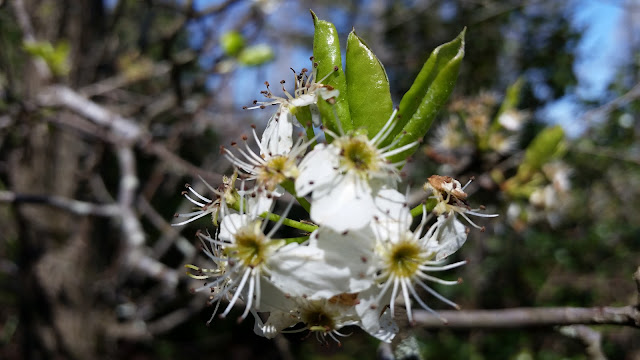
Pear trees are popular in the south because they become "white clouds" in early spring. This is Cleveland Pear, an improved variety of Bradford Pear, the bane of the existence of my horticulture friends. Bradfords are short-lived, weak-limbed, and given to storm damage. They can also be invasive.


Flowering quince is another popular shrub that blooms in early spring. This one is peach colored.


Alabama Croton is a rare semi-evergreen shrub, in fact, on the endangered list. In early spring it puts out yellow fringe flowers above leaves that are green on top and silver on bottom. If you want an unusual "conversation" shrub in your yard/garden, try this.


If azaleas hate my garden, the other ubiquitous shrubs of the lower south, camellias, love it. I have two dozen bushes, all blooming prolifically. Go figure. This particularly lovely one is "Nuccio's Pearl." 


Camellias come in a wide variety of sizes and colors. If you have a small and shady spot in your yard/garden that needs something, try this camellia that grows only three feet tall, "Emmett Barnes." In winter, it will give you an abundance of pure white flowers.


One corner on the back side of my garden is anchored by a windmill palm. The large evergreen shrub is Chindo Viburnum, a recent import from Korea. It starts a screen of evergreen bushes around the back side of the garden. Just beyond, on the left here, is a ditch that runs rushing water down a hill through winter and spring and becomes a dry bed in summer.

So, just when we thought we were getting over one emergency, the plague, here comes another, the worst war since WWII. No one asked for these. They were given to us for the living of our lives. We have no choice now but to respond to them. It is how we respond that matters. And, I am greatly heartened by the wonderful responses to adversity that I see all around us: who cannot be inspired by President Zelensky, by the fortitude of the Ukrainian people, by the bravery of the protesters in Russia, by the incredibly generous welcome to refugees in Poland and the other border states of Ukraine, by the aid workers inside Ukraine, the words of the pope, and so on? Even in this darkest of hours, the light of grace abounds. No evil deeds, not even those of Putin, can overcome the goodness of God and the people who do his/her work in the world. Peace.


Wednesday, March 16, 2022


THE LEGACY

OF BISHOP MARK LAWRENCE


Mark J. Lawrence is ending his tenure as a diocesan bishop after fourteen years. He served as bishop of the Episcopal Diocese of South Carolina from 2008 to 2012 and as head of the Anglican Diocese of South Carolina from 2012 to 2022. This month, March of 2022, he is being succeeded by a new bishop of ADSC, "Chip" Edgar. It is not too early to start thinking about Lawrence's legacy. What difference did he make? How will history see him? These are fair questions to start asking.

Certainly the obvious first response would be to see him as the bishop of the schism in South Carolina. He led the majority of the clergy and laity of the Episcopal diocese of SC out of the Episcopal Church and into a new denomination. First and foremost, Lawrence will always be remembered as the bishop who presided over the division of one of the nine founding dioceses of the Episcopal Church. This is not controversial. What is controversial is whether this was the right thing or the wrong thing to do. 

We should not jump to conclusions now even though everyone involved has his or her own opinion of Lawrence. In time, history may see things differently in ways that we cannot imagine today. For instance, my father was chief of police of Pensacola FL in the 1960's and 1970's. That town, as every one in the south, was embroiled in racial unrest. Our phone rang off the hook morning noon and night as people for civil rights and people against civil rights turned to him to get the police to help. He was caught in the middle and could seemingly please no one. He was mercilessly criticized and sometimes physically threatened. Nevertheless, he soldiered on and even in the midst of all the civic tumult directed a major reform of the department that made it a professional force for the first time. When he retired, as weary and sad as Lawrence seemed to be last week, we assumed he would always be remembered as the controversial chief of the civil rights era. We were wrong. Now, all these decades later, my father is remembered primarily as the chief who turned the Pensacola police department into a high-level professional force. So, how we see Lawrence's legacy today may not be how people see it years from now.

In beginning to approach an assessment of Lawrence as bishop we should start with the empirical data at hand. This is the best way we can quantify the actual effects of his work as bishop. When Lawrence arrived, in January of 2008, the Diocese of South Carolina listed 31,572 baptized members and 27,670 communicants (active members). In its most recent figures, of 2020, Lawrence's diocese, ADSC, claimed 19,597 baptized members and 11,337 communicants. This is a drop of overall members from 31,572 to 19,597 and active members from 27,670 to 11,337. So, Lawrence's is leaving a diocese 11,000 members and 16,000 active members fewer than the one he gained fourteen years ago. Even if we combine the 7,000 members of the Episcopal diocese of SC today, we would still see a big drop in collective membership. Moreover, the ADSC lost members steadily every year since the schism of 2012. Thus, we can see there has been a severe and unrelenting loss in diocesan membership in the Lawrence years. This is a legacy we know from the irrefutable evidence at hand. If the proof is in the pudding, this pudding is bitter.

Beyond the quantifiable data, there are areas we can partially quantify or are in the process of quantifying. Before the schism, the diocesan leadership led the people of the diocese to believe 1-the diocese could secede from the Episcopal Church intact, and 2-the local parishes could leave the Episcopal Church with their local properties in hand. These issues went to court when Lawrence's contingent sued the Episcopal Church on Jan. 4, 2013, starting a very long course of bitter and expensive litigation. 

As for the first point, the U.S. District court in Charleston ruled that the diocese did not secede from the Episcopal Church, that the departing people formed a new entity in 2012, and that the Episcopal diocese was the legal heir of the old diocese. To boot, the judge issued an Injunction forbidding Lawrence's diocese from claiming in any way to be the heir of the pre-schism diocese. This decision is now on appeal but there is very little chance that it will be overturned. The first claim the schismatics made is on the cusp of being legally denied forever. 

As for the second point, in 2017, the South Carolina Supreme Court ruled that 29 of the 36 parishes in question were property of the Episcopal Church and that 7 of the parishes owned their own property. The circuit court then nullified this decision; and this nullification is now on appeal before the SCSC. The SCSC can either affirm their 2017 decision or revoke it in favor of the circuit court's nullification. No one should predict how this will turn out, but it is hard to see how the state supreme court could reverse their own decision that had become the law of the land. If in fact the SCSC affirms its 2017 ruling, the diocese that Lawrence led will be left with 6 parishes (one of the 7 was St. Andrew's of Mt. Pleasant which is in Steve Wood's ACNA Diocese of the Carolinas). If the SCSC rules in favor of TEC, the second pre-schism assertion will be disproved. 

If the U.S. appeals court and the SC supreme court finally rule in favor of TEC, both assertions put forth by Lawrence's diocesan leadership in 2012 will be shown to be false. This would be another bitter legacy, at least bitter to the lay people who trusted their diocesan leadership, and in a way bitter to everyone involved on both sides.

Of course, followers of Lawrence may argue that it is not quantity that matters but quality, and they may have a point. Numbers of members and of churches do not necessarily translate into strength. As we all know, sometimes smaller churches can be more active and accomplish more than larger ones. There are many more things to be measured besides just empirical data.

Lawrence's Anglican Diocese of SC has survived for nearly ten years even though it is on a downward trajectory. One cannot be sure it will go on much longer as an independent entity, even if it wins in the SCSC. Although I know of no hard evidence, I suspect that the diocesan leadership decided before the last bishop's election to go to an outsider and one from the overlapping ACNA diocese. Hence, Edgar, a man who had had no connection with the ADSC was put up against two in-house candidates who had played relatively minor roles in the schism. Nevertheless, there was a surprisingly strong diocesan reaction as Sturdy ran a competitive race before finally losing out to Edgar. This signaled that a lot of laity did not want to lose the separate identity they had nurtured for so many years in the war of the courts. Yet, no one should be surprised if Steve Wood's Diocese of the Carolinas absorbs the larger Anglican Diocese of South Carolina. If ADSC disappears altogether, this would throw another question on Lawrence's legacy.

On a personal note, in the four years I spent researching my history of the schism, I grew to admire many qualities of Lawrence as a person. A big regret I have now is that he did not take me up on my offer for an interview. I have never met him although I have seen him at church functions. Everyone who knew him, even his strongest critics, would admit to certain outstanding aspects of his personality. By all accounts he was a stellar parish rector who, sometimes, against formidable odds, built up thriving congregations. They were almost all devoted to him. He had a certain charisma as a teacher, pastor, and priest. I sometimes wondered if parish ministry were his true calling. He certainly appeared happier then, but perhaps that was just the vigor and idealism of youth.

I wondered too if his critics before and after the schism focused too much on him personally even though as bishop he was naturally the point of the focus. In all fairness, Lawrence did not originate the schism in South Carolina. In fact, he came rather late to the process which really started moving in 1982 when Bishop Allison began a trend of criticizing the Episcopal Church. By the 1990's the anti-TEC movement had gained a lot of steam and some people of the diocese began organizing to oppose the church. The national church's approval of a non-celibate gay man as a bishop and the election of a woman as presiding bishop heightened the rising tide of criticism in SC against TEC. Indeed, testimony was given in court that the search committee consciously and deliberately sought a candidate for bishop who would lead the diocese out of the Episcopal Church. Lawrence did not apply. He was invited, and then tapped. By the time he arrived in 2008, the secession movement in the diocese of SC was well under way after 26 years. So, it is not accurate to blame Lawrence entirely for the schism. However, once he accepted the mantle as leader of a diocese already set in opposition to the national church, he apparently never looked back. Between July and October of 2012, events suggest that the diocesan leadership plotted in secret to remove the diocese from the Episcopal Church. Even though Lawrence did not create the secessionist movement in South Carolina, by all appearances, it seemed to me that he willingly led it as bishop.

Since the winners typically write the histories, much of Lawrence's legacy will depend on how the two court cases end. His best hope is for the SCSC to agree to let Judge Dickson's order stand and for the U.S. court of appeals to overturn Judge Gergel's order. This way, ADSC would hold all the 36 parishes in question and the entity of the old diocese. The worst case scenario for ADSC is for the SCSC to deny Dickson and uphold its 2017 decision and for the appeals court to uphold Gergel. This way, the ADSC will wind up with 6 parishes and nothing of the pre-schism diocese. It would have to relinquish Camp St. Christopher and all the diocesan properties, as the bishop's residence on Smith Street. The people now meeting in the 29 parish churches would have to move out or stay in and return to the Episcopal Church. The best case would brighten Lawrence's legacy, the worst case would diminish it. So, much remains to be seen.

Long term, the future of the Anglican diocese of SC is not good, and not so much because of declining membership and losing court cases, but for the tide of history. History is moving inexorably against the identity of the ADSC. The sweep of history in the last few centuries has been toward human rights. The rise of democracy was a huge part of this. The ADSC was set up to oppose human rights for homosexuals and for women. It and its parent, the Anglican Church in North America, aim to keep non-celibate gays and women out of the church leadership. This is against the tide of history. In time, chances are the tide will wash away the man-made sand dunes of resistance and the people who tried to build those barriers.

Finally, one way to reflect on Lawrence's legacy is to contrast his arrival as bishop and his departure. His consecration, on 26 January 2008, was really a three day festival where hundreds of people from all around the world descended on Charleston for a raucous celebration. His house was overflowing with friends from far and wide, dinners, receptions and the like kept cheerful people up all hours. The procession of bishops in the consecration was so long, it took thirty minutes to finish. By contrast, his leaving office on 11 March 2022 was a sad, tearful, and wearisome litany of thank-yous to groups and friends who had stood by him. After fourteen years, there was no ebullient celebration of victory. What had come in as a roaring lion went out as a quiet lamb. Perhaps this tells us more about Lawrence's legacy than anyone can say now.

As a student of history, I hope that Mark Lawrence will write his memoirs, or at least his account of the schism. We need to know his side of the story. It would give us all a better understanding of what happened in this event that has been so much a part of our lives. Besides, I think his legacy deserves it.  

Monday, March 14, 2022


LAWRENCE'S FAREWELL ADDRESS:

May we one day share a toast at the taste of victory.


Bishop Mark Lawrence gave his farewell address to the Anglican Diocese of South Carolina on 11 March 2022 at the annual meeting of the diocese. An audio file of the speech is available here . It is thirty minutes long.

If one were expecting great oratory or fireworks, one would be disappointed. It was a low-key, lackluster, mostly innocuous and emotional listing of self-serving generalities and thank-yous. The only slightly edgy comment came in his thank-you to the standing committee when he said to them, "May we one day share a toast at the taste of victory." Actually, his diocese has lost in both the state supreme court and federal court and although both are on appeal, it is dubious that he will see "victory" in either.

In the first half of the address, Lawrence briefly tried to justify the schism by putting his actions in the context of the Anglican Church in North America and the GAFCON world. He gave a long list of activities various people had done with ACNA. To be sure, he used the word "province" for ACNA repeatedly. In fact, ACNA is an independent religious denomination. It is not a province of anything. As "province," he used the word "Anglican" time and again as if repeating it enough would make it authentic. The ACNA and ADSC are faux Anglican. They are not recognized by the Archbishop of Canterbury. They are not in the Anglican Communion. Their bishops will not be invited to the Lambeth conference this year. 

He tried to justify his leadership actions as necessary for "the battle for the soul of Anglicanism." He tried to wrap them in Anglicanism with "the larger Anglican church came to our rescue." What came to his rescue was not the Anglican Communion but the collection of reactionary Anglican bishops resolved to keep homosexuals and women from equality and inclusion in the life of the church.

In the second half of the address, Lawrence went through a long list of emotional thank-yous to various diocesan groups and people. The only slight dig he made at his critics came when Lawrence sneered at critics' references to the clergy as "lawrencian lemmings and other insulting absurdities." Blogger Steve Skardon often called the followers of Lawrence Lawrencians but I do not recall that he ever labeled the clergy as Lawrencian lemmings although it does have a ring to it.  

Interesting too at what Lawrence did not say. He left out an awful lot he could have mentioned. He said nothing directly about the schism and nothing at all about the litigation. He gave no hint at a possible union with Steve Wood's diocese. He did not say when his last day of bishop would be. He said nothing about the severe and unrelenting decline in membership.

On the whole, the Lawrence we hear now seems tired and old, seemingly a far cry from the vibrant man who arrived in 2008. Gone is the fire and soaring, if grandiose, rhetoric of his long and impassioned diocesan addresses of the old wrestler's fighting days. In fact, we have not heard much from him since the schism of 2012. The most we have gotten from Lawrence was in his rally tour of the diocese after the SCSC decision of 2017 when his diocese was expecting to leave the properties and reconstitute in exile. We saw the old fire of combat return then. It was not in his farewell address of 2022.

I will return later with an assessment of the Lawrence years.