Thursday, April 28, 2016


A CAUTIONARY NOTE FOR
THE DSC


The schismatic diocese of South Carolina (DSC) is supposedly in "discernment" about whether to join the Anglican Church in North America. A special convention is expected to be called this autumn to pass the first approval. The second and last vote will come in the regular convention of March 2017. Since the committee on affiliation is recommending joining ACNA, and the committee was personally named by Mark Lawrence, it is a foregone conclusion that DSC will join ACNA. (See my post of March 23, 2016, "South Carolina and the Anglican Church in North America.")

The recent election of a new bishop in the schismatic diocese of Pittsburgh should be a cautionary note for the folks in South Carolina. See the excellent description in EpiscopalCafé: www.episcopalcafe.com/holy-spirit-stirring-in-acna-pittsburgh-diocese/ and the comment of blogger Mark Harris: www.anglicanfuture.blogspot.co.nz/2016/04/let-this-be-sign-unto-youacna-and.html .

On April 23, the Anglican Diocese of Pittsburgh (ADP) (of the Anglican Church in North America, ACNA) held an election for a bishop to replace retiring Robert Duncan. Originally eight candidates were presented but three dropped out leaving five, all from outside the diocese. Another candidate was nominated from the floor, the Rev. Jonathan Millard, a popular rector in the diocese. He was obviously the first choice of the clergy and laity of the diocese, but just before the election, Duncan issued a dire warning to the assembly that Millard might not get approved by the College of Bishops of ACNA because he was divorced. (Ironically Duncan had been elected bishop of Pittsburgh after being nominated from the floor). On the first ballot, Millard led the field with clearly the highest votes in both clergy and laity. The Rev. Jim Hobby, rector of an Anglican church in Thomasville GA, trailed. The same was true on the second ballot as Millard remained the clear favorite among both clergy and laity. On the third ballot, three candidates remained and votes shifted toward Hobby. By the fourth ballot, Hobby was ahead and Millard dropped away. Hobby was elected on the fifth ballot. In the end, the diocesan convention elected a person who was not the leading favorite of the assembly.

Under the Constitution and Canons of ACNA, power is concentrated at the top, in the archbishop and the College of Bishops. A bishop is nominated by election in the diocese but must be approved by a two-thirds vote of the College of Bishops. In TEC, bishops are normally approved by a majority of the Standing Committees of the dioceses. The ACNA C and C also spell out the approval of sexual relations only within a permanent and lifetime matrimonial union of one man and one woman. This sets a very high bar indeed as it would presumably disqualify anyone for bishop who ever had any kind of sexual relations outside of legal, heterosexual marriage as well as divorced men (only men can be bishops in ACNA). Even so, the delegates in Pittsburgh wanted to elect, and almost did elect, a man outside the narrow bounds as laid out in the ACNA C and C.

Before the good people of DSC go headlong into the ACNA, they should be aware of what joining will mean to their selections of their own bishops. They will have to follow out-of-date and very narrow guidelines that will eliminate many good candidates, as Millard. They will also have to submit to near-dictatorial rule of the ACNA hierarchy. A two-thirds vote is tantamount to a veto among the bishops of ACNA. This will leave DSC, as it has ADP, at the mercy of the ACNA archbishop (who alone can convene the College of Bishops) and bishops. DSC will be very highly constricted in whom it can choose as its own bishop. This is a cautionary tale for a "diocese" that for years before the schism of 2012 railed long and hard against the supposed tyranny and dictatorship of the Episcopal Church. In reality, ACNA is far more undemocratic than TEC ever was. DSC may have to learn this the hard way, as the good people of Pittsburgh have just learned.


The schism in Pittsburgh has not gone so well for the planners, not only in the defiant vote mentioned above. State courts ruled entirely in favor of the Episcopal diocese. Some local churches that initially broke away, returned to TEC. The Episcopal diocese now lists 36 local churches and about 10,000 members while the Anglican diocese lists 40 churches and 7,937 members with many in these numbers being beyond the geographical boundaries of the old diocese. 


Saturday, April 23, 2016


MY GARDEN, APRIL 23, 2016


Two weeks ago (April 9), I posted photos of my garden. Since many people appreciated seeing the garden, I am posting more photos showing what is blooming in the garden today, Saturday, 23 April. As any gardener knows, plants change daily, and show off at different times in different ways. This year is providing an unusually beautiful springtime here in the South. As one sees I am fond of trees, shrubs, and perennials. My motto is: "Low Maintenance." One will also see weeds. My philosophy is a garden that does not grow good weeds is not much of a garden. I pull the weeds as I can but do resort to Round-Up although I hate putting poison in my garden.


I hope you enjoy this garden as well as the gardens in different forms all over the place. They are everywhere if one will only look. Every now and then it is best to forget about everything else and just soak in the incredible beauty of God's creation all around us.

 Deutzia (Deutzia gracilis) is an old fashioned Southern favorite shrub. You can see why.

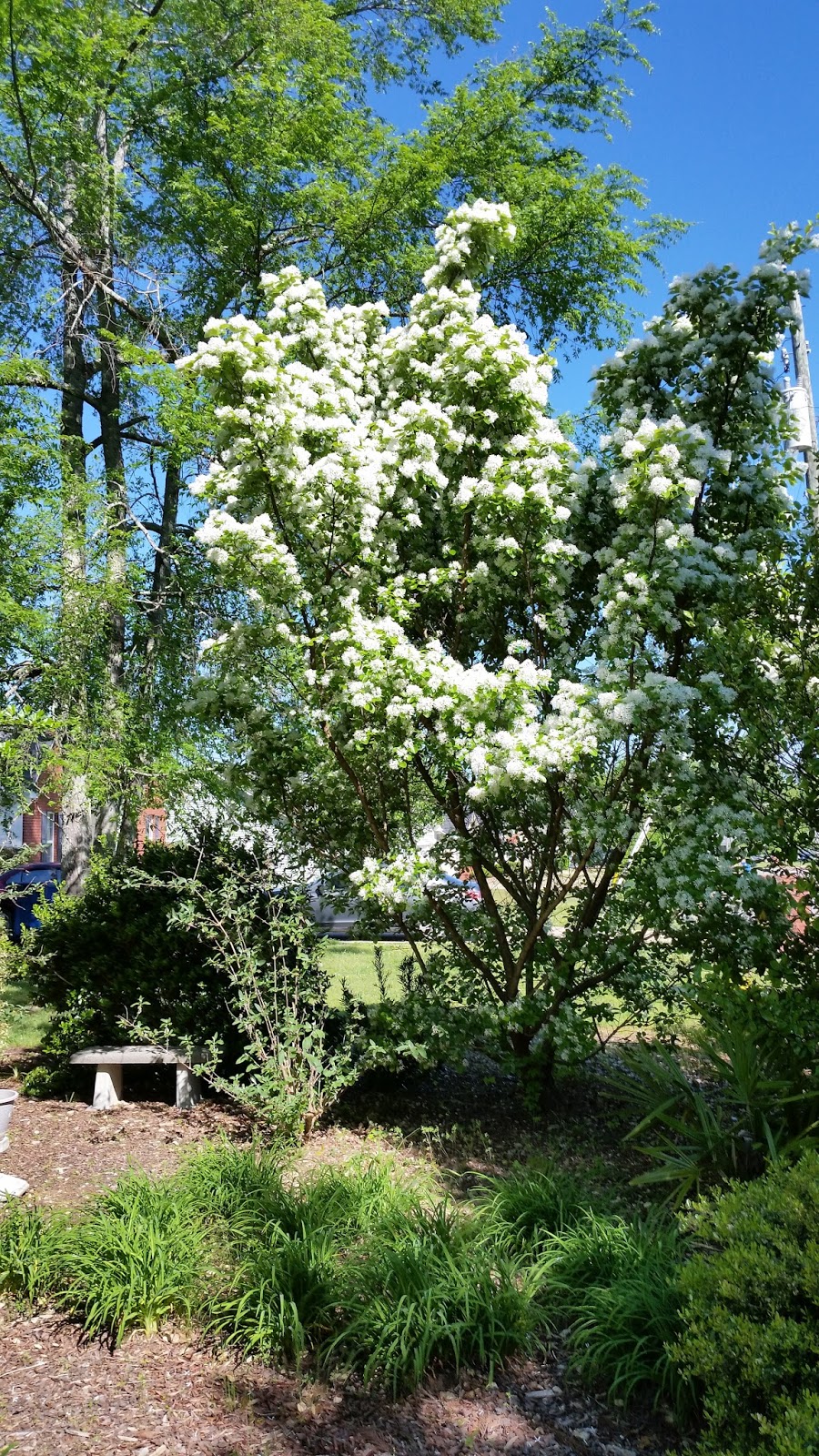
Chinese Fringe Tree (Chionanthus retusus) is covered with white "fringe." It is nearly full grown at about 15'. The star of the garden at the moment (Snowball bush is fading out).

Clematis is one of the most common vines anywhere, and for good reason. This is 'Polish Spirit.'

Red Knockout Rose is my favorite rose because it is low care and blooms prolifically from frost to frost. Japanese beetles arrive in late May early June but do not last as they are favorite food for some of the birds that inhabit my garden. I have 32 Red Knockout Rose bushes. I prune them in winter, give them a little fertilizer and then leave them alone. They reward me in abundance.

Blue Wild Indigo (Baptisia australis 'Purple Smoke') is another favorite perennial shrub.

Blue Wild Indigo with banana trees in foreground. Every southern garden should have banana trees.

Eve's Necklace (Sophora affinis) is a small tree, eventually to 15'. It has long blooms resembling necklaces. This is one of the most unusual plants in my garden. In fact, I have never seen one growing anywhere else. I ordered this as a seedling from a nursery in Texas.

Clematis 'Duchess of Edinburgh'.

Bananas on left. Foreground is Bluestar (Amsonia hubrichtii). Middle ground is Wild Indigo, yellow (Baptisia 'Screaming Yellow'). Large bush in background is a camellia.

Weigela is another common southern shrub. This one is an unidentified cultivar. It is also quite large, over 7'.

Crossvine (Bignonia capreolata var. atrosanguinea). The vine is on a trellis but I let it tail as it likes. In gardening, as in life, I am a democrat. I believe society should incorporate Liberty, Equality, and Fraternity. I give the plants freedom as long as they are not invading other's spaces (BIG exception=poison ivy). I treaty them equally. and I give them an environment of brotherhood and harmony, hundreds of very different species living together happily. I suppose my garden is my own little metaphor for my worldview. Crossvine is one of many plants feeding the many hummingbirds in my garden.

Spiderwort (Tradescantia virginiana 'Concord Grape') in foreground. Back is Louisiana Palmetto (Sabal minor "Louisianaises"), my favorite bush-type palmetto, very cold hardy and producing large blue-green fronds. The weeds are evident.


Where did you get your plants? I have heard that a lot. I have over 800 individual plants representing over 300 different species ranging very widely. Most of my plants came from nurseries local to me, others from my travels, or other people's trips. For my readers in South Carolina, I can tell you my two favorite nurseries in SC. One, Woodlanders, in Aiken, is primarily a mail-order business. They have a huge variety of native and unusual plants. For a walk-through nursery, my favorite in SC is Nurseries Caroliniana in North Augusta. It is vast but well organized, presenting an enormous variety (for instance the Chinese Fringe Tree pictured above came from there), and reasonably priced. Of course, every city in SC has its share of fine nurseries too. 


Thursday, April 21, 2016


FORT WORTH
IN APPEALS COURT TODAY ---
with Addendum (20 Apr.) and
Second Addendum (21 Apr.)


Original post, 19 April:     The Texas Second Court of Appeals, in Fort Worth, is hearing the Episcopal Church case today, Tuesday, 19 April, at 1:30 p.m. To my knowledge, there is no audio or video streaming of today's hearing. The judges will be hearing arguments from the competing dioceses concerning the Episcopal Church's appeal of the "Final Judgment" of Judge John Chupp, of the 141st Judicial Court, of Tarrant County, Texas, dated July 24, 2015. The Judgment awarded everything in question to the breakaway diocese.

Of all five secessionist dioceses, Fort Worth has had the most curious history of litigation. Three of the five cases were completely one-sided, Pittsburgh and San Joaquin entirely in favor of the Episcopal Church while Quincy was the opposite, completely in favor of the secessionist diocese. Fort Worth, however, has been on both sides.

The original court judgment in Fort Worth awarded all to the Episcopal Church side. That was Judge Chupp's order of 21 January 2011. The breakaways then appealed that decision directly to the Texas Supreme Court which held oral arguments on 16 October 2012, and rendered a written decision on 30 August 2013. In a 5-4 split, the supreme court ruled that the case must be remanded to the Judicial Court with direction to follow "neutral principles." The minority of the court held that the case was not appealable to the state supreme court. The Church side then appealed to the U.S. Supreme Court in 2014 but that court refused to accept the case for judgment, perhaps because it had not been decided by the highest court in the state of Texas. The case then went back to the original judge, John Chupp, in the 141st who held a new hearing directed by the state supreme court order for neutral principles on 20 February 2015 and issued a terse written order on 2 March 2015 with a short "Final Order" on 24 July 2015. Chupp awarded all to the breakaway diocese, the exact opposite of his 2011 ruling. It is this "Final Order" that the Church side appealed to the Appeals Court and is being heard today.

There is plenty here for the appeals court judges to consider. The Church side is essentially arguing for hierarchy, that is with sovereignty in the central authority, while the secessionist side is arguing for local rights, that is, with sovereignty in the local entity.

On December 3, 2015, the Episcopal Church diocese and the Episcopal Church both filed briefs (written arguments) with the appeals court, 202 p. and 49 p. These may be found at: http://episcopaldiocesefortworth.org/episcopal-parties-file-appellate-briefs-in-the-fort-worth-court-of-appeals . The breakaway (also known as the Episcopal Diocese of Fort Worth) side then filed a response brief of 95 pages on 4 March 2016: www.fwepiscopal.org/downloads/AppelleesResponsetoLocalParties-030416.pdf .  

Since we cannot see or hear the hearing today, we can only hope for a detailed description from the two sides involved asap. I will pass these along as I receive them.


ADDENDUM, 20 April. The hearing was held yesterday in the Second Court of Appeals, in Fort Worth. Three judges heard the oral arguments: Anne Gardner, Lee Gabriel, and Bonnie Sudderth. The courtroom was packed to capacity for a hearing that lasted 39 minutes.


An audio recording is available at:  http://episcopaldiocesefortworth.org/court-of-appeals-hears-arguments/ . This also has a report from the Episcopal Church diocese.


The schismatic diocese also has a report on the hearing at: http://www.fwepiscopal.org/news/courtofappeals.html .


SECOND ADDENDUM, 21 April. 


Having heard the audio of the hearing on 19 April, these are my thoughts:


The plaintiff (Episcopal Church diocese) lawyer spoke first. He argued basically that the Episcopal Church was hierarchical and that when the diocese was created (in 1983) it gave unqualified accession to the Constitution and Canons of the Episcopal Church with the force of an irrevocable contract. The diocese had no right to unilateral independence or to secession from TEC. In Fort Worth there were two entities: 1-the Corporation (incorporated under Texas law) that held title to the deeds and 2-the unincorporated diocese. The corporation held the property in trust for the Episcopal Diocese of Ft. Worth which itself is part of the national Church. In sum, this property issue was really an ecclesiastical issue that must be left to the Church under the First Amendment.


The defendant (secessionist diocese) lawyer countered that the diocese was an independent entity free to amend its rules under state law. The Corporation was an independent entity under state law and governed by the diocesan convention. Courts must follow "neutral principles" and settle the property issues under state property laws.
A judge interrupted the defendants' lawyer to speak twice: 1-are not we getting into ecclesiastical issues (referring to the structure of the diocese)? and 2-the Texas Supreme Court did not make a decision in the case, only remanded to lower court with direction for neutral principles.


The Church lawyer then offered a rebuttal. He said only the Church, not the courts, may decide which is the rightful diocese. He also pointed out that the 55 property deeds state explicitly the property was held in trust for the Episcopal Church in the Diocese of Ft. Worth. He asked the court to enforce the deeds.


The fundamental issue in Ft. Worth was the same as in South Carolina, sovereignty. The Church's position is that ultimate power rests in the national Church, specifically in the General Convention. All dioceses must recognize that. As for property, all local properties are held in trust for the Episcopal Church and its diocese. On the other hand, the secessionist side argued for local sovereignty, that the local diocese governed itself and existed as an independent legal entity under state corporate law, and that the national Church had no right over the local properties.


It is impossible at this point to predict how the Texas Second Appeals Court will rule. It is dealing with contradictory decisions from the same judge (John Chupp), the first giving all to the national Church side, the second giving all to the secessionist side, and a direction from the state supreme court that the case be heard under "neutral principles." (The appeal before the court is Chupp's second decision). A judge asked only two questions on Tuesday, both of which suggested reluctance to interfere in an ecclesiastical matter. As we have seen, neutral principles does not necessarily mean the secessionist side will win. In California, the court followed neutral principles and found all in favor of the national Church; and this was affirmed by the appeals court. 


Monday, April 18, 2016


BREAKING NEWS ---
ANGLICAN CONSULTATIVE COUNCIL REJECTS PRIMATES' "CONSEQUENCES"


The Anglican Consultative Council voted today to reject the "consequences" imposed on the Episcopal Church by the primates in their January 2016 gathering in Canterbury.

According to the Episcopal News Service report just posted, the ACC today passed Resolution C34 which recognized the Archbishop of Canterbury's report on the primates' gathering and affirmed the decision to "walk together." Then, the ACC tabled (withdrew without a vote) Resolution C35 which would have accepted the primates' statement. The ABC himself wanted C35 to be withdrawn. For EpiscopalCafé's report see: www.episcopalcafe.com/intentional-discipleship-in-a-world-of-differences-acc-2016-declines-to-enforce-consequences-issued-by-primates .


Passing C34 and killing C35 speaks loudly and clearly that the ACC rejected the primates' directive to the ACC to impose punishment (using the euphemism of "consequences") on the American Episcopal Church.

Two points to emphasize here: 1-the Anglican Communion has no central government. It has "Four Instruments of Communion" that are separate and co-equal. No one Instrument has any authority over any other. No one has any right to interfere in any of the 38 independent churches (provinces) of the AC. The primates' had no right to direct the ACC to do anything and the ACC has now told the primates' that in no uncertain terms.

2-More evidence to support my contention that the movement to drive the Episcopal Church out of the AC and replace it with the Anglican Church in North America is dead (see my postings of April 11, "The Collapse of the Anti-Episcopal Church Movement in the Anglican Communion" and of Feb. 1, 2016, "The Failure of the Replacement Strategem"). The ABC and the ACC rallied to save the Episcopal Church's place in the AC. The anti-TEC hardliners have now been reduced to a marginalized handful of the most fiercely anti-homosexual-rights primates of equatorial Africa. In one case, Kenya, even the delegates rejected their archbishop's wish and attended the ACC meeting anyway.


Monday, April 11, 2016


THE COLLAPSE OF THE ANTI-EPISCOPAL CHURCH MOVEMENT IN THE ANGLICAN COMMUNION


After three days of the Anglican Consultative Council meeting in Lusaka, Zambia, it is not too soon to draw the conclusion that the movement to drive the Episcopal Church (TEC) out of the Anglican Communion (AC) has ended in a fizzle. Death occurred in Lusaka, Zambia.

The movement actually started in 1997 in a conference hosted by the newly-formed right-wing political action committee called the American Anglican Council that brought together anti-homosexual-rights' forces in the Episcopal Church with anti-homosexual-rights' Anglican leaders from equatorial Africa. In 1998, this coalition pushed through the Lambeth Conference a statement condemning homosexuality. From there, equatorial African primates began incursions in America, in violation of a longstanding principle in the AC against cross-border actions. In 2000, the primate of Rwanda sponsored the Anglican Mission in America, under Chuck Murphy, of Pawleys Island, SC. Peter Akinola, primate of Nigeria, was in the U.S. on the eve of the vote on Gene Robinson in 2003 to help unify the anti-homosexual forces. Soon, Rwanda, Kenya, Nigeria, and Uganda were all making links among the anti-homosexual forces leaving TEC. The Chapman Memo in December of 2003 outlined a blueprint for schism from TEC. The Barfoot Memo in March of 2004 laid out a scheme for dissident Episcopalians to unite with African bishops. By 2004, when the Anglican Communion Network formed, the goal of the anti-homosexual American dissidents was to create a replacement church to take the place of TEC in the AC.

In July of 2008, GAFCON (Global Anglican Futures Conference) formed from Third World, highly evangelical, Anglican provinces and drew up the Jerusalem Declaration that purported to set up a "confessional" Anglicanism which explicitly condemned homosexuality and rejected the authority of Anglican provinces (i.e. TEC and Anglican Church of Canada) that supported rights for homosexual persons. The next year GAFCON "recognized" the new Anglican Church in North America (ACNA), the outcome of the 10-year movement in TEC against the reforms favoring homosexuals. GAFCON and its allied group, Global South, supported ACNA as the replacement church to take the place of TEC. Global South was an organization of 24 Anglican provinces (of the 38 in AC), with a Steering Committee headed by Mouneer Anis, primate of Jerusalem and the Middle East. He has been a very strong advocate for Mark Lawrence, even before the schism of 2012. In 2014, GS announced an "oversight" plan for the schismatic diocese of South Carolina.

In 2015, TEC adopted same-sex marriage and changed its canons to reflect this, the first province in the AC to do so. The equatorial African bishops responded with strong protests against the destruction of "the godly order" of the AC. By late 2015, the movement to drive TEC out of the AC seemed stronger than ever and on the brink of success.

The unknown problem was that much of the anti-TEC movement was an overblown illusion and had been all along. Neither GAFCON nor GS had the unity or resolve they tried to project. This became starkly and surprisingly clear in the primates' gathering in Canterbury in January of 2016 when the GAFCON/GS coalition put everything to the test. Stanley Ntagali, primate of Uganda led the attack on TEC. No doubt he was upset by TEC's General Convention resolution supporting pro-homosexual groups in Africa. Ntagali presented a crisis to the primates on the first day of the gathering demanding that TEC be expelled. Put on the spot, GAFCON/GS, which actually counted the majority of the primates, collapsed. Ntagali stormed out of the gathering in protest, alone. This drew back the curtain revealing the actual disarray of the anti-TEC coalition. Next, the anti-TEC party tried to get TEC expelled from AC for three years. That failed too, the second blow to GAFCON/GS. Then the primates drew up a communiqué with two landmark provisions: a slap-on-the-wrist for TEC (called consequences), and the rejection of the ACNA for admission to AC. This ended the "replacement" scheme. In retrospect, the Archbishop of Canterbury's (ABC) "walking together" theme saved the day for TEC. He insisted the AC would remain the same. This was the important point that saved TEC; the "consequences" were really inconsequential.

The hardliners refused to throw in the towel. As a last gasp in the anti-TEC movement, certain equatorial African primates turned to the upcoming Anglican Consultative Council meeting in Lusaka, Zambia, 8-19 April, 2016. They insisted that TEC had rejected the "consequences" and demanded TEC be restricted in the meeting.


As a protest against TEC, 5 primates announced they were opposed to their provinces participating in the Lusaka meeting (the equatorial provinces of Uganda, Kenya, Rwanda, Nigeria, plus Mouneer Anis' (chair of GS) Jerusalem and the Middle East). A strange case happened in Kenya when the primate claimed a forged letter allowed his delegation to attend. The three delegates from Kenya did attend in spite of their archbishop's opposition. (The official attendance roster showed that only three provinces actually boycotted the meeting: Uganda, Nigeria, and Rwanda. Kenya was in fact represented by its 3 delegates and Jerusalem/Middle East by its 1, the Rt. Rev. Michael Lewis.) The reality that only 3 of the 24 GS provinces actually boycotted the meeting showed the dying weakness of the anti-TEC movement among the GAFCON/GS caolition. Obviously the vast majority of the GAFCON/GS churches in the AC were no longer willing to act against TEC.

Before the ACC meeting, the chair, James Tengatenga, of Malawi, made it clear that TEC had every right to attend and participate. The ABC sent a letter to all 37 other primates on March 16 urging them to support the meeting. This was a scarcely veiled rebuke of the equatorial primates who had announced their (anti-TEC) boycott. In his opening address to the ACC meeting on 8 April, the ABC made it clear that all proper actions had been taken regarding TEC and the meeting should proceed. All three TEC delegates were present and ready to participate fully. 

Then, on 11 April, Josiah Idowu-Fearon, General-Secretary of the Anglican Communion, of Nigeria, issued a blistering rubuke to the equatorial primates, particularly that of Kenya. ( www.anglicannews.org/news/2016/04/a-statement-from-the-anglican-communions-secretary-general.aspx ). He listed nine points strongly defending TEC, and the ABC, and taking to task the anti-TEC side. He minced no words. One should read it to get the full effect that a second-hand description would lack. It appears to me that Idowu-Fearon's statement of today is the nail in the coffin of the anti-TEC movement.

In the end, the reality of the AC remains unchanged. It is essentially a friendship circle of 38 independent churches that adhere to a religious and cultural heritage from the English Reformation. It has no central government of any kind. There are four "Instruments of Communion" (ABC, primates, ACC, and Lambeth meetings), but not one has any right to interfere in any one of the 38 churches (called provinces). Moreover, the four Instruments are separate and equal, and no one Instrument has power over any other. Thus, the primates had no right last January to impose any requirement on the ACC. The ACC is an independent body with its own constitution.

TEC survived. Her enemies failed. The AC survived. Classical Anglicanism survived. I do not think it is too early to declare that the storm has passed. GAFCON/GS proved to be only an angry house of cards. Life goes on. But it goes on with greater justice, freedom, and equality because the American Episcopal Church had the courage and resolve to lead the way and the ABC, and other Anglican leaders had the wisdom to defend the Anglican Communion.


(Footnote. Time, events, and greater knowledge have compelled me to alter my original impressions of the primates' gathering of Jan. 2016. In hindsight, we can see that there were two dangers lurking by 2016: the Anglican Communion was about to split up into two hostile groups, and the Episcopal Church was close to being expelled and replaced. Either would have been a tragedy. It was the deceptively wise, calm, and resolute leadership of the Archbishop of Canterbury that kept both of those from occurring. We can now see that what he did in the secrecy of that primates' meeting was really a stroke of genius. He saved the Anglican Communion. He saved the Episcopal Church's place in the Anglican Communion. What more could we ask?
Time has also revealed to us the ABC's biological father. Somehow I think the father, Sir Anthony Montague Browne, a noteworthy public servant in his own right, would have been proud of what his son did this year.)          

Saturday, April 9, 2016


MY GARDEN, APRIL 9, 2016


Let's take a break from church business and just enjoy this most beautiful springtime for a moment. There is nothing more glorious than Spring in the South. These are pictures of my garden I took this morning, April 9, 2016. I live in a small subdivision in Jacksonville, Alabama, where I have my retirement home. I bought the vacant lot next to my house a dozen years ago and developed from scratch my dream garden. Planning, planting, and tending it has been my therapy as well as my joy for all these years. I have hundreds of plants, mostly trees and shrubs but also perennials, vines, groundcovers, palms etc. There are walk paths and seating areas. One will notice no bird feeders. Instead I planted an abundance of natural bird food; and now I have a garden filled with happy birds that sing to me every day. I live on the line of zones 7/8 so have a great variety of plants, some tropical and some northern (as apple trees). In the landscape, there is a lawn in the middle with two garden areas flanking it. Most of the plants are common southern ones, but I do have some rare and unusual ones I collected between Florida and California. You are welcomed to visit! 


"The kiss of the sun for pardon,
     The song of the birds for mirth,--
 One is nearer God's heart in a garden
     Than anywhere else on earth."
Dorothy Frances Gurney, "God's Garden."


The trellis is White Chocolate Vine (Akebia quinata 'alba'). The arching trellis forms an entrance. Flanking the trellis are boxwoods. The tall conifers in the background are Japanese Cedar (Cryptomeria japonica). Along the lawn are Red Knockout Roses (pruned in winter). In a month, they will be in full bloom providing a blanket of red along the lawn. The small tree to the left of the trellis is Corkscrew Willow. The palm is a dwarf palmetto (sabal minor). To the left of it is Spartan Juniper.


The larger side of the garden. Red Knockout Roses along the lawn.


My favorite view. From the top of a slight slope, I can see most of the garden. Camellias on left, hydrangea on right. Small tree is crabapple. Large trees on left, maple.


Yellow Lady Banks Rose (Rosa banksiae). Small tree is Grancy Graybeard (Chiomanthes virginicus). The ground cover on left is Blue Rug Juniper (Juniperus horizontalis 'wiltonii'). Shrub on right is forsythia.


Purple shrubs=Loropetalum Chinese. Yellowish shrubs on right=Abelia grandiflora 'Francis Mason'


Japanese Snowball (Viburnum plicatum 'Sterile'). The crowning glory of the garden at the moment. 15' tall. Hundreds of "snowballs."

Tuesday, March 29, 2016


SOUTH CAROLINA AND THE ANGLICAN CHURCH IN NORTH AMERICA


In the recent convention of the independent diocese of South Carolina (DSC), the task force on affiliation recommended the diocese join the Anglican Church in North America (ACNA). The task force was set up two years ago when the members were hand-picked by Mark Lawrence. The task force's choice means Lawrence's choice. The diocese is supposed to be in "discernment" about whether to join ACNA, but this is a silly charade. Since he became bishop of the Episcopal diocese in 2008, the diocesan bodies have never rejected a recommendation of his. Some proposals have been tabled in convention (compassion for homosexuals; rector to control local property), but none has ever been voted down. A special convention will be called this fall to pass the first approval of the "affiliation" with ACNA. The second and last vote would come in March 2017 in the annual convention.

What is the ACNA? Let's look at origins, structure, history, and prospects.

ACNA's roots go back to the Institute on Religion and Democracy, a right-wing political action group of 1980 funded by deep-pocketed highly conservative foundations and organizations in the U.S. The longtime head of IRD was Diane Knippers, a conservative Episcopalian and member of the Truro Church of Virginia, a prime seedbed of opposition to the reforms of the Episcopal Church. First set up to promote President Reagan's foreign policy, the IRD turned to a domestic agenda at the end of the Cold War around 1990. It then focused on defeating and destroying forces of liberalism in American life. It soon moved to fighting social reform in three denominations prominent in America, Methodist, Presbyterian, and Episcopal. Knippers and two friends set up the American Anglican Council (AAC) in 1996 specifically devoted to fighting progressive reforms in the Episcopal Church, particularly equality for homosexuals. After the consecration of an openly homosexual bishop in TEC in 2003, AAC became the prime facilitator in the formation of an anti-homosexual church to take the place of the Episcopal Church in the Anglican Communion. AAC officers issued the infamous Chapman Memo in December of 2003 which laid out a blueprint for conservative Episcopalians to leave the Church and form a socially reactionary replacement church. The next month, under AAC's guidance, ten ultra-conservative dioceses of TEC formed the Anglican Communion Network, the framework for the future replacement church. Robert Duncan, bishop of Pittsburgh, was "Moderator," or head of this group. Of the ten dioceses in the ACN, five later voted to leave the Episcopal Church.

In 2008, Duncan was deposed from the office of bishop by the TEC House of Bishops for abandonment of the Communion. Shortly thereafter, in December of 2008, he led a convention of highly conservative elements called the Common Cause Partners (or Communion Partners) to set up a new church to be called the Anglican Church in North America. Its aim was to be the replacement church. It declared itself to be an Anglican "province" in formation with Duncan as its archbishop. Also in 2008 formed GAFCON (Global Anglican Futures Conference), a coalition of socially conservative Anglican primates of the Third World pledged to oppose rights for homosexuals in the Anglican Communion. GAFCON "recognized" ACNA, as the replacement church for pro-homosexual TEC, and Duncan as  "primate." In 2014, Duncan retired and was replaced as archbishop by Foley Beach, who, as Duncan, was consecrated largely by equatorial African Anglican primates well-known for their anti-homosexual rights stands.

The Archbishop of Canterbury made it plain that ACNA was not a part of the Anglican Communion. 

In January of 2016, the primates' gathering in Canterbury discussed the admission of ACNA to the Anglican Communion. They said in their communiqué that if ACNA wished to apply for admission to the AC, it would have to go through the Anglican Consultative Council. They also recommended to the ACC that they not admit ACNA to the AC. This effectively ended any chance ACNA had in joining the AC or of ever becoming the Anglican replacement province in the United States. It is interesting to note that the GAFCON primates in Canterbury abandoned ACNA in the meeting and in the communiqué even though Beach was present in the sessions. Thus, ACNA remains for the foreseeable future an independent church with friendly support of some of the primates of the Anglican Communion, but it is not, and almost certainly never will be, a part of the Anglican Communion.

The ACNA is governed by a Constitution and Canons, available on the Internet. The people of South Carolina would be wise to read and study this document before affiliating with ACNA. The C and C is a strange and contradictory mixture of local rights and central authoritarianism. On one hand, it says that local dioceses will retain their own structures, local properties remain in local ownership, and any diocese and local church may secede from the union at any time (the recipe for the inevitable disintegration of this union). On the other hand, it sets up an authoritarian government controlled by the archbishop and the bishops. All bishops have to pledge personal allegiance to the archbishop.

The government of ACNA is vested in four bodies. 1-"The Council" is the decision-making body deciding on policy and rules for the C and C. In The Council, each diocese will have one bishop, one other clergy, and two laity. 2-"The Executive Committee" formed by the Council as the "Board of Directors" is a committee of 12, 6 clergy and 6 laity and chaired by the archbishop. 3-"The Assembly" is a one-house Duma whose sole job is to ratify decisions of the Council. Each diocese gets seats for bishop, 2 clergy, and 2 laity. 4-"College of Bishops" whose power is to choose the next archbishop and approve new diocesan bishops. In sum. the government of ACNA is under the control of the archbishop and the bishops. It is an authoritarian and anti-democratic institution in which the laity have virtually no power.

The ACNA was created on a negative, that is, opposition to the social reforms of the Episcopal Church mainly on homosexuality, but also for equal rights for women. It should not be surprising then that ACNA's Constitution and Canons expressly forbid rights for gays and restricts those of women. Regarding homosexuality, the C and C has three points blocking rights for gays: 1-Title II, Canon 7, Section 1: "The Anglican Church in North America affirms our Lord's teaching that the Sacrament of Holy Matrimony is in its nature a union permanent and lifelong of one man and one woman." 2-Title II, Canon 7, Section 6: Before a wedding in an ACNA church, the future husband and wife are required to sign a statement that marriage is a lifelong union of a husband and wife. 3-Title II, Canon 8, Section 2, "[ACNA] cannot legitimize or bless same sex unions or ordain persons who engage in homosexual behavior. Sexual intercourse should take place only between a man and a woman who are married to each other." The ACNA is also anti-feminist but less stridently. Title II, Canon 8, Section 3 condemns abortion as sin by declaring the sanctity of human life from conception to death (but it does not condemn the death penalty). The C and C also say only men can become bishops although individual dioceses may choose to allow women to be ordained as deacons and priests. 

The communicants of the DSC should also be aware of how joining ACNA will affect their choices of bishops in the future. Under Title III, Section 4, a diocese may nominate a bishop but is encouraged to select two or three names. However many, the name(s) will be sent to the College of Bishops who must vote by 2/3 to approve the new bishop. In other words, South Carolina can choose a nominee but he will have to get a vast majority approval of the ACNA bishops before DSC can consecrate their choice. If DSC's choice fails to get 2/3 vote, DSC has to start over on choosing a new bishop. Ironically, under a 2/3 rule, Lawrence would not be a bishop today as he received just over 1/2 in 2007 (TEC requires only majority approval). DSC's right to choose its own bishop will be severely restricted after joining ACNA.

Moreover, once a bishop is chosen, he must make an oath of loyalty to the archbishop: Title III, Section 5, "And I do swear by Almighty God that I will pay true and canonical obedience in all things lawful and honest to the Archbishop of this Church." The bishop of South Carolina must sear allegiance to the archbishop of ACNA (there is no oath of personal allegiance in TEC; TEC has no archbishop).

Is the Anglican Church in North America a "province"? No. The word "province" is usually defined as a sub-unit of a larger entity, as a province of the Roman Empire, or a province of the Episcopal Church. A province is not an separate entity in and of itself. ACNA certainly calls itself a "province" and DSC recognizes ACNA as a "province." However, in fact, ACNA is not a province of anything. It is an independent entity. The people of South Carolina should recognize this fundamental fact. It is shameful that DSC is still deliberately misleading its own communicants by continually repeating the myth that DSC would be joining a "province" in the Anglican Communion. The bald fact is that ACNA is not a province. Moreover, ACNA is not in the Anglican Communion. It is not part of the Anglican Communion. Facts are facts.

What are the advantages of DSC joining ACNA? There are obviously certain institutional advantages: pensions, insurance, clergy exchanges, and mutual programs and fellowship/support. The communicants of DSC should weight the pros and the cons of joining ACNA.

Given the uncertain future in the litigation, it is probably wise for DSC to link up with some larger body rather than continuing the sham of an oversight from the Global South. It seems to me that as time goes by, the chances that DSC will prevail in court fade. Day by day, odds turn more and more in favor that the state supreme court will come down on the side of the Episcopal Church. If the state supreme court gives TEC the diocese and all the property, the followers of Mark Lawrence who refuse to return to the Episcopal Church will need a lot of help in reorganizing. The ACNA is right there with a Diocese of the Carolinas. The chances are strong that the state supreme court will deliver its written opinion before DSC calls its special convention in the fall. If so, the delegates will have a lot more to talk about than affiliation. If the court does side with TEC, as I suspect they will, the sensible thing for the delegates to do is to make preparations to return to the church of their ancestors. After all is said and done, the Episcopal Church, and not ACNA, is the home of the Diocese of South Carolina. 


Saturday, March 19, 2016


FANTASY LAND


Finally, there is something from the independent Diocese of South Carolina with which I wholeheartedly agree. In its summary of the recent convention, DSC gave a quote from the Rev. Shay Gaillard, "'I thought the convention was fantastic.'" Amen. Now, to be fair, I assume he meant fantastic in the sense of wonderful, marvelous, etc., as I am sure it was to him. However, "fantastic" also means: absurd, farfetched, nonsensical, incredible, unbelievable, unthinkable, unreal. This "fantastic" can be applied in large measure not just to the recent convention but to the last decade of DSC. The leaders have created a fantasy land for their followers in order to get them to follow their lead out of their ancestral Church, and now, to keep them out.

In my post of Mar. 15, "DSC Caught in its Own Web of Deceit," I showed how DSC has gone to great and, in my opinion, unethical lengths to make its faithful followers believe they are in the Anglican Communion when they are not, have not been since the schism of 2012, and will not be. The Anglican Church of North America is not a "province" of anything. Joining ACNA will not make DSC part of the Anglican Communion, or anything else except ACNA which is in fact a separate Christian denomination apart from the AC. This is just the latest magical fantasy promoted by the fantastic wizards of Coming Street.

Going down the whole list of individual fantasies would take a book--literally. And, I have written one, or nearly so. I am almost through with a manuscript of a scholarly history of the schism up to the start of the litigation in 2013. In my effort to be as complete as possible, I have compiled a detailed narrative already equal to a 600 page book with 1,878 footnotes. The chapter on the litigation will be probably another 100 pages. So this is going to be either a Gone-With-The-Wind length book, or pared down, or two volumes, or maybe a big e-book. Who knows? As Scarlett would say, I'll worry about that tomorrow.

Gaillard's remark started me to thinking again about my favorite fantasies coming out of the DSC camp. I am sure we all have our favorites. I guess my all time best because of its unintentional hilarity was the testimony DSC witnesses gave in the circuit trial in 2014 that the members of the Episcopal churches in South Carolina before the schism did not know they were in the Episcopal Church. I am still laughing at the absurdity.

So, I have jotted down my other favorite DSC fantasies, none as funny as the first. In fact, most are downright sad:

---The schism had nothing to do with homosexuality. (Gross disregard of a mountain of evidence.)

---The Diocese of South Carolina "disassociated" from the Episcopal Church but is still the Protestant Episcopal Church in the Diocese of South Carolina and the Episcopal Diocese of South Carolina. (Oxymoron)

---Mark Lawrence abandoned the Episcopal Church but took with him the authority of bishop that the Episcopal Church gave him. (ditto)

---The "orthodox" (fundamentalists) are the only true Anglicans. ( The actual orthodoxy of Anglicanism is that it is a broad and tolerant collection of different views; no one is true while the others are false.)

---The Episcopal Church, and Katharine Jefferts Schori in particular, were out to "get" Mark Lawrence. (Wait for the book.)

---The Episcopal Church became heretical because it discarded the belief in the uniqueness of Christ and in the Trinity. (Absolutely and outrageously false.)

---The Episcopal Church forced the "orthodox" conservatives to leave the Church. (Most of them are in fact still in the Episcopal Church.)

---The Episcopal Church deliberately rewrote Title IV of the Canons in order to "get" Mark Lawrence. (No connection to reality.)

---The Episcopal Church made an unprovoked, Pearl Harbor style, "attack" or "assault" on the innocent Diocese of South Carolina in 2012. (The other way around. See the book.)

---Mark Lawrence was in the process of negotiating a peace settlement with the Episcopal Church when he was hit by a surprise attack in October of 2012. (ML had already secretly advised the Standing Committee they could "disassociate" the diocese from TEC; Standing Committee had already secretly drawn up a plan of separation. The schism was a premeditated plan by the DSC leadership.)


---The Episcopal Church never settles outside of court. (Last June the Episcopal Church offered an out-of-court settlement in South Carolina giving all the local properties to the parishes. DSC rejected it on the spot.)


There are too many DSC fantasies to list here completely. Unfortunately, the DSC has a well-established record of untruths, half-truths, and misinterpretations misleading its communicants. Thus, its outrageous insistence they are "in" the Anglican Communion is only another example in a long trail. Judging from the falling membership of the DSC, perhaps more and more people are seeing the truth. DSC lost a quarter of its membership in the two years after the schism (2013, 2014)(see Mar. 11, "The Decline of the DSC...). The figures speak for themselves. They cannot be made into a fantasy.

Fantasies have a way of running their courses. In time, truth emerges and exposes the fantasies to be just that. Sometimes the fantasies are harmless, but sometimes they can turn out to be catastrophic. For instance, the U.S. government justified attacking Iraq in the Iraq War because of a charge of weapons of mass destruction. This was a fantasy (even Donald Trump has said so). We now know the truth. There were no weapons of mass destruction. The fantasy was promoted by the neo-cons as an excuse for war. An enormous amount of death, destruction, waste of treasure, and creation of fanatical terrorists is the price we paid for believing this fantasy.

What is your favorite fantastic notion promoted by DSC? e-mail me.     

Friday, March 18, 2016


UGANDA BOLTS---AGAIN, 3rd edition


Stanley Ntagali, Anglican archbishop and primate of Uganda bolted from the primates' gathering in January when he did not get his demand to expel the Episcopal Church on the second day of the meeting. He left on the evening of Tuesday, January 12, the only primate to leave at that time. None of the other GAFCON/Global South primates followed him, although many left on Thursday evening before the end of the event. Ntagali quit in a pique that the Episcopal Church was not to be punished for what he considered its false teaching (equal rights for homosexuals).

The Canterbury Communiqué of Jan. 14-15 stated that the Episcopal Church was to have "consequences" (punishment) of being removed for three years from Anglican Communion decisions on doctrine and policy. This would include the Anglican Consultative Council.

The Anglican Consultative Council is to meet in Lusaka, Zambia, 8-19 April 2016.

Ntagali has announced that Uganda will not participate in the ACC meeting in Lusaka. ( www.anglicannews.org/features/2016/03/draft-programme-for-anglican-consultative-council-meeting-published.aspx ). He is withholding Uganda's three representatives from the gathering. This will make the second time in three months that Ntagali has bolted from the Anglican Communion structure.

The Programme of the eleven day conference is available at: www.anglicancommunion.org/media/214880/ACC-16-Programme.pdf .

The Anglican Consultative Council is a body of around 70 members from all of the 38 provinces of the Anglican Communion. ( https://en.Wikipedia.org/wiki/Anglican_Consultative_Council ) The apportionment of representation is based on a three tier system based on the sizes of the provinces. TEC gets 3 representatives as does Uganda. The function of the ACC is to gather, discuss, and disseminate information and to advise the provinces. It is the only one of the Four Instruments of Communion of the AC that has a constitution. The constitution makes clear it is an advisory body only with no power to enforce any decision on any province of the AC. It does not made doctrine or policy. The Canterbury Communiqué said TEC was banned from making doctrine and policy. These were not part of the ACC anyway.

The representatives of TEC have indicated they will attend and participate fully in the sessions of the Anglican Consultative Council next month. Besides, the primates' have no way to enforce their "consequences." The ACC is a co-equal Instrument of Communion that the primates' have no authority to control.

As of yet, there has been no word that any other Anglican province will boycott the ACC meeting in Lusaka. Once again, Uganda is going it alone.

Uganda has had a particular beef with the Episcopal Church of late, especially since last years' General Convention passed a resolution supporting LGBT persons in Uganda, a country notorious for its harsh legal punishment of homosexual acts. See Wikipedia for LGBT Rights in Africa.

What all this suggests is that GAFCON/Global South is not nearly as cohesive as we had imagined. Only one of their primates refuses to deal with TEC. Most of the rest went along with the slap-on-the-wrist decision for TEC in the primates' gathering in January. They also very clearly rejected the idea that the Anglican Church in North America would ever replace the Episcopal Church as the officially recognized Anglican province in America or even as a parallel province. The hopes of ACNA have been dashed, probably for good. This must be a terribly bitter blow to the schismatic Americans, such as those in South Carolina, who have pinned all their hopes on rescue from foreign primates. The cavalry is not going to arrive.

Ntagali seems to be the only one who really wants to kick TEC out of the AC. Of course, as we know, the Archbishop of Canterbury has established a precedent that the primates can establish the agenda for primates' meetings and make decisions by majority vote and enforce sanctions on the provinces the majority of primates deem to be in error. This is a very dangerous precedent for the future.

For the foreseeable future anyway, the 38 provinces of the Anglican Communion continue on intact. The schismatic "diocese" of South Carolina will meet this coming weekend still outside of the Anglican Communion and likely to continue there forever. The primates gathering last January and the Lusaka meeting next month are bad news for the schismatics. They have been told resoundingly by the Anglican Communion that they are not Anglicans. They can call themselves whatever they wish. It does not matter. They can bring in all the African Anglican bishops they wish. It does not matter. When the schismatics in South Carolina cut themselves off from the Episcopal Church on 15 October 2012, they cut themselves off from the Anglican Communion too. No amount of phony "oversight" schemes will matter.


2nd EDITION (Mar. 10):   The archbishop and primate of Kenya has announced he will join Uganda in boycotting the Lusaka meeting of the ACC. That makes two primates refusing to send representatives to Lusaka. The equatorial African provinces have been in the lead in the hostility to American pro-homosexual reforms. It remains to be seen how many more of the regions primates will join the anti-American boycott of ACC and place themselves outside the constituted structure of the Anglican Communion.


3rd EDITION (Mar. 18): Nicholas Okoh, the archbishop and primate of Nigeria announced on Mar. 15 that Nigeria will join Kenya and Uganda in boycotting the Lusaka meeting of the ACC (homosexuality). However, his letter bears special and close reading: http://gafcon.org/2016/03/15/the-church-of-nigeria-anglican-communion-will-not-participate-in-the-upcoming-acc-meeting/ . While blasting the recent primates' gathering in Canterbury, he called for "Special Status" within the Anglican Communion for anti-homosexual provinces. He did not threaten to leave the Anglican Communion. This is a significant change in tone. The earlier primate of Nigeria was a leading force in getting the Lambeth 1998 statement condemning homosexuality, in opposing the US approval of an openly gay bishop in 2003, and in the creation of an anti-homosexual rival government in the Anglican Communion in 2008 called GAFCON. Okoh's new call for special status within the traditional Anglican Communion instead of threatening to bolt from AC could be a significant softening among the traditionally strongly anti-gay provinces of the Anglican Communion. If so, this could well be an unexpected result of the January primates' gathering in Canterbury.


The three equatorial Anglican provinces of Nigeria, Kenya, Uganda that have announced a boycott of the upcoming Anglican Consultative Council in Lusaka are all notorious for their harsh legal treatment of homosexual acts. See Wikipedia, "LGBT Rights in Africa" ( https://en.wikipedia.org/wiki/LGBT_rights_in_Africa ). In southern Nigeria: 14 years imprisonment. In northern Nigeria: death penalty for men, whipping and imprisonment for women. In Kenya: 14 years imprisonment. In Uganda: 14 years imprisonment for men, 7 for women.


Okoh has been conspicuously active against rights for homosexuals. In 2011, he called for Nigeria to quit the United Nations: http://allafrica.com/stories/201106290729.html . See also the scathing condemnation in The Guardian, "Bishop Okoh's War on Homosexuality," www.theguardian.com/commentisfree/belief/2010/jul/26/archbishop-okoh-nigeria-homosexuality/ .  


As of now, 35 of the 38 Anglican provinces will be participating in next month's Anglican Consultative Council meeting in Lusaka, Zambia (Central Africa). If 35 do show up, this will be a significant defeat for the anti-homosexual rights faction in the Anglican Communion. It will also show the decline of the 2008 Jerusalem Declaration that tried to create a parallel government in the Anglican Communion called GAFCON and its allied group, Global South. GAFCON and Global South tried to split up the old Anglican Communion into two separate groups on the issue of homosexuality. The fact that Nigeria, arguably the most important province of that movement, is now signaling it will stay in the traditional Anglican Communion is a significant indication that the 2008 effort to break up the AC has run out its course in failure. Another sign that this is the case is that the primates' gathering in Canterbury last January flatly rejected the pretensions of the Anglican Church in North America, the anti-TEC proxy of GAFCON/Global South in the U.S. GAFCON/Global South recognized ACNA as the replacement church for TEC. The primates flatly rejected this notion. They said any application of ACNA to join AC would have to go through the Anglican Consultative Council. At the same time, with Foley Beach looking on, the primates recommended that the ACC not admit ACNA. This was the death knell of ACNA's chance of joining the AC. The primates' rejection of ACNA and Okoh's signal that he will not leave AC indicate the collapse if not death of the post-1998 anti-homosexual movement in the Anglican Communion led by the equatorial African provinces. They are now down to three hard-liners. Their influence is severely diminished. This may well mean that the traditional Anglican Communion has survived its own schism of 2008 as the hard-liners' allies are mostly backing away. The best the anti-homosexual faction could come up with two months ago in the primates' gathering was a slap on the wrist for TEC.


Perhaps this is why DSC has abandoned its go-it-alone track of the last 3 and 1/2 years. The foreign anti-homosexual faction on which they were counting has greatly declined. The only logical choice left for the independent DSC is to join the pretend province called the Anglican Church in North America. ACNA is not part of the Anglican Communion. It is an independent Christian church. It is not a province of anything, but it is a larger organization in the US that can give the schismatic DSC the only stability reasonably available. DSC is going to need all the help it can get if the courts rule against them and before DSC eventually returns home to the Episcopal Church.


My observation is that the issue of homosexuality is declining in American culture. Last year's Supreme Court ruling legalizing same-sex marriage in the U.S. and the Episcopal Church's acceptance of the same formed a turning point in which the institutions of the U.S. caught up with American society's changing cultural values. In the last few decades, American society moved from condemnation of homosexuality as immoral to acceptance of it as amoral, that is, inherently neither good nor bad, just another expression of sexuality. The most remarkable thing about last years' monumental events was the almost complete lack of backlash. 


As we have seen, the independent Diocese of South Carolina has suffered a significant decline since the schism of 2012. It lost a quarter of its communicants in the first two years. Given its anti-homosexual stance, it will see more of the same as society moves ever onward in the normalization of life for homosexuals. Acceptance of homosexuality is part of the great democratization of human rights in America, and indeed the world, after the victory of democracy in the twentieth century. ACNA and the independent DSC are both a backlash against the natural flow of history. Backlashes tend to be temporary reactions that melt away in time. Perhaps the recent events in the Anglican Communion are beginning to show just how out of the mainstream they are, even in a worldwide religion with a strong current of social conservatism. It may well be that the Anglican Communion, as the Supreme Court and TEC, has moved beyond the crisis over homosexuality into a new acceptance, however uneasy it may be, of our cultural differences. If this is true, it means classical Anglicanism has survived after all. The anti-homosexual factions' attempt to replace it with a self-proclaimed narrow and intolerant "orthodoxy" has failed. The early and ingenious Anglican divines who sculpted a great religion of reason, differences, and toleration would be proud.            

Tuesday, March 15, 2016


DSC CAUGHT IN ITS OWN
WEB OF DECEIT


For years the leaders of the Diocese of South Carolina have misled their faithful communicants with misrepresentations about the Episcopal Church and the Anglican Communion in order to justify their own myopic view of Christianity. Now they have been caught red handed.

On March 12, the DSC website posted an article entitled "Diocese Considers Affiliation during 225th Diocesan Convention" ( www.diosc.com/sys/news-events/latest-news/723-diocese-considers-affiliation-during ). The original posting has been replaced. The announcement stated: "ACNA is part of the worldwide Anglican Communion, whose membership now exceeds 85 million worshippers in 165 countries."

In fact, the Anglican Church in North America (ANCA) is not now, never has been, and never will be part of the Anglican Communion. This was made perfectly clear at the January primates' gathering in Canterbury. The primates rejected ACNA's bid for membership and said any application would have to go through the Anglican Consultative Council. Furthermore, the primates recommended against the ACC considering membership for ACNA. The way the ACC is composed precludes any vote to approve ACNA. The Anglican Communion has spoken loudly and clearly: ACNA is not in the Anglican Communion. DSC statement "ACNA is part of the worldwide Anglican Communion" was a deliberate falsehood.

This is not the first time DSC has falsely claimed to be part of the Anglican Communion, far from it. At the schism in 2012, the DSC leaders told their followers they were an "extra-provincial diocese" of the Communion. Absurd. Then, DSC announced an "oversight" scheme with the Global South primates that, once again, the DSC leaders claimed made DSC part of the Communion. Still absurd. That sham was so transparent that it could not even be described. These efforts, of course, were meant to make the long-suffering communicants of the DSC believe the fantasy that just because they had left the Episcopal Church, they were still in the Anglican Communion.

Now, DSC announced on Mar. 12 that it was, in all probability, going to join ACNA which is a "part" of the Anglican Communion.

The intrepid and ever-vigilant observer of DSC, Steve Skardon, saw the deceit right away and posted an article on his blog on March 12: "Breakaway 'Diocese' Looking to ACNA as its New Home." He wrote: "As usual, Lawrence and his lieutenants tried to confuse the delegates today by misrepresenting the nature of ACNA. They say it is part of the Anglican Communion, even though it is not recognized by any of the four Instruments of Anglican Unity that govern the Communion."

On Monday, March 14, Episcopal Café picked up the story and posted an article, "Breakaway Diocese Falsely Claims ACNA is Part of Anglican Communion," (www.episcopalcafe.com/breakaway-diocese-falsely-claims-acna-is-part-of-anglican-communion ). 

DSC's original article of 12 March "Diocese Considers..." suddenly disappeared from the DSC website taking with it DSC's claim of ACNA being "part" of the AC. DSC put in its place a new article, "Diocese Moves Forward 'Making Biblical Anglicans for a Global Age,'" under the same address: ( www.diosc.com/sys/news-events/latest-news/723-diocese-considers-affiliation-during-225th-diocesan-convention  ). The new article remarkably omitted any reference to ACNA being in AC. However, DSC could not keep itself from even more deceit. The article said, in reference to ACNA: "and provide us with a formal provincial identity." This implied ACNA was a province of the Anglican Communion. ACNA is not a province of the Anglican Communion, never has been, never will be. If it is any sort of "province," it is of its own making.

The communicants of DSC should not be fooled. If DSC joins ACNA, it will still not be in the Anglican Communion.

On March 14, Skardon posted another article showing DSC backing away from its claim that ACNA is part of the Anglican Communion, "Breakaways Back Off Claim that ACNA is in the Anglican Communion."

DSC should stop embarrassing itself by making patently false claims. They must know that others can see them immediately.


For a long time now, the DSC leaders have been obsessed with using the word "Anglican" and its variations, as "Anglicanism." It is as if they repeat them enough, the faithful will believe they are in the Anglican Communion. In his "Bishop's Address" to the convention, Lawrence said the word "Anglican" and variations a total of 28 times. The diocesan official report on the convention posted on its website used the "A" word 14 times. The resolutions lauding the Bishop's Address used it 11 times.


The basic problem here is that since leaving TEC, the majority of the old diocese of South Carolina have no identity, and no direction of where to go. This was the fault of the leadership. They were so focused on making a schism that they gave little thought on how the "diocese" would move into the future. (Images of the Iraq War.) In fact, DSC is not in the Anglican Communion and will not be in it until it returns to the Episcopal Church. Deliberately advancing misleading assertions reflects badly on DSC as it would on any Christian denomination. This time, the DSC leaders have been caught and exposed worldwide; and no amount of backtracking or covering up will help them until they come to grips with the reality of the tactics they have used to mislead their own people.